
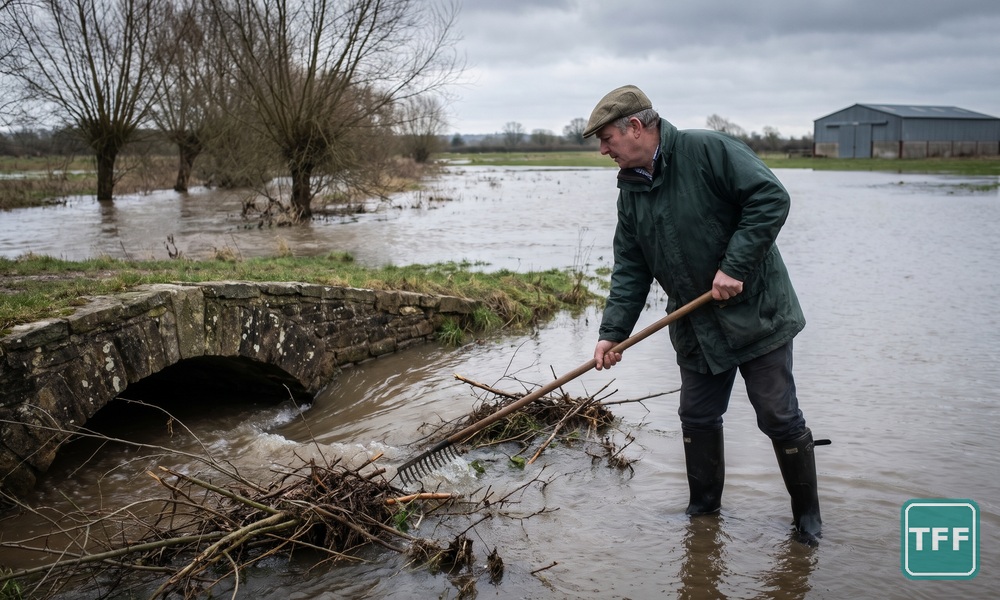
When Storm Chandra pushed the River Otter in Devon to its highest recorded level on 27 January, flooding homes and businesses around Ottery St Mary, farmers on The Farming Forum had their explanation ready before the water had dropped. “But surely if it had been cleaned out and or maintained, then the level would have been less”, asked the contributor who opened the conversation that evening, and over the following weeks the exchange grew into the sector’s full argument about who keeps water moving: dredging, beavers, drains and farmland itself.
By TFF News | 11 November 2026 | Environment
The conversation drew 186 visible contributions and had been viewed 11,335 times when counted on 11 November 2026. It gathered 639 reactions, an average of 3.44 per contribution, and ran from 27 January to 17 April 2026. Of the contributions, 80 read as negative in tone, 102 as neutral and 4 as positive. These are the views of the people who chose to take part, not a representative survey of the industry.
The night the Otter broke its record
The trigger was real enough. ITV News reported on 27 January that the River Otter had passed its previous record, set in December 2000, with flood defences overtopped before dawn; by the next day a major incident had been declared in Somerset. The Met Office put the heaviest Storm Chandra totals in Devon, led by 115.1mm at White Barrow, and its January statistics confirmed what the conversation’s rain gauges were saying: England recorded 50 per cent more rainfall than its January average, southern England 74 per cent more, and Devon had its second wettest January since 1836. The flooding itself was not disputed. What the room argued about, for eleven weeks, was why it was so bad.
The maintenance argument
Watercourse maintenance was the biggest theme, carrying 46 contributions. “For generations our forefathers drained land, provided drainage, run off’s, gutters, slice gates etc, etc, etc to ensure we had productive land and to alleviate flooding.” one contributor wrote, arguing the system has been allowed to silt up since, and the strand’s wider complaint was that “Now we are advised by experts who have no first hand experience and take no responsibility for the outcome of their advice.”
The Environment Agency’s published position is more nuanced than the conversation allowed. In its own explainer on floods and dredging, the agency says dredging and desilting “are not as effective at reducing flood risk as other options” and can raise flood risk downstream, while accepting the work “can be effective and justified” as part of a catchment approach. Contributors were unpersuaded and turned to who should hold the job. “What we need is for the EA to be stripped of its power to manage the water courses and given back to regional drainage boards”, one wrote. Another read the problem differently: “It might actually be that the EA does NOT have enough power and is actually hamstrung by Natural England”.
Farmers doing the work themselves sat in an uneasy legal position. One contributor described clearing a choked 300-metre stretch beside his grazing; the reply was a warning that “you could find yourself not being thanked, but being prosecuted in court!” Another, dealing with her own county council, noted that “Landowners are already required to ensure free flow of water that drains onto their land and the water from their own land.”
Beavers take the blame, and the defence answers
The Otter holds England’s best known wild beavers, and 33 contributions argued over them. The sceptics’ case was mechanical. “Beavers build a dam, water backs up & spreads out creating these wetlands that they love, heavy rain occurs, the ground is already saturated, excess water goes over the top/around the sides of the dam, water continues to flow at the same rate as without them…or the dam breaks”, wrote a contributor near the river’s headwaters, while another pointed to burst dams releasing collected debris in a lump that clogs bridges and culverts downstream.
Whether that happened at Ottery St Mary is unresolved, and the conversation knew it. “Allegedly the flooding in Ottery St Mary was exacerbated by one or more culverts being blocked by beaver damn debris. I wonder if we’ll ever know for sure?” wrote one contributor who has worked around the lower river for four decades.
The published science cuts both ways. The River Otter Beaver Trial, England’s first licensed wild release, found that six dams upstream of flood-prone East Budleigh measurably reduced peak flows, while its lead scientist warned that the gain “may come at a cost of water being stored on farmland upstream”. The most experienced local voice drew the same line: “Once the water gets to the lower stretches of a river it needs to get out asap, otherwise it just backs up,and causes more flooding. Slowing water down makes a lot of sense, but upstream, not on the lowlands.”
Soils, drains and farming’s share of the blame
The conversation did not spare farming. Its one persistent critic cited the standard text on British flood management to argue that compaction under intensive cropping sends winter rain straight off the land, and reported from his own patch that “Where I am in UK the riparian tenant has cleared banksides and flash flooding lower down has increased.” Another contributor half agreed, blaming run-off from soils short of organic matter, and a Somerset mixed farmer conceded the point while rejecting the framing: “Farmers realise compaction is a problem, basically, for us, it means reduced yields, so many actively take steps to mitigate it.”
The hydrology argument came back to managed land. “Wet land does not act as a reservoir as many outsiders seem to believe”, one contributor wrote of rewetting schemes. For the drainage trade, the most commercially pointed line was that “land drains completed under grants are nearing or beyond the end of life (well beyond end of design life)”, with short-term tenancies leaving nobody willing to pay for renewal. And the sense of being the default culprit ran deep: “Let’s just blame farmers, as it’s always the easiest option. Far easier to accuse a group of individuals rather than any national bodies.”
Concrete, run-off and who ends up liable
Fifteen contributions pointed at development, asking how many square miles have been built over while no matching water storage was added, and recalling a parish council’s flooding concerns about a new east Devon town being waved away because the modelling showed no risk. The Somerset farmer brought the market’s verdict on floodplain housing: “we renewed our insurance yesterday, asked the question, insurance for houses built on flood plains, the answer, ‘we don’t insure them’”. The conversation’s opener saw liability as where the argument lands, writing that insurers may yet force the issue: “Because in this world we live in, someone is normally liable.” Underneath it all sat the trade’s standing grievance about blame: “If nobody wanted food, nobody would be a farmer.”
The question the trade is left with
Strip out the frustration and the conversation leaves a concrete commercial question. A record wet January exposed a maintenance backlog that no single party now owns: the agency says dredging is rarely the best value, riparian owners fear prosecution for doing the work themselves, and contributors report grant-era land drains running past their design life. For drainage contractors, pipe and culvert suppliers, insurers and the machinery trade, each of those gaps is work waiting for a payer. Whether the money to manage water follows the damage, or stays stuck between agencies, owners and insurers, is the question this conversation could not answer, and the one the trade should watch.
Read the source conversation and analysis
Read the full conversation on The Farming Forum here. A nine-slide analysis of the conversation, with theme, sentiment and contributor breakdowns, is available as a PDF: download the conversation analysis deck.
This conversation had been viewed 11,335 times on The Farming Forum when counted on 11 November 2026. Want your brand in the room when farmers talk environment? Book advertising with Agri Web Media.