
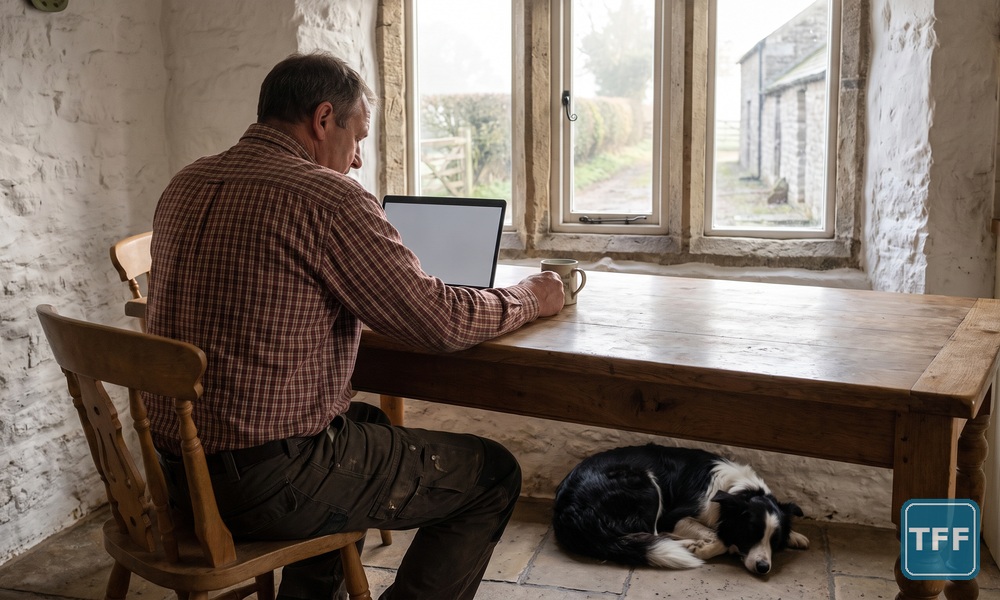
England’s flagship farm support scheme sold out like festival tickets on Monday. The second application window for SFI26 opened at 10am on 22 September with £233 million to allocate and the Rural Payments Agency closed it at 15:48 the same day. A conversation on The Farming Forum that began three days earlier with a missing green button became a live commentary on the scramble, and it splits the trade’s customers three ways: those who put AI agents on the queue, those whose paid agents got only half their client lists through, and those who came back from the mart to find the scheme shut.
By TFF News | 23 September 2026 | Business
The conversation drew 265 visible contributions and had been viewed 7,807 times on The Farming Forum by the morning of 23 September. Contributions attracted 434 reactions, an average of 1.64 per contribution, between 19 and 23 September, with 233 of the contributions landing on application day itself. Those figures describe this one conversation, not a representative survey of English farming.
The queue formed before the doors opened
The conversation started on the Saturday evening because the application button had vanished. “now I can’t get anywhere at all which is highly frustrating bearing in mind applications open in 3 days,” the opening contribution said. Twenty one contributions dealt with that pre-opening confusion, including uncertainty into Monday night about what time the window would open.
Nobody in the conversation expected the money to last: “Even though there are £100k caps and 25% limits on some options it’ll be massively over subscribed,” one contributor wrote the night before. Both figures are confirmed in the published scheme rules on gov.uk. The professional queue was forming too: “Heard from one agent with 65 ready to submit wondering if he needs to get his colleague to help so they can get through them quicker. Which order will he submit them in??”
AI agents joined the queue
The most striking strand of the conversation, 36 contributions, was farmers openly deploying AI tools against a first come, first served scheme. “My AI agent is polling the site every 10 minutes, waiting for that green button to appear, fill it out, and submit,” wrote one contributor on the Sunday. By Tuesday lunchtime his gamble had come off: “Took an hour for the AI to fill it all out and-it did come across a few land use issues, which it seemed to sort out itself.”
Results were mixed. A contributor running three applications gave up on his bot: “On another note my AI agent didnt work properly, so I cant be smug about that.” The fairness objection came quickly. “So is it first come first get an agreement ?” asked one livestock contributor, arguing farmers without bots, agents or a free Tuesday were at a structural disadvantage.
£233m allocated in under six hours
The window opened at 10am. The Defra farming blog put the Window 2 pot at £233 million: £180 million originally allocated, £50 million added in response to the drought year, and £3 million unspent from Window 1. The countdown played out in real time. “Email from RPA. 25% of budget now used,” a contributor posted before midday. The reaction was immediate: “Absolutely crazy. I reckon if you’ve not got it in within the next 24 hours, you’ve got no chance.” Even that proved optimistic. Defra’s updates confirm 50% allocated by early afternoon and the window closed at 15:48, with applications processed in the order submitted and successful applicants given 30 days to accept an offer. Farmers Weekly reported a quarter of the money gone within two hours.
Glitches carried a price
Application problems were the biggest theme of the conversation, raised in 71 contributions: actions refused on eligible fields, land use codes needing edits mid application, and a helpline offering callbacks against a clock nobody could see. One arable contributor watched eligible herbal ley fields refuse to appear: “Must be a system error, I’ve raised a query but goodness knows when that will be replied to. Tried to ring, they should ring back by tomorrow, so I think I’m stuffed with 25% gone already.” Farmers Weekly reported Strutt & Parker advisers hitting the same class of error on the day, so the accounts in this conversation were not isolated.
Several contributors said they submitted cut down applications rather than lose everything, intending to appeal the refused parcels afterwards. The hardest account came from a contributor who spent the day on the phone to the RPA and was on his fourth call when the closure email arrived: “it seems that all the people that could have done the check had clocked off earlier in the afternoon.” Defra’s closure notice says farmers who reported technical issues to the RPA before the window shut may still be able to complete their applications.
Who missed out
A contributor who had paid an agent to prepare his application in advance still lost the lottery: “Spoke to him at 3.30 as he was doing it. He phoned just after 4 to say he got half of his done. Guess which half mine was in.” A tenant working a second job missed the window by an hour, and with it what he put at £24,000 a year on 300 acres of tenanted land. Another, whose Countryside Stewardship agreement ends within months, was blunter: “I am now falling off a financial cliff as my CS finishes in December.”
Contributors kept returning to the farmers who could not be at a screen on the day: at the mart, at TB testing, at an eartag inspection, coming home to a closed scheme. One warned that in his view thousands of farms will now be without any support when their current SFI and stewardship agreements end around the turn of the year. A dairy contributor with no stake in the outcome summed up the wider mood: “But how the future of a medium sized arable farm can depend on what time you pressed send is utterly appalling.”
There was a counter view. One contributor who missed the previous round and treated this one as a military operation had no patience with the complaints: “prepared in advance, watched the videos, watched the webinars, asked the questions, checked the system at 5 minute intervals from 6am, put everything else on hold, got it in, job done.” That is opinion, but it describes what winning looked like on the day.
The redesigns farmers put on the table
Thirty six contributions worked on how the next round should be built, and advisers will hear these ideas from clients all winter. Pro rata allocation was the most concrete: “Could defra have given everyone a month the submit an application then shared the money out as a percentage of their original application.” Others defended the structure while wanting the timing fixed. On the argument that first timers were squeezed out, one contributor noted that “But Window 1 was set up explicitly to allow those without any existing agreement to get in first. And it closed with £3m still in the pot.” Looking forward, the ask was scheduling: “As an industry we also need RPA to open SFI 27 early in the year with start dates from end of existing end dates.”
The question the trade is left holding
Defra says there will be another opportunity to apply in 2027 and that it will refine the scheme before then. The unresolved question is whether SFI27 opens the same way. “For the next SFI window if run like this one I can forecast far greater use of AI and multiple computers and blocking software to get to that front of queue,” one contributor predicted. Sentiment in the conversation ran 126 contributions negative against 17 positive. For agents, advisers and software firms whose customers’ cashflow now swings on a five hour window, the arms race around the next green button has already started.
Read the source conversation and analysis
Read the full conversation on The Farming Forum here.
Download the full conversation analysis as a PDF slide deck.
This conversation had been viewed 16,300 times on The Farming Forum when counted on 1 October 2026. Want your brand in the room when farmers talk business? Book advertising with Agri Web Media.
Pingback:MPs ask about SFI. Farmers have already answered | Agri Web Media