
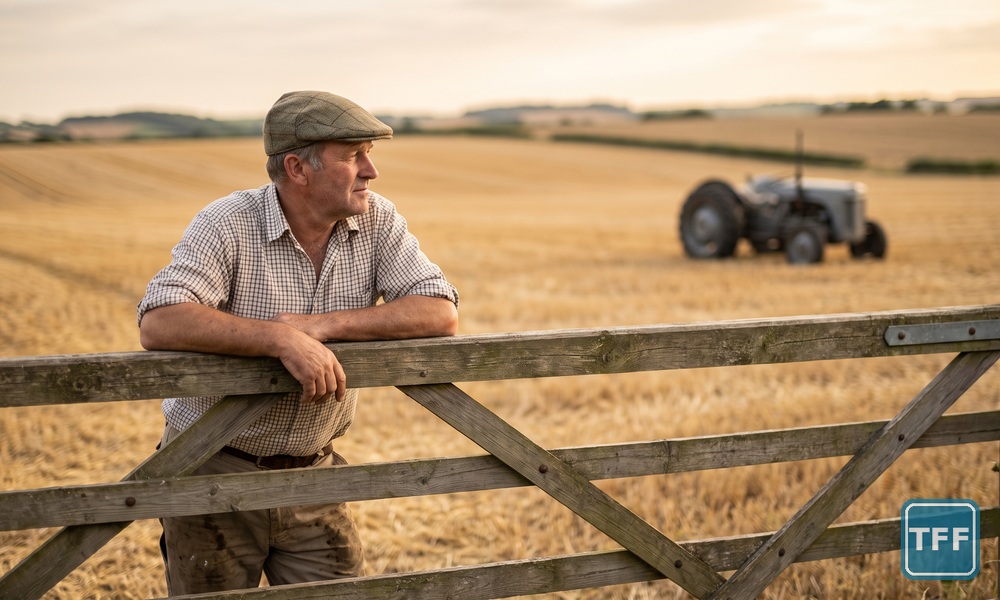
A conversation on The Farming Forum asking what happens to the land after this harvest has drawn predictions of uncropped acres, a wave of farm sales and busy machinery auctions, alongside evidence that cash-rich buyers are still paying whatever it takes. For the trade, it describes a customer base pulling in two directions at once.
By TFF News | 13 September 2026 | Business
The conversation, titled The future, ran in the Agricultural Matters section and drew 146 visible contributions between 10 and 16 July 2026. It had been viewed 8,150 times when counted on 13 September 2026 and contributions attracted 358 reactions, an average of 2.45 per contribution. These figures describe one self-selected conversation on The Farming Forum. They are not a representative survey of UK farming opinion.
Predictions of a post-harvest shake-out
The opening contribution set the tone, reporting months of discussions with farmers and land agents: “chatting with some land agents I’m sure there will be a huge amount of farms coming for sale after harvest and obviously a lot of farm machinery auctions aswell”. The same contributor described a machinery sale at Cambridge where “there were very very few people there and tractors were a hard sell”. These are one contributor’s accounts, but the direction of travel is corroborated by market data: analysis of Strutt & Parker’s Farmland Database reported by FarmingUK shows 177 farms launched to the market in the first half of 2026, the highest first-half figure in almost 20 years and 16 per cent above the five-year average, while average arable values eased 6 per cent to around £10,500 an acre.
One claim in the opening contribution, a £20 a tonne sugar beet price for next year, was challenged within the conversation as not having been announced, and Agri Web Media has not been able to confirm it.
A market pulling in two directions
What makes the conversation valuable to the trade is the disagreement over demand. One contributor described consolidation at pace: “Round here several “Mr Bigs” have cornered the land market for anything that comes up that’s worth growing cereals on. They can outbid all comers so nobody gets a look in.” Another reported strong rental bidding, “Middling bare land we are vacating is being eagerly bid over £200/ac, I’m told.”, yet the same contributor later called it “There is currently an, as I see it, suicidal bidding war going on, to take any land that comes available.”
Others saw the opposite. One relayed a land agent’s reading of the market: “She said people were getting out left right and centre.” At the top of the market, one contributor farming irrigated light land put rents in a different world entirely: “Yes, that’s the going rate for irrigated sand land for root vegetables. Outdoor pigs have to pay similar, and it stacks up, without any subsidies.” That rate was £1,000 a hectare, and on that land, he added, “Cereals and sugar beet are now “last resort” break crops.”
At the other end, a livestock contributor saw upland values stuck above what the market will pay: “The hill farms are especially valued far too high in my opinion to back this up they aren’t shifting and most have been reduced.” Another expected the gap to widen along a new line: “Land that is irrigated or naturally draws or retains moisture or is further north and still gets useful spring rainfall will get more expensive.”
Margins, tax and the scheme backdrop
The pessimism about cropping was blunt. In one contributor’s view, “at current prices for fert & fuel and forward selling prices for cereals very few could show any meaningful profit”. For machinery suppliers, the most commercially significant line in the conversation may be this response to the squeeze: “My immediate reaction is to stop buying kit. Sweat what we’ve got.” The same contributor set out the arithmetic: “Need 3 to 4t/acre cereal crops to stand any chance of turning a profit. 2t isn’t going to do it.”
Tax ran through the conversation as a driver of both sales and stalled sales. Since 6 April 2026, 100 per cent inheritance tax relief on agricultural and business property has been capped at £2.5 million per person, with 50 per cent relief above that, after the government raised the planned £1 million threshold in December 2025. Contributors still saw a valuation problem in the transition: “Anyone who is having land valued due to a death in the family will be caught up in a bit of a trap at the moment.” On support schemes, the opening contribution assumed environmental agreements were oversubscribed; the current position is that the reformed SFI 2026 scheme closed its first application window on 28 August 2026, with a second window opening in September. One contributor summed up the adjustment facing arable businesses: “The rules of engagement have changed, if farm businesses don’t also change they will either have to subsidize themselves from outside income or run out of cash.”
AD crops and water as the way out
Where contributors did see land staying in production, anaerobic digestion kept coming up. One observed of large holdings: “The new gig with these large estates/farms seems to be going towards AD , maize and Forage Rye and cart it away in lorries”. Not everyone welcomed the terms on offer, with one contributor giving the opinion that “The trouble with growing for AD is they will want to pay peanuts for it” and arguing farmers should own digesters cooperatively rather than grow for others.
After a summer of drought, water infrastructure was the other recurring answer, from winter storage reservoirs to a blunt national prescription: “We just need a national grid for water, not data centres”. Several contributors reported applying for or considering winter rainfall reservoirs, a signal for suppliers in that market.
The market has already moved
One contribution stood out for calling what came next. Comparing North American harvest projections, the contributor suggested “UK arable may well have some respite from our own domestic farming issues, if the bread baskets of those abroad have had drought and war setbacks.” Since the conversation ended in mid July, UK feed wheat futures for November 2026 delivery have climbed, closing at £215.75 a tonne on 28 August, the contract’s highest level, according to AHDB’s arable market report. Whether that rally is enough to change cropping and buying decisions made in the gloom of July is another matter.
What the trade should watch
The conversation leaves the trade with a live question for the autumn. If the predicted wave of sales, retirements and machinery auctions arrives, the buyers on the other side appear to be fewer, larger and better capitalised, running bigger fleets across more acres, while a second group stops buying kit altogether and a third redirects land into AD crops, schemes and water infrastructure. Land agents, machinery dealers, AD operators and input suppliers will each read that differently. The unresolved question is not whether land changes hands this autumn, but who ends up farming it and what they will spend money on.
Read the source conversation and analysis
Read the full conversation on The Farming Forum here.
Download the full conversation analysis as a PDF slide deck.
This conversation had been viewed 8,150 times on The Farming Forum when counted on 13 September 2026. Want your brand in the room when farmers talk business?
Book advertising with Agri Web Media.