
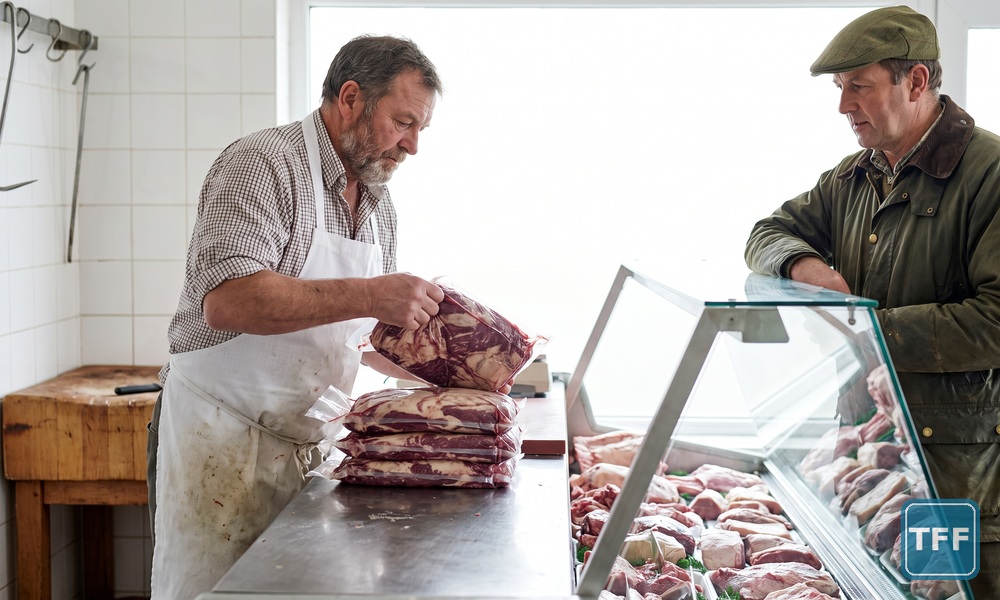
A livestock producer walked into the butcher’s shop he supplies and found a pile of vac-packed Australian grain fed topsides and sirloins, bought off the market that morning for well under £10 per kilogram, with the outer packaging printed in Chinese. The conversation that followed on The Farming Forum moved quickly from one shop counter to the biggest commercial questions over British beef: import competition under the new trade deals, whether the EUROP grid has bred eating quality out of the national herd, and where displaced global volume goes next.
By TFF News | 12 September 2026 | Livestock
The conversation drew 112 visible contributions between 10 and 17 July 2026, was viewed 3,669 times on The Farming Forum, and gathered 333 reactions, an average of 2.97 reactions per contribution. Nearly a third of contributions carried a negative tone, and those negative contributions drew more than twice the average reactions of neutral ones. These figures describe one self-selected conversation, not a representative survey of the sector.
What turned up on the counter
The conversation opened with a first-hand account: “Went to Butcher I supply today and he showed me a great pile of Australian Grain fed beef that he had bought off the Market this morning. It was much less than £10 per kg and the quality was excellent.” The same contributor, who had sent the butcher a beast that day at £6 per kilogram deadweight to the shop, put the commercial problem plainly: “The trouble is I am not sure how we are going to compete with this?” He later established the consignment was “Definitely cut and packed in Australia and was destined for the China market.”
Import competition ran through 20 contributions. One contributor cited HMRC figures showing New Zealand beef imports up around 340 percent in the first five months of the year, and noted of the trade deal terms: “UK trade deals with Australia allow for 110,000 tonnes of beef to be imported tariff free phased in over the next 10 years.” The quota description checks out: the agreement gives Australian beef a duty-free quota starting at 35,000 tonnes and rising to 110,000 tonnes in year ten, per the Australian government’s outcomes summary. The direction of travel is corroborated too: HMRC data reported by The Grocer showed New Zealand beef shipments up 239 percent in the 11 months to November 2025, and AHDB’s Q2 2026 trade update has Australian and New Zealand volumes still above a year earlier. The absolute tonnages remain modest: AHDB’s March 2026 outlook put Australia’s 2025 shipments at roughly 15,000 tonnes, using 29 percent of its quota, while New Zealand used 95 percent of its 17,500 tonne quota, which rises to 38,800 tonnes by 2032. The headroom, not the current volume, is what worried contributors.
On whether shoppers will pay for provenance, the most-reacted contribution in the whole conversation was blunt: “you say alot want to know where it came from, i can garuntte you a lot more couldn’t give a flying feck!” Another widely agreed contribution turned the criticism inward: “The trouble with this country is we have been sucked in to thinking we produce a premium product with all the bells and whistles of red tractor etc, partly true but it has just added to costs and made us less competitive.”
The grading argument turns inward
Eating quality and grading was the largest theme, in 31 contributions. Several contributors argued the imported product’s consistency is the real threat, not its price alone. Notably, few defended the status quo on eating quality, and the sharpest division was over what causes the problem. One finisher wanted the payment model changed outright: “Scrap the europ grid and pay for total saleable meat plus marbling bonus. That’s what’s driven there meat industry forwards and led to a very consistent product that consumer trust and enjoy.” Another put the breeding consequence directly: “The EUROP grid has rewarded confirmation, with no regard for anything else, so of course farmers have bred for that.”
Others pushed back that the grid is only a measuring stick and the money behind it is what steers breeding: “If the buyers genuinely only wanted R4L cattle like we keep getting told, then that grade would get the best/highest price. But no the buyers pay a premium for higher conformation cattle by paying extra for E and U grade cattle.” A large-scale finisher took the commercial view: “Top and bottom of it is we have to produce what the market wants and what pays the best to survive otherwise we wouldn’t still be in business.” On the consumer side of the same problem: “Inconsistency is a big issue. They recon it takes 1 or 2 bad eating experiences to put consumers off something.” There was also a strand of feeding debate, summed up by one of the most-reacted contributions: “personally i’m not ‘sold’ on all this ‘pasture reared’ stuff……grain fed meat is just as good if not better IMO”
China, quotas and beef looking for a home
A parallel strand traced why Australian product is arriving at all. Contributors pointed to China allocating smaller import quotas and protecting its own producers, with the United States raising tariffs, leaving exporters hunting for alternative markets. That reading is consistent with AHDB’s analysis, which notes China gave Australia and Brazil smaller quotas in 2026 after record Australian output in 2025. One contributor’s warning was short: “There will be a lot more beef looking for a home soon.” The answer offered from within the conversation was not protection but trade: “Thats why we need a buoyant export market. Can’t just rely on not importing it.”
Old rules and new contracts
Domestic rules took sustained criticism. The over-thirty-month rule drew an exasperated “why the hell do we still have OTM ?” and a producer’s verdict that “All the rubbish about OTM etc has spoilt the quality beef job.” One contributor relayed a butcher’s claim that OTM controls had already been dropped. That is partly true: since Great Britain gained BSE negligible risk status on 29 May 2025, the vertebral column of over-thirty-month cattle is no longer specified risk material for the domestic market, though export-facing controls continued pending EU recognition, per the Food Standards Agency’s action note. Age-related price penalties at the point of sale are commercial, and in contributors’ experience they still bite.
Supermarket integration was the other pressure point, discussed in 17 contributions. A supermarket Angus scheme with a 270 to 400 kilogram carcase specification was weighed up and declined by one finisher: “My cattle will be too big for them ,then theres the other hoops you’ve to jump through. Decided I’m just as well taking the standard premium” The longer-range worry was structural: “They’d love it if they could control it like they do pork and chicken for consistency as well as control. Let’s hope it never gets to that.”
The question left on the table
The contribution that best captured the conversation’s centre of gravity was not about Australia at all: “There is no upside to underestimating your competition. Its all downside.” If the imported product is consistent, well marbled and lands at a price domestic finishers cannot match, then, as the same contributor put it, “We have to rely on patriotism and the goodwill of our customers then and you know that counts for nothing when money is concerned.” For processors, retailers and breed societies the question this conversation leaves open is whether the British industry changes what it pays for before the import quotas finish phasing in, or after.
Read the source conversation and analysis
Read the full conversation on The Farming Forum here
Download the nine-slide conversation analysis deck (PDF)
This conversation had been viewed 3,669 times on The Farming Forum when counted on
12 September 2026. Want your brand in the room when farmers talk livestock?
Book advertising with Agri Web Media.