
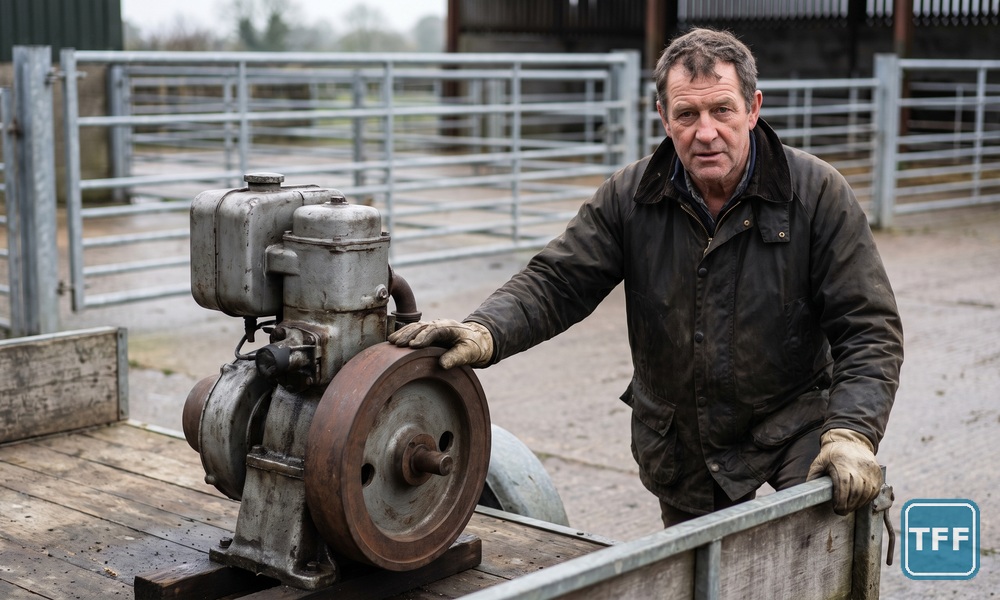
A machinery buyer who bid in a monthly online collective sale without viewing, on the strength of a phone call in which the vendor assured him the lot was in good working order, unloaded it at home to find the engine seized. He asked the trade where he stood. The conversation on The Farming Forum gave him a blunt answer, caveat emptor, and then the auction company gave him a different one: a full refund. The exchange is a revealing audit of where responsibility sits as machinery sales move off the yard and onto the screen.
By TFF News | 5 October 2026 | Machinery
The conversation drew 186 visible contributions and has been viewed 9,466 times on The Farming Forum. It ran from 15 to 18 May 2026, gathering 301 reactions at an average of 1.62 per contribution; 30 contributions were asides and guessing games about what the mystery machine was. The figures describe one conversation among the members who took part, not a representative survey of the machinery trade or of UK farmers.
Pay your money, take your chance
The opener set out his position plainly: he rang the vendor before bidding and “he tells me the item is all good & is in good working order”, only to get the lot home and “find out its a right dog & is not in any kind of working order at all”. The reply from much of the trade was the oldest rule in the auction ring. “One man’s good, is another man’s crap”, was one dealer-contributor’s verdict.
The hardest line came from a contributor who buys from collective sales weekly: “Well if you didn’t view then you really don’t have a leg to stand on.” Another summed up the format in a single sentence, “You pay your money and take your chance”, adding that “If your wanting to try before you buy, get a warranty and have it cleaned before delivery you should be going to a dealer not an auctioneer.” Yet even the sceptics left a door open: the weekly collective buyer conceded that “So yes IF a phone call took place then you should have an argument.”
What a working order description is worth
With 32 contributions on descriptions and comeback, the conversation became a seminar on auction paperwork. The opener reported ringing trading standards, who told him the entry form a vendor completes when lotting an item matters more than the small print, because “this is a legal binding contract between the seller and the auction company”. He later shared the relevant clause from the auction company’s own conditions: “Any item described as in working or running order or condition shall have no defect which renders it incapable of the reasonable work for which it is intended & must be capable of performing such work.”
Sellers were less reassured by the paperwork. One noted of a well known auction group’s entry form that “it’s just a drop-down menu and the options are pretty subjective.” A contributor who used to take in lots for mart sales described the caution on the rostrum side: “If i was told something was in working order i never wrote that down on lot description”.
The statutory position is as unsettled as the conversation suggested. Government guidance on online and distance selling gives customers a 14 day cancellation right on distance sales, but those protections are written for traders selling to consumers, and the Consumer Contracts Regulations 2013 carve out sales at a public auction, defined as one bidders can attend in person. Where a timed online collective sale with lots scattered across farms sits against that definition, and whether a farm business counts as a consumer at all, is precisely the grey area this dispute fell into.
Who gets the vendor’s number
An equally sharp split, 31 contributions, formed over whether the auctioneer should ever have passed the vendor’s details out. One contributor was adamant: “No trustworthy or reputable auctioneer would give vendor details in a collective sale.” Others reported the opposite as routine. “Given that the machines are on farm, how is one to view without getting name address and phone number?” asked one, and a former auction worker was franker still: “we were often asked about sellers of lots and depending how friendly or good a customer the person asking was info was then provided”.
The practical defence of vendor contact was about machinery, not manners: “Because machinery is complicated now with electronic controls which cannot be assessed simply by inspection.” The tension is structural. The anonymity that protects vendors in a traditional collective is exactly what dispersed online sales cannot offer if buyers are expected to view on farm.
The shift the trade is riding
Behind the dispute sat an argument about the format itself. “Very few yard sales now in scotland, probably only ten percent of pre covid levels.”, reckoned one contributor, who also argued that “If a man wont put his name to a machine, u know it could be a wrong un and bid accordingly.” Another pushed back: “They really aren’t dying out. York gets bigger every month and nothing is ever very cheap”, though that sale itself now runs its bidding on screens.
The money is following the screens. Cheffins reported £23 million of machinery sold in the second quarter of 2026, 30 per cent up on the same period last year, with the quarter’s top lot, a 2023 Fendt 942 Vario at £257,000, selling through a timed online auction. Big machines now change hands on photographs, videos and phone calls, and the conversation showed both edges of that. One contributor described a seller who refused to deal remotely: “But he said he’s not happy to sell unless I see it first hand…..not that I wouldn’t given the cost.” Another recalled a £64,000 retirement sale tractor whose buyer “never viewed, or contacted him before bidding, better nerves/trust than me”.
A refund, and the question it leaves
The conversation had a precedent before it had a resolution. An engineer contributor described inspecting a disputed farm sale tractor for a customer, after which “a lorry turned up and took tractor away and they got a full refund!” Three days after his opening question, the buyer reported the same outcome: “A full refund is happening and the auction company have been very good about it”. Not everyone was persuaded, with the conversation’s most persistent sceptic observing that “We will never know both sides of the story.” The vendor did not take part in the conversation; the account of the sale, the phone call and the refund is the buyer’s own.
If a vendor’s assurance on the phone, or a working order line on an entry form, can unwind a hammer price days after a sale, then descriptions in online collective sales are quietly becoming warranties. Auctioneers who absorb refunds as goodwill, vendors who sign entry forms casually, and buyers who bid on a voice rather than a viewing are all carrying risk the traditional yard sale never asked them to price. Somebody will have to, before the next seized engine comes off the trailer.
Read the source conversation and analysis
Read the full conversation on The Farming Forum here.
Agri Web Media’s nine slide analysis of the conversation, with engagement, sentiment and theme breakdowns, is available as a PDF: Online sales conversation analysis (PDF).
This conversation had been viewed 9,466 times on The Farming Forum when counted on 5 October 2026. Want your brand in the room when farmers talk machinery?
Book advertising with Agri Web Media.