
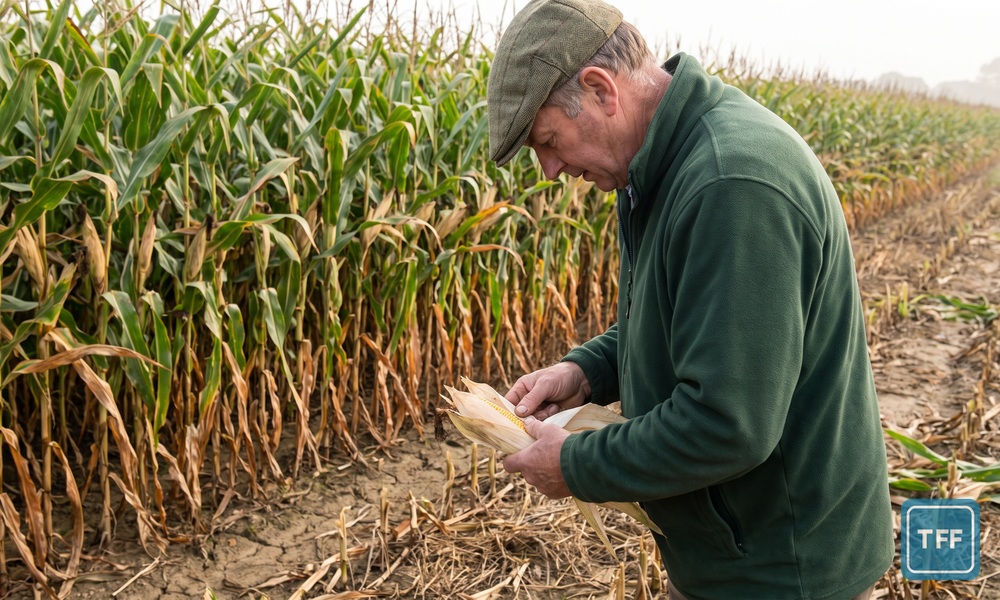
A maize season that farmers on The Farming Forum tracked from drilling in May to foragers running weeks early has ended in a standoff. Growers with standing crops are asking £700 to £1,300 an acre. Buyers staring at half-empty clamps after the drought are doing the dry matter arithmetic and sitting on their hands. In between sit organic herds short of forage, a contested derogation question, and a warning that next spring’s maize seed may be the next shortage.
By TFF News | 6 October 2026 | Forage
The conversation runs to 283 visible contributions, viewed 32,070 times, with 340 reactions between 9 May and 2 October 2026, an average of 1.2 reactions per contribution. The tone was measured for a season this hard: 182 contributions read as neutral, 58 negative and 43 positive. These figures describe one conversation among the people who chose to join it. They are not a representative survey of maize growers.
From best crop ever to dead on the south coast
The season opened well almost everywhere. By mid July the mood had split on rainfall lines. One grower wrote on 19 July: “Drilled end of April and never looked back. 2 weeks ago I'd have said potentially the best crop ever grown, but the lack of moisture is really stressing it now”. By the end of the month the reports from the far south had turned: “apparently cutting along the south coast, maize dead.”, one contributor relayed on 30 July.
The official backdrop matches the conversation. On 10 August the Environment Agency declared 71.3% of England in drought after the driest July in 190 years, with livestock farms already feeding winter forage. Farmers Weekly reported on 13 August that grass growth had halted across almost all of Britain, maize was tasselling unusually early, and temperatures above 30C during tasselling could cut pollen viability and starch, a risk contributors had raised a month earlier. The far west was the mirror image: growers in the west of Scotland had moisture to spare and spent September waiting for sun.
An early harvest with yields all over the map
Foragers were running on the south coast in early August, weeks ahead of normal. A Norfolk-coast grower with 151mm of rain all year reported on 13 August: “Oven dry matter 32.8%. Yield 21 t/ha which is not bad considering the rainfall, and our naturally lower yields by the North Sea coast.”.
From there the reports scatter. “Think I'll take around 14t acre over 80 acres as a good result for the year. Variability even within field was huge. It yielded better than last year.”, wrote one grower across 80 acres. A heavy-land grower who deliberately trades yield for an early harvest date called his “Good cobs, 35% DM averaged 14t/ac average across 100 ac. One of our best crops ever.” Others reported 11 to 12.5 tonnes an acre, fields ranging from 18 tonnes to 5 within one boundary, and crops with no cobs at all. Farmers Guardian reported on 14 September that early harvests were continuing around the country with yields looking hopeful considering the year.
Sellers ask four figures, buyers do the maths
The commercial heart of the conversation is the standing maize trade. One buyer reported: “Been offered a 10 ton/acre ( at best) for £1300 today, think we'll be okay, just won't be purchasing any cow's until the spring”. The response was immediate: “Now that's just bonkers 400 plus per ton dm. Palm kernel straw and wheat would be a much better option. At just over half the price.”. Another contributor walked a crop with his consultant and set out the working buyers are applying to ten tonne crops at those prices: “10t in is <9t out. £100 to get it in the clamp so £120/t silage of probably mediocre quality”.
Sellers have their defenders: “Unfortunately its a sellers market & they only get to sell it once. You can’t blame them for asking top dollar when the opportunity is there.”. But the market is visibly stuck. “Got 65 acres of standing Maize to sell, seems like everyone is sitting waiting, I've had very little interest and they are reasonable crops given the season”, wrote one would-be seller at the end of August. A buyer described his discipline: “There is a lot of fence sitting, I’ve bought some at strong money, but I’ve walked over 200 acres and bought the best 15.”. And an agent’s view, relayed by another contributor: “Local agent thinks there’s no money To pay for it and folks are hoping a late large 4 cut will save them.”.
Growing costs frame the argument. Estimates run from £250 to £400 an acre before land to a fully costed “I reckon on around £650/ac inc opportunity cost of land in the pit and usually get 15-17t, be lower this year.”
Organic herds add pressure from the sidelines
Several contributors reported organic herds, paid well above conventional milk price, competing for the same forage. One put the position as he understood it: “organic boys around us are fuming, they cannot get a derogation this yr to buy maize, if they do, back to non organic milk price, ouch.”. Under the organic rules, feeding non-organic forage needs a derogation granted by Defra in catastrophic circumstances, applied for through the farm’s certifier, as Soil Association guidance from the 2025 dry year sets out. Whether derogations are being granted this autumn could not be verified against a published Defra position, and contributors’ doubts about whether the rules are being observed are opinion, challenged in place. The sharpest criticism came from an organic producer arguing the sector should solve its own problem: “the organic system isn’t supposed to be easy, I would argue many herds are overstocked!”
The next shortage may be seed
In mid September the conversation turned to 2027. One grower placing his usual early seed order reported being told that “supplies of seed for next yr were def very very short from EU, surplus would have to come from Chile, which wouldn't arrive till may, if no customs problems.” Another added: “French have chopped most of the maize , and a lot less was sown due to fert cost”. The continental backdrop supports the caution: Reuters reported in July that France, the EU’s biggest maize producer, was heading for a harvest of 8.9m to 9.5m tonnes, roughly a third down and the lowest this century, with Coceral forecasting EU production at its lowest since 2007. The 70% delivery figure one contributor was given stands as his account of a sales conversation. His conclusion costs nothing to act on: “moral – order, and take delivery early.”
The question left for the trade is which side blinks first. If the clamps prove as uneven as the yield reports, forage demand tightens into spring just as the continental maize deficit reaches feed markets, and the four-figure sellers may yet find their price. If late grass and alternative feeds bridge the gap, the buyers doing dry matter arithmetic were right to wait.
Read the source conversation and analysis
Read the full conversation on The Farming Forum here.
Agri Web Media’s nine-slide analysis of the conversation, with engagement, theme and sentiment charts, is available as a PDF: Maize 26 conversation analysis (PDF).
This conversation had been viewed 32,070 times on The Farming Forum when counted on
6 October 2026. Want your brand in the room when farmers talk forage?
Book advertising with Agri Web Media.