
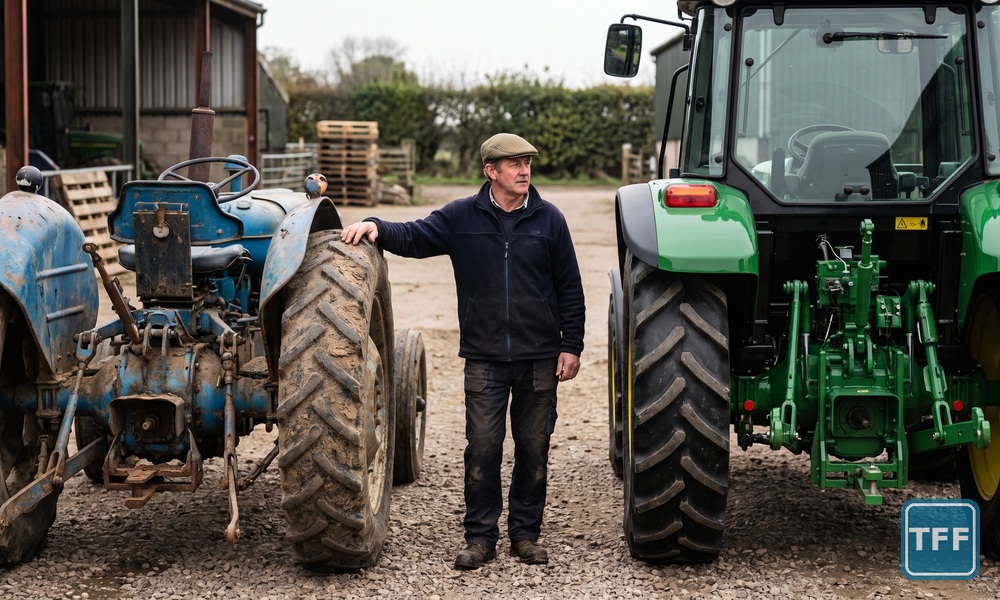
A mixed farmer who had just paid £45,000 for a ten year old tractor asked his dealer to quote the same machine new. The answer, £204,500 on farm with a three year warranty, set off a two week audit on The Farming Forum of who is actually paying today’s new tractor prices. The conversation split three ways: the arithmetic no longer works, cheap finance and warranty make new the shrewd buy, or the registration data shows somebody, mostly on the livestock side, is still signing the orders.
By TFF News | 14 October 2026 | Machinery
The conversation ran from 19 April to 5 May 2026 and drew 170 visible contributions, 13,846 views and 504 reactions, an average of 2.96 reactions per contribution. Who is still buying led the themes with 48 contributions, ahead of running older kit instead (34) and new price and affordability (28). These figures describe one conversation among the farmers who chose to join it. They are not a representative survey of UK agriculture.
The arithmetic that started it
The opening contribution laid the numbers out in full. The ten year old tractor, 5,500 hours with RTK steering, cost £45,000 direct from a neighbouring farm. The new equivalent, near identical bar 10hp and a bigger screen, was quoted at £204,500, with finance at £49,898 a year over five years with no deposit. On his sums, buying new works out around £42 an hour in depreciation at 500 hours a year, against roughly £7 an hour for the used machine. “Either way why and how is anybody affording new tractors. I’ve sat crunching numbers and simply do not understand how this is working for people.” he wrote.
The first replies took his side. One contributor described the replacement cycle bluntly: most buyers change again before the final balloon payment, and “its a treadmill thats getting steeper and faster”.
The counter case: cheap money and peace of mind
The defence of buying new was about risk and finance rather than paint. “For me though its peace of mind. We run a very lean fleet and cant have major breakdowns. Service packages and warranties are very important for me.” wrote one arable contributor, who argued the sums only work with machines doing at least 1,000 hours a year. A contractor was more direct: “A new tractor is a powerful way to get access to incredibly cheap money”, he wrote, adding that without manufacturer finance his business would not exist at all.
A buyer who had spent eight months hunting a used market where “everything low houred/tidy is making stupid money” was underbidder on a 2,500 hour tractor that made £80,000 at a farm sale with no warranty, then “went back to dealer brand new same model 125 k , 0% finance, warranty for 12 mths,, in our case it was a no brainer , new was by far the better deal” Another contributor who only buys new said he had never seen depreciation at anything like the opener’s figure.
The conversation’s most agreed with contribution cut both ways: “Don’t question the people buying the new tractors ,if they don’t make the decision you won’t have a decision to make”
The registration data settles one point
Midway through, a contributor pointed at the market statistics: “Someone’s buying new, the market is up 34% on last year, YTD.” That figure checks out. Agricultural Engineers Association data reported by Farmers Guardian put first quarter 2026 registrations at 2,992 machines, up 34.3% on a year earlier. The comparison year matters: 2025’s total of 8,791 was the lowest since AEA records began, and by mid year the recovery had cooled, with half year registrations of 5,955 up 22.3% but still 5% below the five year average.
Dealer side reports matched. “things ain’t as bad as portrayed on here at times”, wrote a contributor whose son works for a large dealer. Yet a week later another asked, “Is any farmer actually buying any machinery at the moment ?” and reported arable areas at a standstill. Both were right, because the market has split by sector.
Livestock money is doing the buying
The clearest pattern was who the buyers are. “There’s livestock and mixed boys who have never seen revenue like they have over the last year or so.” wrote one contributor, with arable described as having it tough and dairy as princes and paupers. From Scotland: “Every beef/sheep farmer seems to have bought a new loader tractor in the last month up here.” The counterpoint came from an English beef and sheep farmer: “Am I the only sheep and beef farmer trying to fill the massive hole that no BPS has left? Never mind buying new tractors”, he asked. Another contributor supplied the explanation, that “Scotland still get the equivalent BPS each year”, a point borne out by the Scottish Government, which paid £322m in Basic Payment Scheme and Greening support from September 2025 and says it has kept direct payments unlike elsewhere in the UK.
The value end of the market drew its own strand. “The Deutz are priced very aggressively and were advertising 5 years zero % finance.” reported one contributor, describing a family owned dealer shifting budget tractors to hill farms. Another put the appeal plainly: “Back up from a dealer thats not gonna clean ye everytime you go through the door is more important than colour.”
The price history argument
The conversation’s longest tail tried to work out when new tractors broke away from inflation. One contributor itemised a well specced 120hp tractor bought new in 2010 for £41,000: “With inflation, the same spec tractor ought to be costing £68k today, yet something of similar specification is near double that”, he asked. Another recalled watching the used price of his 2008 purchase: “Almost zero depreciation, but the price of new kept on going up instead. Five years later the price for a new equivalent tractor had almost doubled.” Contributors traded 1990s invoices, mostly £24,000 to £27,000 for 120hp class machines, against six figure equivalents today.
The one correction came on like for like comparisons: “A 300 hp Fendt is not comparable with anything sold thirty years ago whilst a 100 hp Deutz or Zetor isn’t light years away from a similar horse power tractor sold in years gone by.” wrote a contributor, arguing that spec inflation, options lists and emissions equipment explain part of the gap, and that simpler budget tractors remain closer to historic pricing than the headline machines.
Where the money goes instead
For the farms not buying tractors, the capital is not necessarily idle. A dairy farmer observed that a milking parlour lasting twenty years costs less than one new tractor, and a hill farmer put the same allocation in one line: “I’ve 30ks worth of tractors but probably over a million in sheds”
The question left for the trade is whether this spring’s registration recovery is confidence returning or the treadmill speeding up for a shrinking pool of buyers. The opener’s sums have not changed, livestock receipts are carrying the order books, and every farm that steps off the new cycle tightens tomorrow’s used supply and removes a future trade in.
Read the source conversation and analysis
Read the full conversation on The Farming Forum here. A nine slide analysis of the conversation, with engagement, sentiment and theme data, is available as a PDF: download the conversation analysis deck.
This conversation had been viewed 13,846 times on The Farming Forum when counted on 14 October 2026. Want your brand in the room when farmers talk machinery?
Book advertising with Agri Web Media.