
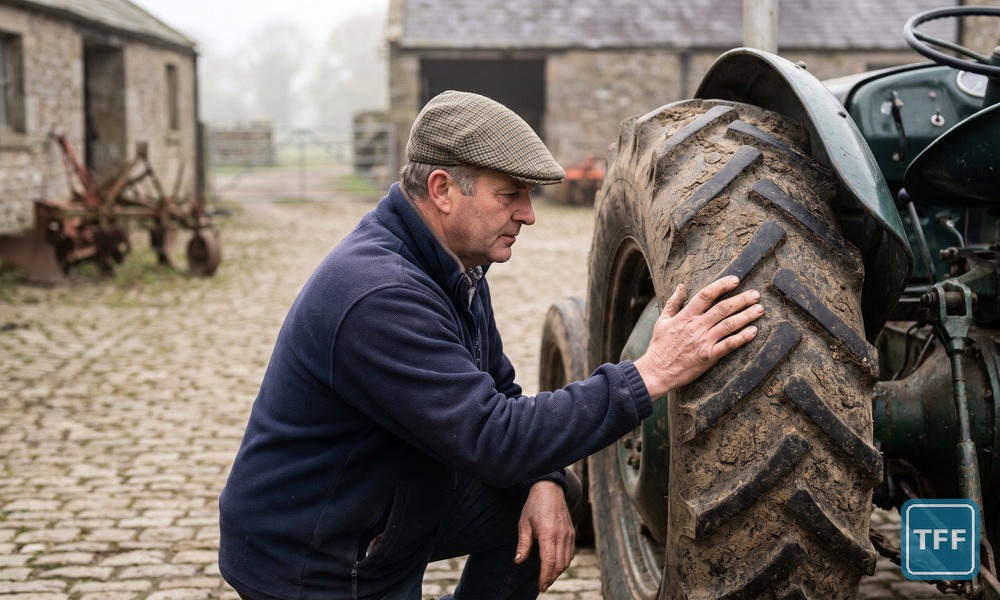
A farmer weighing up a second-hand tractor of more than 200hp asked The Farming Forum a simple question: is a Fendt worth that much more, even used? Five weeks later the conversation had become a full audit of the premium-brand question, taking in used values, repair ledgers running past 20,000 hours, dealer back-up, and a running argument about whether the badge or the ballast does the pulling.
By TFF News | 15 October 2026 | Machinery
The conversation ran from 14 April to 20 May 2026 in the Machinery section and drew 398 visible contributions, 28,035 views and 789 reactions, averaging 1.98 reactions per contribution. A large share, 172 contributions, was banter and side tangents, and the figures describe this conversation only: it is not a representative survey of UK farmers or machinery buyers.
The premium goes on trial
The price gap was contested from the first page. One buyer put it against a comparable New Holland bluntly: “you got and price a 724 fendt vs a 270nh and tell me the price difference ur looking at like 70k difference”, and cited a recent quote: “he is in for an enormous cost to change when the time comes, 230k ballpark i was told”. Long-term Fendt operators disputed the size of the gap, with one high-hours arable business reporting that its last three John Deere and Fendt quotes came back at very similar money and that cost of ownership, not headline price, decided the order. Others argued the real cost of the premium is the capital it ties up, plus the dearer insurance, servicing and parts around it.
Depreciation evidence pointed both ways. One mixed farm worked its 2015 purchase through honestly: “I dunno what its trade value would be now, assume in the low 30s, at near 13,000hrs that’s £6.50/hr depreciation so far.” Adjusted for inflation, he conceded, “So based on that it’s £9.79/hr depreciation.” Another contributor’s 724 had disappointed: “Residual value on the 724 was also poor depreciation at the time of £16/hr.” The used market is carrying the premium for now: Cheffins sold more than £23m of machinery in the second quarter of 2026, up 30% on a year earlier, and its top lot was a 2023 Fendt 942 Vario Profi+ at £257,000 in a timed online auction (Cheffins).
The reliability ledger
Owners answered the title question with service records rather than slogans. “Our Fendt record is getting a tractor to 21000 hours, currently have a 716 on 14000.” reported one farm on its eighth Fendt, and a grassland farm described a 310 that did 30,000 hours over its forty years with the brand. A second forty-year owner listed nine tractors, among them three gearbox bearing failures and an engine rebuild, and concluded: “So there you are then, about 50/50 I suppose. Probably the same as every other brand hey!”
The 828’s engine problems came up repeatedly, and so did how they were handled. One owner whose machine is on its third engine, the latest fitted beyond 10,000 hours and covered by the manufacturer, judged it this way: “OP was “has anyone been disappointed?”. Well, yes, obviously with the engine issues, but not with the back up which has extended way beyond (in my experience) where alternative brands will walk away from you.” Overall he called the ownership experience far from perfect but better than the alternatives he has run. The caution came from the used trade: one buyer’s account of an older 714, reported here as his side of the story only, was “Was told it was serviced before sale. Hadn't been serviced in at least 1500 hours.” and it has put him off the brand. Running costs drew their own warnings, including “Just had 4k hour service done and over 3k including VAT.” from a mixed fleet that still prefers its Fendt.
Grip, weight and the demo that decides
The sharpest split was over arable pulling. A farm that once ran an all-Fendt fleet and now runs none said the 700 series is too light on the front axle for draft work: “We demoed a fully ballasted 728 with Vario-Grip and a 6r250 absolutely embarrassed it, in fact it really was unbelievable.” His wider opinion, contested in the conversation, was that “To me they have slowly lost the Fendt quality over the years since being under the AGCO umbrella.” — though he also called them excellent contractor, PTO and loader machines. The counter-case came from operators who want exactly that power-to-weight ratio: a long-term 724 operator running a direct-drilling system argued the light chassis with removable ballast is the point, letting one tractor drill, spray and cart while protecting soil. Another demo went the other way entirely: “in field demo of both makes on heavy land with 3 leg subsoiler fend tractor simply blew the jd away”. Contributors noted the brands badge power differently, and the most repeated advice was that ballast, tyres and pressures decide more than paint. Fendt has been an AGCO brand since 1997 (Fendt history), and the current 700-series Gen7 runs AGCO Power’s CORE75 engine, developed for use across the group’s brands (Agriland), a parts-sharing reality that fed a long argument about what the premium badge still buys; a pasted AI-generated component breakdown was challenged in the conversation itself and is not repeated here as fact.
Back-up decides more than badge
The nearest thing to consensus was that the dealer, not the tractor, settles the purchase. The opening poster ended the conversation planning to buy another brand on exactly those grounds: “But from what I see and hear fendt dealers don’t want to deal with you unless it’s bought of them”. A contributor who has worked in a Fendt dealership explained how that reputation forms: “We sold little to no new fendts. This meant we had small amounts of training on Fendt. Our local area would get buyers of used fendts, we'd then get landed with issues we weren't used to seeing.”The warranty small print drew its own warning, that cover pays for the repair but not for the standstill: “The amount of fall outs, never buy that brand again types, that have been caused by lengthy warranty repairs without a replacement tractor is incredible.”
What it means for the trade
Behind the brand argument sits a cautious market: the AEA counted 5,955 new tractor registrations in the first half of 2026, up 22.3% on a record-low 2025 but still about 5% below the five-year average, a recovery its economist called fragile (Farmers Guardian). In that climate the conversation’s most-agreed-with contribution was also its simplest: “buy what you want to drive , they can all break down & cost money”, and another contributor put the psychology plainly: “it’s less painful spending money on a tractor you like as opposed to spending money on a tractor you dislike”. The unresolved question for the trade is the one the conversation circled: the premium is paid for back-up and residual value as much as for the machine, and both are promises about the future. If slow warranty repairs, patchy used-machine support and converging specification keep eroding them, what will the extra money buy next time?
Read the source conversation and analysis
Read the full conversation on The Farming Forum here. A nine-slide analysis of the conversation, with every figure drawn from the complete visible record, is available as a PDF: download the conversation analysis deck.
This conversation had been viewed 28,035 times on The Farming Forum when counted on 15 October 2026. Want your brand in the room when farmers talk machinery? Book advertising with Agri Web Media.