
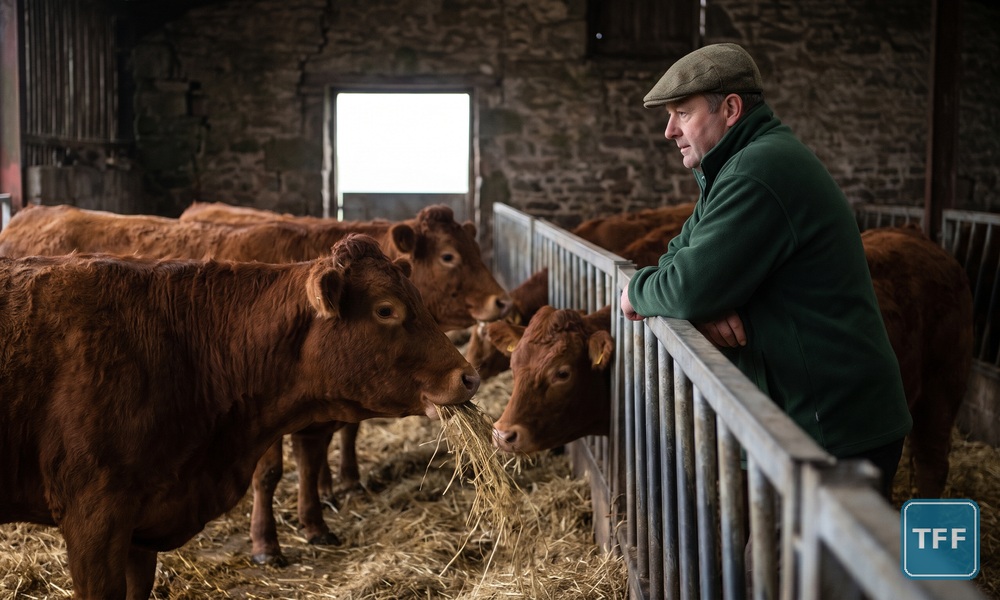
At the end of March, with nitrogen prices spiking and suckler cows wintering too well, a mixed farmer asked The Farming Forum a question that sounds absurd anywhere near a dairy parlour: how do you make silage that is deliberately worse? The answers became an audit of what winter forage on a suckler farm is for, and with cows going back into sheds, every argument is live again.
By TFF News | 24 October 2026 | Forage
The conversation ran on the Livestock & Forage section of The Farming Forum from 31 March to 14 July 2026 and drew 104 visible contributions, 4,218 views and 165 reactions, an average of 1.59 reactions per contribution. These figures describe one conversation among the farmers who chose to join it. It is not a representative survey of the sector.
The opening contribution set the problem out plainly: “Currently ending up with our suckler cows too fat over the dry period as we tend to make the silage “too good”.” The farm wanted forage dry cows could eat ad lib along a barrier, no mixer wagon, no ring feeders, and with the grass inside an arable rotation the seed mixture could be picked to suit.
Cut later, and choose grass that earns it
Tactics for taking the shine off silage led the advice, carrying 25 contributions. Timothy, cocksfoot and forage rye were all suggested as species to leave standing, with one contributor warning, “Avoid Tertapliods in the mix as they tend to be higher in Sugars” Not every bulky option survived scrutiny: “Westerwolds a waste of time in my experience.”
One suckler farm already runs the system the opener wanted, calling it the cheapest way of keeping cows short of outwintering: “Leave til at least 50% headed, into the pit and cows self feed along a barrier.”
The arable side is where the plan picked up its warnings. “It would reduce the quality but also potentially leave you with a grassweed problem in future arable crops.” said one contributor of letting grass set seed, and another rejected the opener’s species outright: “I wouldn’t touch Italian in an arable rotation, especially with glypho resistance becoming more prevalent.”
The practice has official cover: AHDB’s grass silage guidance notes digestibility falls by up to 0.5 D-value units a day once heading starts, and says dry cow silage may deliberately target stemmier, less digestible herbage.
A ledger that starts with fertiliser
Costs were the largest theme, 26 contributions, and the timing explains why. “We are thinking the same, particularly where fertiliser prices are now.” wrote a suckler farm on day one. A week earlier AHDB had reported granular urea at £618 per tonne on 20 March, up 36 per cent on February, and UK ammonium nitrate at £504, driven by Middle East disruption and gas, around 60 per cent of nitrogen production costs.
One contributor priced a mature pit cut at around £17 a tonne and argued, “Zero feeding costs above that. No diesel, no mixer wagon, no forklift depreciation.” A hill farm agreed: two cuts plus bought straw would take a £12,000 silage bill towards £30,000, and “Thirty k would pay my cake bill for 3 years !”
Bale economics cut the other way for some. “Bulky, low feed value silage is damned expensive to wrap a lot of” noted one, suggesting the savings belonged in a straw shed, and a buyer cautioned anyone planning to purchase the shortfall:“Worth remembering it’s easy to buy in terrible quality silage, and almost impossible to consistently buy in good stuff.”
Straw depends on the postcode
The stock answer to over-fat cows, dilute good silage with straw, split the conversation by geography across 17 contributions. From arable country: “silage is about the most expensive thing we feed to our cows, and bad silage has to be the dearest feed there is for what you get in return.” From the west, the opposite: “My last load of wheat straw was £170/t around a month ago.” One farm showed the dilution route needs no special kit:“I worked out a ration of 10kg haylage, 6kg straw and 3kg blend which worked out as 1 bale of haylage every 3 days, with 1 bale of straw for the 2 days in-between for 25 cows.”
An April prediction, “Be plenty of straw about this harvest”, has largely come good. AHDB’s hay and straw series puts GB big square baled wheat straw at £74 a tonne in the week ending 25 October, below the £82 of a year earlier, with barley straw at £89, so dilution is cheaper this winter than when the conversation began.
Multi-cut against one big cut
Under the costs sat a real agronomy row, 21 contributions, about what late cutting does to the ley. A convert to earlier cutting reported fresh grazing weeks sooner: “We now cut the same area a month earlier and feed it with straw, we’ve got less bales to haul and wrap and we have fresh grazing 6 plus weeks ahead of what we used to.” A contributor who sells silage off his own ground argued, “one big cut is the quickest way do spoil a good ley”, while another, citing a former research farm director at Dumfries, countered the multi-cut yield case head on: “Over the same timescale, two cuttings of more mature grass will always yield more DM than 3 cuttings of leafy grass.”
The second dry summer part-settled it in hindsight. Returning in mid July, the early-cutting convert reported his May-cut ground already grazed while late-cut stubble sat bare: “If I left silage until this time I’d be feeding cows in fields before silage was even cut.”
The fat cow problem underneath it all
What kept the conversation grounded was the animal. “I got sucked in with the quality quality merrygo round. Never again. Belly fill.” wrote one farm. Another put the welfare case:“A full suckler is a happy suckler.” adding, “Its not poor quality silage, it’s the correct quality silage for the job.” The plan was summed up as “Feed the cows belly fill, then hit them with the rocket fuel once they’ve calved”, though several contributors argued even the rocket fuel is overdone, since a freshly calved cow eats more of the same ration anyway.
Scotland’s Farm Advisory Service targets condition score 2.5 to 3 at calving for spring calvers and warns that excess fat around the pelvic canal can lead to complicated and assisted calvings, exactly what the opener’s too-good silage was building towards.
The question the trade is left with
This conversation describes customers optimising to buy less: less bagged nitrogen, fewer contractor cuts, less wrap, no mixer wagon, and seed chosen for bulk over quality. One contributor reckoned“Every suckler farmer is having the same thoughts this year.” With straw cheaper than a year ago and nitrogen still volatile, the open question is whether the deliberate downgrade is a drought-era economy or a permanent redesign of the suckler winter, and which suppliers are positioned for a customer who has decided that worse is better.
Read the source conversation and analysis
Read the full conversation on The Farming Forum here. A nine-slide analysis of the conversation, with engagement, sentiment and theme breakdowns, is available as a PDF: download the conversation analysis deck.
This conversation had been viewed 4,218 times on The Farming Forum when counted on
24 October 2026. Want your brand in the room when farmers talk forage?
Book advertising with Agri Web Media.