
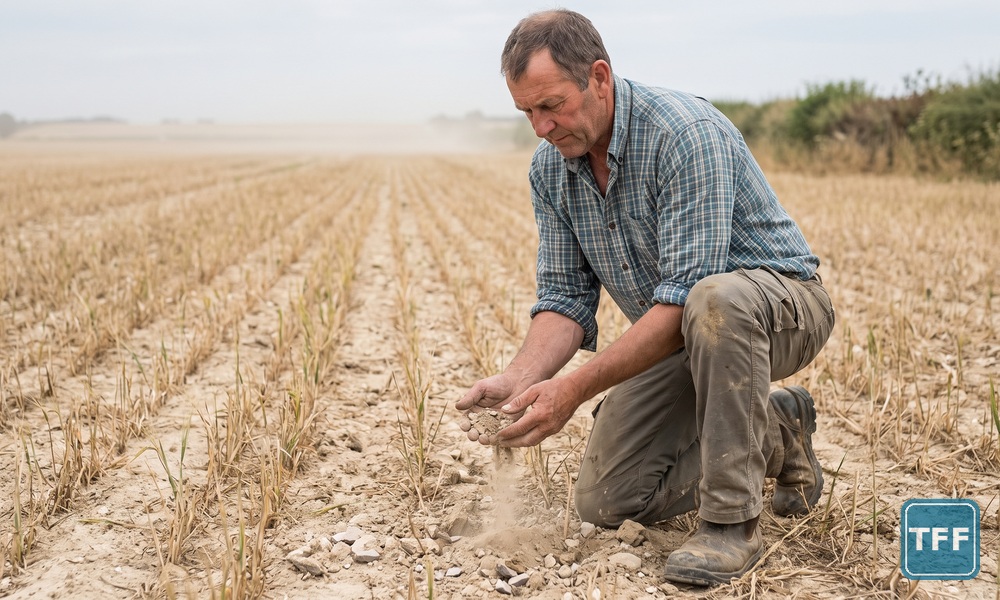
Two failed springs in a row have pushed arable growers into the most serious rethink of cropping plans in years, and a conversation on The Farming Forum shows how far some are prepared to go. One grower’s question about abandoning spring crops on drought-hit land became a working meeting on rye, drought-tolerant grasses, input budgets and, for a minority, whether to grow combinable crops at all. Seed, fertiliser and machinery decisions this autumn are being made on very different assumptions.
By TFF News | 16 September 2026 | Arable
The conversation ran from 6 July to 31 July 2026 and drew 121 visible contributions, 6,759 views and 242 reactions, an average of 2.0 reactions per contribution. It reflects the views of those who took part and is not a representative survey of UK farming.
Spring cropping loses its place
The opening contribution set the tone. The grower reported “just 50mm from Feb 19th to July 12th for two years running” and asked whether to “change away from spring crops and beans which look a complete disaster this year to early hybrid barley and osr”. That rainfall figure is the contributor’s own record, but the question resonated. One echoed that “Spring crops are getting very risky for us now”, while another admitted “It’s tough to get enthusiastic about a cropping plan for this autumn.”
Crop and rotation choice was the largest theme, raised in 35 contributions. The drift was already visible in national data: AHDB’s Early Bird Survey for harvest 2026 put spring barley intentions down 15% at 610,000 hectares and oats down 14%, with winter oilseed rape up 30%. This conversation suggests the second dry summer will push the balance further towards autumn-sown and earlier-maturing crops. One contributor argued the variety lists need to change too: “We are as farmers going to have to plant varieties that are earlier in their development so they do not get hit by the June heat”.
Rye, fescue and chickpeas move up the agenda
Alternatives that were curiosities five years ago are now planned in earnest. One mixed farm is going for“Less barley, oats and wheat, will be adding rye and triticale for hopefully more straw.” A grower four years into rye on light land reported “Spring barley on same farm struggled to 2t/acre last year. Rye did 4t according to company that milled it.” Those yields are the contributor’s own figures, and one dissenter questioned rye’s feed value. Tall fescue and newer soft-leaved varieties were discussed for drought-prone grassland, soya was judged not yet ready on varieties, and sunflowers, sorghum, chickpeas and lentils were all floated for the driest land.
The chickpea suggestion has substance behind it. The Lincolnshire vining pea sector has had a second failed season, with Princes forecasting the UK pea harvest at around 60% of normal yield and the Holbeach Marsh growers’ co-operative trialling chickpeas for the first time and examining lentils.
Some are stepping out of arable altogether
The starkest contributions came from growers on thin land over limestone. One, direct drilling for 25 years, has concluded that“arable, more often than not, is no longer viable on 80% of our farm” and will put grass, legumes and herbs in this autumn ahead of a move into cattle and sheep: “It’s not where I thought I’d be heading 5 years ago, but needs must.” He is already “aiming at doubling the number each year” of dairy cross calves bought in.
A light-land grower in the east, shifting to sheep fed on barley and turnips, agreed:“But to be honest it’s a simpler more profitable system and probably the way forward for us. Cereal growing for sale off farm is no longer viable.” Others cautioned that record cattle and sheep prices make it an “Expensive time to get in to the job.” Another backed the movers: “Realistically we cannot compete with grain from abroad especially with extra costs put upon us.” These are individual business judgements, attributed here as the opinions they are, but nine contributions discussed leaving combinable cropping for livestock, and none was laughed out of the room.
Inputs priced for yields that no longer arrive
Underneath the rotation talk sat a harder commercial question: whether input spending should still be budgeted on yields the weather no longer delivers. One contributor put it directly:“We could just reduce our input costs according to average yield?” Another wondered whether “chasing pie in the sky yields every year does actually waste more cash than farming for average”. A third put it bluntly: “the answer to unpredictable weather is pick whats cheap to grow not whats productive in the right year”, adding that “How you square that with UK land prices/rents is another question.” The light-land sheep convert is considering ordering no fertiliser at all next spring. For input suppliers, that is demand risk in plain terms.
Not everyone blamed the sky. One well-reacted contribution asked:“Are we living off depreciating our soils too? I refuse to believe that climate change is the only thing responsible for growing less yield.”
A new normal or another dry spell?
The conversation split on whether the pattern is permanent. The starkest position was that “these aren’t a once in a while event like 1976 but a consistent trend to very dry springs which has made cereal growing with expensive inputs commercially non viable”. Others pushed back. One reminded the room, “I can guarantee, that we WILL get a wet summer soon… We have short memories and forget bog crops with sprouted ears and wet rotting straw.” The reply captured why waiting is not a strategy: “doing what has always been done in the past hasn’t worked for the last 5-10 years isn’t going to keep someone in business in my part of the UK.”
Two distinctions ran through this section. Several argued that “its the heat that is damaging the crops” as much as the missing rain, and geography matters: while the south and east burned, one grower reported, “Not wanting to rub it in, but we have had almost perfect growing conditions in NE Scotland this year.” Official data backs the severity where most contributors farm: days after the conversation closed, the government declared 71.3% of England in drought, confirming the driest July in 190 years, with July rainfall as low as 1% of average in south-east England against 26% in the north-west.
What the trade should take from it
The signals are concrete. Demand is tilting towards winter cereals, earlier-maturing varieties, rye, triticale and drought-tolerant grass and herbal ley mixtures, and away from spring barley seed on the driest land. Fertiliser budgets are being openly questioned where yield potential has fallen, and dairy contributors expect more arable silage in the system. A minority of arable customers on marginal land are becoming livestock customers instead, just as store and breeding stock prices sit at record levels. The unresolved question, for farmers and everyone who sells to them, is the one the conversation could not settle: whether autumn 2026 plans should be built for a run of dry years or for the wet season that history says will eventually arrive.
Read the source conversation and analysis
Read the full conversation on The Farming Forum here.
Download the full conversation analysis as a PDF slide deck: Are you going to change crops because of drought? Conversation analysis (PDF).
This conversation had been viewed 6,969 times on The Farming Forum when counted on 1 October 2026. Want your brand in the room when farmers talk arable? Book advertising with Agri Web Media.