
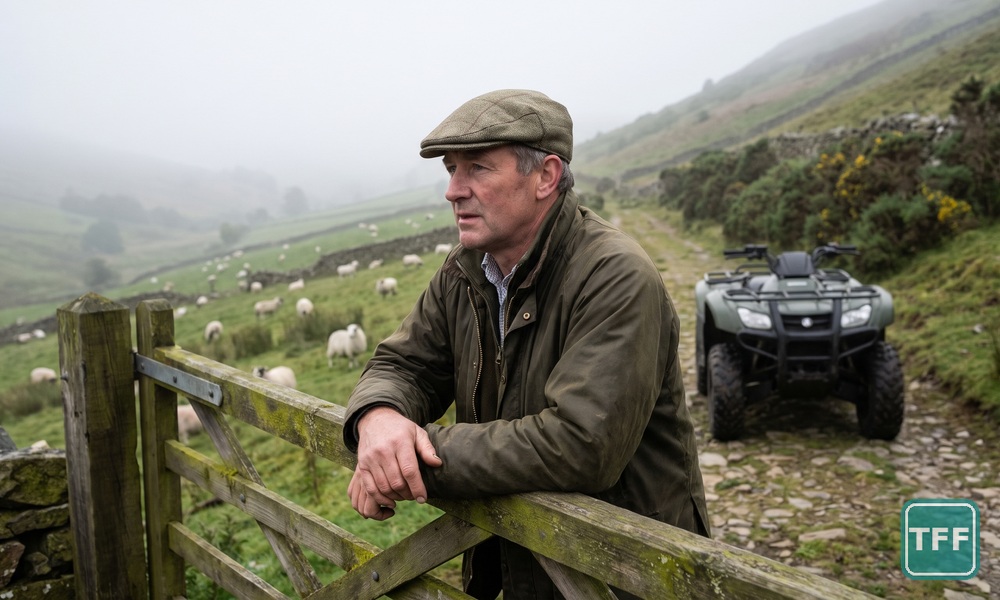
A conversation that opened with nothing more than a podcast clip of the former minister Rory Stewart discussing farm subsidies turned, over a fortnight on The Farming Forum, into a sharp argument about what farm support should now be for. The room broadly accepted that unconditional area payments are finished. It could not settle who the remaining money should reach, where a cap should fall, or whether support should exist at all.
By TFF News | 12 November 2026 | Policy
The conversation ran in the Agricultural Matters section from 25 January to 9 February 2026 and drew 244 visible contributions, 9,919 views and 515 reactions, an average of 2.11 reactions per contribution. By theme, the New Zealand comparison led on 49 contributions, scheme design and subsidy dependency carried 30 each, and caps, tenants and land, and the aim of support followed; politics and general asides accounted for 87 between them. Sentiment split 149 neutral, 88 negative and 7 positive. These figures describe one self-selected conversation and are not a representative survey of farming opinion.
A cap for everyone, in a different place
Contributors summarising the clip said its case was that farming deserves support on social, environmental and economic grounds, delivered with a cap. One quoted its claim that every £1 in direct payments to a poor upland farmer puts £9 into the rural economy. The first substantial reply went straight to the hard part: “All good but where do you set the limits of a small farm, modulation.”
Almost every answer named a different number. One contributor rejected capping outright: “I’m a small farmer 220 acres but someone doing 10 times as much on 2200 acres deserves 10 times the sub.” Another proposed a flat rate per working farmer per holding. A third would cap environmental scheme money hard: “Personally I’d cap all ELMS/SFI to a max of £20,000 and ditch ALL capital funding (because that only goes into the suppliers’ pockets).” A fourth went further: “Give every working farmer £20,000 a year. If it’s not enough you’ll have to get a job on the side.” An arable ceiling sat far higher, but it was still a ceiling: “Personally I think a cap of £150k with no capital grants makes sense.”
The counterargument ran right through. “Any payment skewed towards smaller area caps or smaller producers is more of a welfare payment in my eyes as opposed to a payment to encourage the business”, one livestock contributor wrote, while another argued a cap protects the industry from itself: “Blanket unlimited subs will lead eventually to one farmer farmng the whole country.”
The multiplier and who banked the last one
The £9 multiplier drew suspicion even from the sympathetic. “That seems a very high figure to me – I get that it does filter down, but I’d be very interested to see the way that £1 multiplies up by a factor of nine”, wrote the contributor who quoted it; another put the published figure nearer £7 but defended the mechanism. The sharper argument was where the money finally landed. “Direct payments have been a disaster for tenants and a klondyke for landlords.”, one contributor wrote, pointing at rents and land values. A tenant pushed back from experience: “Direct payment was good for me as a tenant, it came directly to me which was good.” The conversation’s most agreed early contribution blamed uncapped payments for contract farming deals that kept land off the market and prices high.
Strings attached, and who ties them
Part of the room wanted the phrase direct subsidy retired. “Taxpayer support is only a direct subsidy if there are no strings attached. The minute there are strings attached, it stops being a direct subsidy and becomes a scheme you can enter into.” Several contributions argued the strings mainly generate work for consultants, and that grants for lime, drainage, ditching and fencing would be more welcome than audits. One dismissed the whole bargain: “They are not putting strings on me. I retain my right to farm as I want.”
New Zealand, the test case everyone reaches for
The biggest theme, 49 contributions, was New Zealand’s removal of farm subsidies from 1984. A contributor farming there was blunt about the cost at the time: “If you think that farmers had it hard with Rogernomics and subsidy removal then spare a thought for all the support industries in the local towns that nearly or did go out of business from 1984 to the early 90’s.” Another, there in the mid 1980s, recalled: “People who were very comfortable paying 10% interest were ruined at 25%”
The trade relevance is current. “It’s concerning that in this country we are exporting our food production to elsewhere”, wrote one livestock contributor of the post trade deal flow of New Zealand beef. HMRC figures compiled for AHDB and reported by The Grocer show combined fresh and frozen beef imports from New Zealand reached 12,950 tonnes in the eleven months to November 2025, up 239.3 per cent year on year, and AHDB’s June 2026 market update puts the UK at around 5 per cent of New Zealand’s beef exports. A higher figure offered in the conversation does not match the published data and is not repeated here. The standards point was put plainly: “Costs have been stacked on the UK farmer whilst simultaneously importing
food produced in countries with lower standards .”
An industry asking whether it is addicted
Underneath ran a more uncomfortable question, from a contributor who doubted the industry could imagine operating without state money: “Is it a form of addiction ?” The most considered answer accepted the charge and spread it wider: “As an industry we are addicted to government support to a large extent, largely due to government policy in society wide areas. It’s not just farmers, it’s the agricultural supply industry as well.” Not everyone accepted the framing. “Up to the family to preserve there own farm not some tin pot government . Family’s that are switched on do mighty fine in agriculture in the Uk.”, countered one contributor from the hills.
The question the room never answered
By the end the argument was back at first principles. “The question has to be what’s the aim of farm support? Is it social or is it environmental or is it production ? From there you work out how to do it.”, asked one contributor. “The aim of farm support surely should be to maintain some kind of food security for the people that live on the island that we farm on.”, answered another. A third noted the production argument was settled decades ago: “Subs haven’t been in place to encourage production since the 1980’s.
Since then they have always been to support rural communities and reduce depopulation, so yes, a social benefit.”
Policy has since answered the cap question, if nothing else. Three weeks after this conversation wound down, Defra announced SFI26 with payments capped at £100,000 per business. In Wales the Sustainable Farming Scheme opened on 1 January 2026 paying £70 per hectare on the first 70 hectares, with deductions on larger payments starting at £25,000 and nothing paid above £300,000, per AHDB’s summary. One contribution cited different Welsh capping figures; the figures here are the published ones.
What no scheme has answered is the aim. That is the live question for the trade: a capped, conditional system changes which farm businesses have money to spend and what they spend it on, and the supply trade was built on the old system too. As one contributor put it: “If society doesn’t care about UK food production, then they should have the honest to tell us that.”
Read the source conversation and analysis
Read the full conversation on The Farming Forum here. Agri Web Media’s nine slide analysis of the conversation, with theme, sentiment and contributor breakdowns, can be downloaded as a PDF: Conversation analysis deck (PDF).
This conversation had been viewed 9,919 times on The Farming Forum when counted on 12 November 2026. Want your brand in the room when farmers talk policy?
Book advertising with Agri Web Media.