
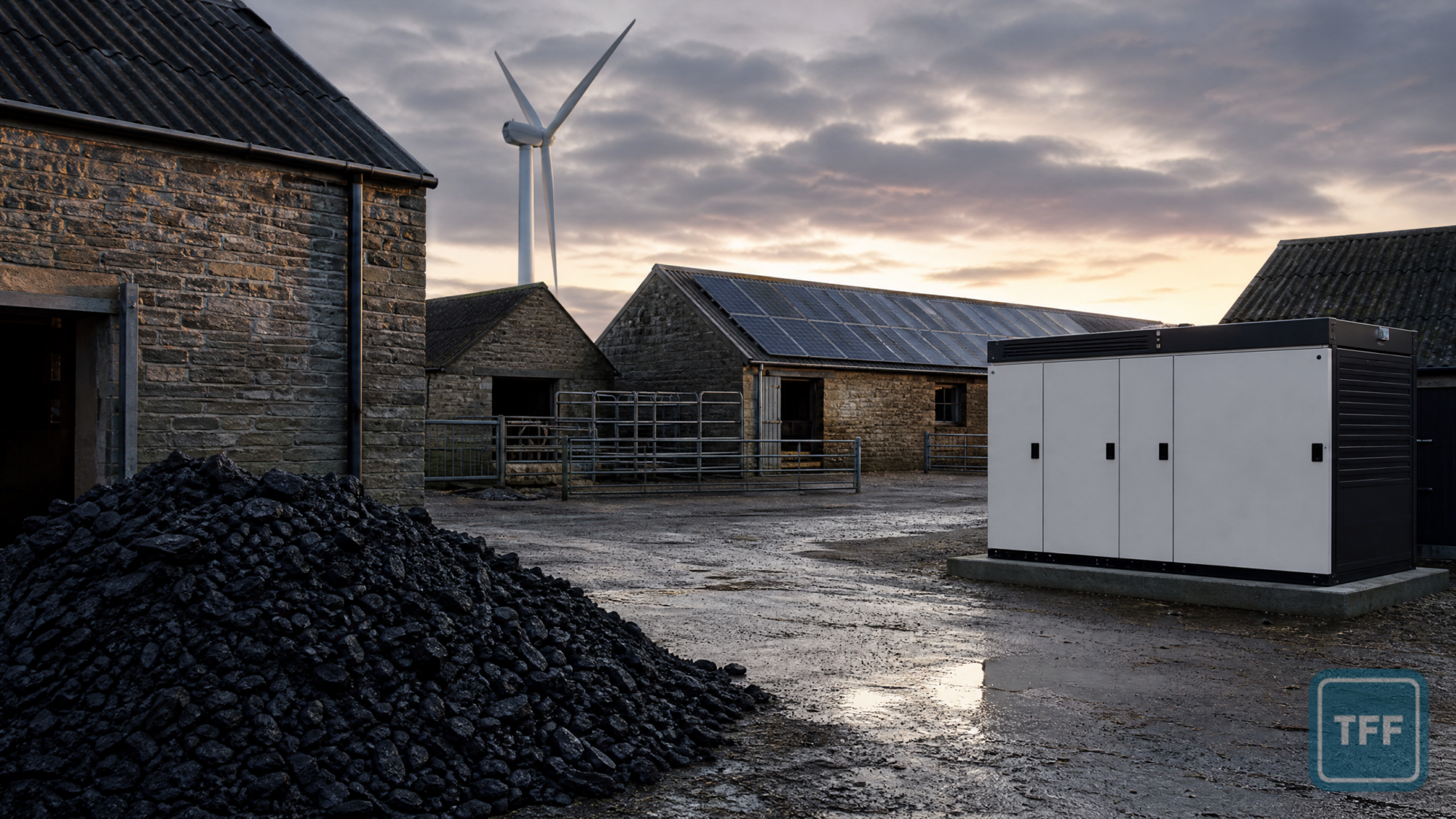
Farmers Weigh Coal, Nuclear and Storage
By TFF News | 5 August 2026 | Energy & Farming
This farmer conversation matters because it moves the debate from headlines to the yard gate. Farmers are the users and operators of energy at the local scale. Their concerns about fuel quality, storage cost, handling risks and long term stewardship expose gaps between policy statements and on farm realities. If energy solutions are to work for rural areas they must be safe, affordable and manageable by people who run machinery, livestock and small enterprises.
Farmers took a news item about global coal use and drove it into practical territory, asking what it means for the kettle, the boiler and the farmyard.
Sea coal and local lore
Jasper started the practical side of the talk by asking if anyone uses sea coal. spark plug answered from northern England experience: sea coal can be collected where spoil washed back to shore and it burns acceptably in a sealed burner. The catch is contamination. Stones and grit make it a poor choice for an open hearth. As spark plug put it, ‘Any stones that were shovelled up with the coal can explode flying across your living room.’ That sums the risk assessment farmers do without fuss.
Storage and the dunkelflaute problem
Several contributors used the German term dunkelflaute to describe long periods with little wind or sun. Swarfmonkey warned that large scale battery storage to cover a whole week of low renewables ‘is staggeringly expensive’. glasshouse recommended keeping thermal stations as backup, a common farmer preference where reliability matters more than ideology.
Nuclear: waste, cost and reprocessing
Nuclear prompted both technical defence and practical worry. Some contributors pointed to French reprocessing and vitrification of waste as a workable path, noting the relatively small volumes involved after treatment. Others pointed to high capital costs and sceptical examples such as strike prices. The debate was less ideological and more about who pays and who maintains long term stores.
Hydrogen versus batteries
Hydrogen came up as a possible medium for long term storage. Y Fan Wen championed electrolysis and gasholder storage as a modern version of the old gasworks, while critics noted the efficiency losses and handling challenges. Ammonia as a carrier was mentioned as an industrial workaround. The practical view among farmers was cautious: pilot systems before wholesale adoption.
Data, AI and electricity demand
FonterraFarmer and others questioned bold claims about the energy use of data centres, AI and crypto. Estimates ranged widely. Farmers demanded better numbers, not slogans, echoing a broader concern: policies should be based on transparent, verifiable metrics rather than sweeping assertions.
What farmers said
Quotes that cut through: ‘Nuclear is not the answer, Australia has sunlight’ (glasshouse); ‘You gonna run the whole country off a battery at night?’ (TelesnaAg); ‘The use of electricity to make hydrogen and then burn that hydrogen in a gas turbine is nothing like efficient enough’ (ollie989898). Those lines show the mix of local practicalities, cost awareness and engineering scepticism that drove the conversation.
The conversation shows farmers do not accept simple answers. They ask about fuel quality, storage feasibility, handling risks and transparent costs. Any energy plan that affects rural communities needs to answer those practical questions with data, pilots and clear responsibilities for long term stewardship. Farmers will back solutions that keep the lights on, the machinery running and the yard safe.
Read the full conversation on The Farming Forum here.
You can view a slide deck for the conversation by clicking here.
This conversation had been viewed 18,805 times on The Farming Forum when counted on 1 October 2026. Want your brand in the room when farmers are talking? Book advertising with Agri Web Media.