
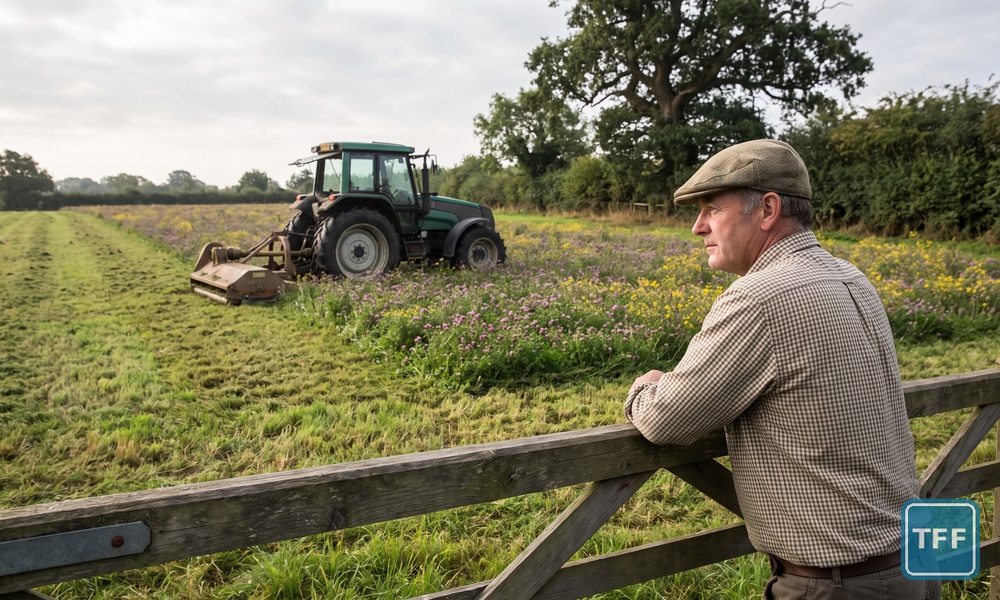
A question first asked on 6 July took until 11 September to get a definitive answer, and the Rural Payments Agency itself had to seek internal confirmation before giving it. Farmers ending Sustainable Farming Incentive 2023 agreements wanted to know when a legume fallow can be destroyed and the land drilled with wheat. The conversation that followed on The Farming Forum shows how much commercial planning now hangs on agri-environment small print, and how little confidence some agreement holders have in the answers they are given.
By TFF News | 14 September 2026 | Arable
The conversation drew 143 visible contributions, 5,861 views and 100 reactions between 6 July and 11 September 2026, an average of 0.7 reactions per contribution. These figures describe a single conversation on The Farming Forum. They are not a representative survey of UK farming.
A simple question without a simple answer
The opening contribution set out the problem in three lines: two agreements, ending 31 March and 30 June 2027, both containing the NUM3 legume fallow action. “When can I destroy the fallow and plant wheat?”
Exit timing was the dominant theme of the conversation, raised in 61 of the 143 contributions. Contributors disagreed over whether the fallow must stand until the agreement end date or only until the action’s aims are achieved, and whether the answer differs between the 2023 scheme and the 2024 expanded offer. One contributor summarised the interpretation he said was general in his area: “Can destroy after August 31in third year of the action.” Another reported a direct confirmation: “It’s been confirmed on the q&a that I can terminate my pre march 23agreement on its 3 year anniversary (1dec 26 )and don’t have to let it run to feb”
Others were not prepared to move on interpretation alone. “The last thing anybody needs in a year like this is an RPA clawback.” wrote one contributor, while another said he would sit tight regardless: “I’m being super cautious to make sure all actions have been met, don’t want any comebacks”
Nobody moves without it in writing
Distrust of the guidance, and of the agency administering it, ran through 31 contributions. “It’s the vagueness of all the rules that causes the problems/confusion” was one contributor’s diagnosis. Another explained why he routed his question through an agent rather than ask directly: “I could have asked the rpa myself. But I don’t trust them.”
One contributor who did ask the RPA directly shared the holding reply he received on 2 September: “We are currently reviewing your question to confirm whether land under the NUM3 Legume Fallow action can be planted with another crop where the action requirements have been met, or if the land remains subject to the agreement period restrictions.” His response to fellow contributors urging him on was blunt: “That is my thinking, but with the RPA its best to get something in writing!”
Nine days later he posted the agency’s answer: “We have had confirmation that if the NUM3 has achieved the action’s aims, then this can be rotated off the parcel.” The reply, as he shared it, advises retaining evidence that the aims were met before destruction. His conclusion: “It looks like I can now get some wheat in the field even though my agreement does not end until March 27.”
The answer arrived too late for some. One contributor, reading a linked guidance page mid-conversation, reacted with the accusation that officials had “quietly changed theses rules and without actively informing existing agreement holders!!”, an opinion that captures the wider frustration.
The rate cut changes the sums
Whether anyone would sign up again is a live commercial question. Under the 2023 scheme, NUM3 paid £593 per hectare, according to Farmers Weekly’s guidance on the action. The equivalent SFI 2026 action, CNUM3, pays £532 per hectare, and its published aims now include green cover over the winter months as well as summer flowering, according to the current gov.uk action page. That winter cover requirement effectively rules out the drill-flower-and-remove cycle some contributors had planned within a single year.
One contributor recalled the new rate from memory and drew his own conclusion: “530/ha iirc. Certainly not worth it if planting each year now.” He returned to the point later: “But I’ll say again that at the new rates, it’s not worth rotating.” Not everyone agreed. Another contributor reckoned a fallow could still beat spring beans on his own farm’s figures once harvest costs and the following wheat were counted.
Best option for nature, or money down the drain
Running alongside the rules debate was a sharper argument, in 33 contributions, about whether the action deserves public money at all. One contributor called it “an abuse of public money” delivering no lasting public good, a minority view in the conversation but argued at length. The response from those who have grown the fallow was direct: “It was a win for the farmer a win for the environment and a win for the tax payer.” Another put it more simply: “Can confirm that a legume fallow, in place for three years, is absolutely the best thing for nature. Best sfi option. Shame they cut the rates really.”
Overall, 42 contributions were negative in tone against 15 positive, with 86 neutral, most of those the patient work of interpreting agreement dates. Even a defender of the payment rate conceded the cultural unease: “It pays well though. But it doesn’t feel like a proper farming thing.”
What follows three years of fallow
For the trade, the agronomy tail matters as much as the policy. Contributors weighed leatherjacket and other pest pressure in fallow stubbles ahead of first wheats, with one warning that after three years the ground “will be full of unfriendly bugs wanting to spoil it”, and others reporting clean, restructured soils. As the conversation closed, the exits had begun. “Farewell legume fallow. My most successful block of 60ac is being mulched today. The soil is beautiful.” wrote one contributor. Another, flailing off his fallow ahead of a March agreement end, signed off with “Never again.”
The question the trade is left with
The RPA’s confirmation, as relayed in the conversation, settles the exit question for one agreement holder who asked in writing; retaining evidence that the aims were met is the practical takeaway for anyone doing the same. What it does not settle is the pipeline. Fields are coming out of legume fallow this autumn into wheat, and the replacement action pays £61 per hectare less with a tougher winter cover requirement. Seed houses, agronomists and land agents will find out over the coming application windows whether the farmers saying never again mean it.
Read the source conversation and analysis
Read the full conversation on The Farming Forum here.
Download the full conversation analysis slide deck (PDF).
This conversation had been viewed 7,142 times on The Farming Forum when counted on 1 October 2026. Want your brand in the room when farmers talk arable? Book advertising with Agri Web Media.