Sustainable Farming Incentive (SFI) Weekly Forum Summary
Date Range: 13 July – 19 July 2026—
Executive Summary
This week’s discussions within the Sustainable Farming Incentive (SFI) section of The Farming Forum highlighted key concerns and information exchanges around cover crop seed certification, application process uncertainties, solar energy integration on farms, and practical insights into SFI option implementation. A particularly active conversation on the legality and requirements for cover crop seed certification drew significant input, reflecting the sector’s keen interest in compliance with evolving standards. Meanwhile, contributors shared detailed experiences with solar photovoltaic (PV) systems, addressing questions on system worth, configurations, and contracts. The ongoing dialogue about the progress and next steps following SFI application submissions further informed many members awaiting clarity on scheme delivery timelines. Smaller yet substantive discussions ranged from on-farm visitor management to technical upgrades and heat metering for renewable heat incentives. Overall, the week underscores a community actively navigating both policy frameworks and practical implementation of sustainable farming practices.—
Conversations at a Glance
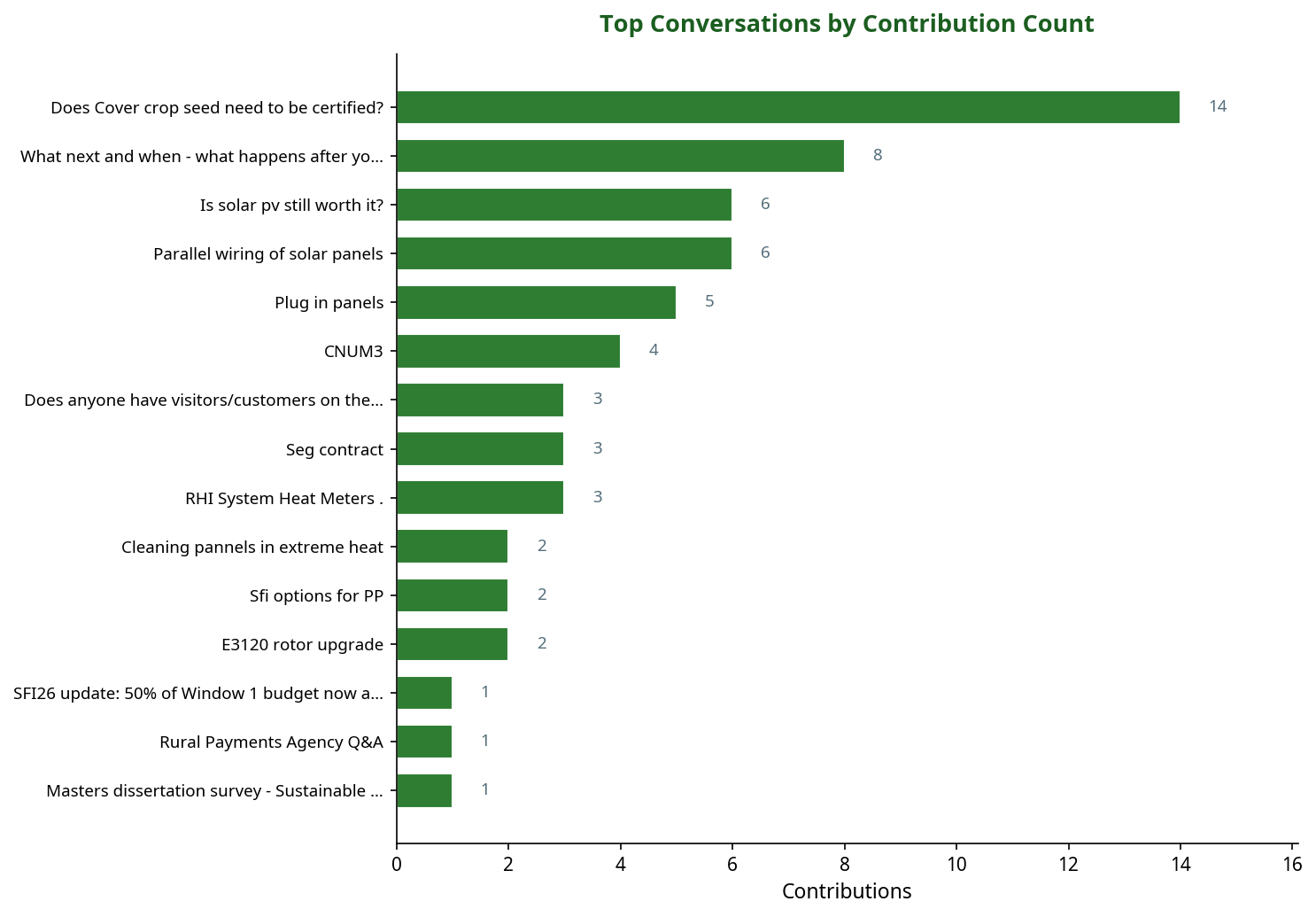
| Conversation Name | Contribution Count | Key Topics Covered |
|---|---|---|
| Does Cover crop seed need to be certified? | 14 | Seed certification legality, Farm Saved Seed usage, SFI inspection requirements |
| What next and when – what happens after you submit an application | 8 | Application status updates, RPA processing timelines, budget allocation |
| Parallel wiring of solar panels | 6 | Solar panel wiring methods, system efficiency |
| Is solar pv still worth it? | 6 | Cost-benefit analysis, energy generation, financial incentives |
| Plug in panels | 5 | New battery technologies, tariff options, integration with solar PV |
| CNUM3 | 4 | Technical details not fully specified in summary |
| RHI System Heat Meters | 3 | Meter installation rationale, multiple meter usage, RHI deadlines |
| Seg contract | 3 | Solar Export Guarantee (SEG) contract types, tariff selection |
| Does anyone have visitors/customers on their farm? | 3 | Farm diversification through tourism, customer engagement challenges |
| E3120 rotor upgrade | 2 | Technical upgrade discussions |
| Cleaning panels in extreme heat | 2 | Maintenance schedules, panel efficiency under heat extremes |
| Sfi options for PP | 2 | SFI implementation on permanent pasture |
| Rural Payments Agency Q&A | 1 | General enquiry session |
| SFI26 update: 50% of Window 1 budget now allocated | 1 | Budget allocation status and implications |
| Masters dissertation survey – Sustainable Farming Incentive | 1 | Academic research, survey participation invite |
Detailed Discussion Summaries
Cover Crop Seed Certification and Legal Considerations
The most vigorously debated conversation concerned whether cover crop seed requires certification under the SFI. Contributors shared insights on the legality of using Farm Saved Seed (FSS) versus certified seed, referencing UK regulations that prohibit the buying, selling, or sharing of agricultural seed outside certified channels. Several contributors sought clarity on whether SFI inspections have demanded invoices or proof of royalty payments, with anecdotal evidence indicating variations in inspection stringency. The forum also discussed strategies for sourcing seed legitimately, emphasizing compliance to avoid penalties. This reflects a wider uncertainty on how SFI standards intersect with existing seed certification laws, making it a critical focal point for farmers striving to remain within the scheme’s rules.Application Process and Scheme Updates
Following submissions of SFI26 applications in late June, members expressed a need for clearer guidance on the post-submission process, including expected timelines and scheme start dates. Several contributors confirmed continued “application submitted” status on their RPA accounts, prompting speculation over processing speed and next procedural steps. Notably, a posted update confirmed that approximately 50% of the Window 1 budget is now allocated, indicating substantial uptake early in the application window. Frequent suggestions encouraged applicants to monitor RPA channels daily, underscoring the demand for transparency in scheme administration. This conversation demonstrates farmer eagerness for timely feedback and certainty to plan ensuing farm activities.Solar Energy Integration on Farms
Solar-related conversations remain prominent, encompassing practical and economic discussions:- System Configurations: Contributors exchanged technical insights into parallel wiring of solar panels to optimize output and system resilience. Questions on legal and practical aspects of integrating ‘plug-in’ battery systems with existing grid and tariff arrangements featured prominently, including restrictions on battery control interfaces.
- Economic Viability: Debates on whether solar PV remains a financially sound investment reflected diverse experiences, with users noting high export tariffs on domestic supply versus commercial arrangements. Livelihood considerations, such as space utilization for ground-mounted arrays and planning permission nuances, were carefully weighed.
- Maintenance Practices: Anecdotes about panel cleaning frequency ranged widely; some contributors claimed minimal cleaning suffices, while others highlighted cleaning during extreme heat to preserve efficiency.
Within this theme, discussions on securing appropriate Solar Export Guarantee contracts featured advice on selecting tariff types matching farm consumption profiles and battery integration capabilities.
Smaller Yet Insightful Conversations
– RHI System Heat Metering: A smaller group addressed the practice of deploying multiple calibrated heat meters to comply with Renewable Heat Incentive (RHI) deadlines, touching on the cost implications of meter replacement and legal assurances regarding double claims. – Farm Visitor Engagements: A brief but candid exchange surfaced about the challenges and benefits of having visitors, customers, or events on farms for diversification, with farmers mostly wary of the public interaction demands. – Technical Upgrades and SFI Options: Discussions touched on practical upgrades such as E3120 rotor improvements and SFI pathway options on permanent pasture, providing a window into operational considerations supporting sustainable farming goals.—
Conclusion
This week’s SFI section on The Farming Forum paints a picture of an engaged farming community actively grappling with regulatory, technical, and economic facets of sustainable agriculture. The dominant themes reveal a balance between clarifying compliance obligations—particularly regarding seed certification—and embracing renewable energy technologies as part of the farm’s green transition. The ongoing need for transparent, prompt updates on scheme progress notably characterizes farmer experience, while technical conversations emphasize practical know-how sharing. As the SFI scheme evolves, these forums remain vital spaces for peer-to-peer support, knowledge exchange, and collective problem-solving within the UK’s agricultural sector.