
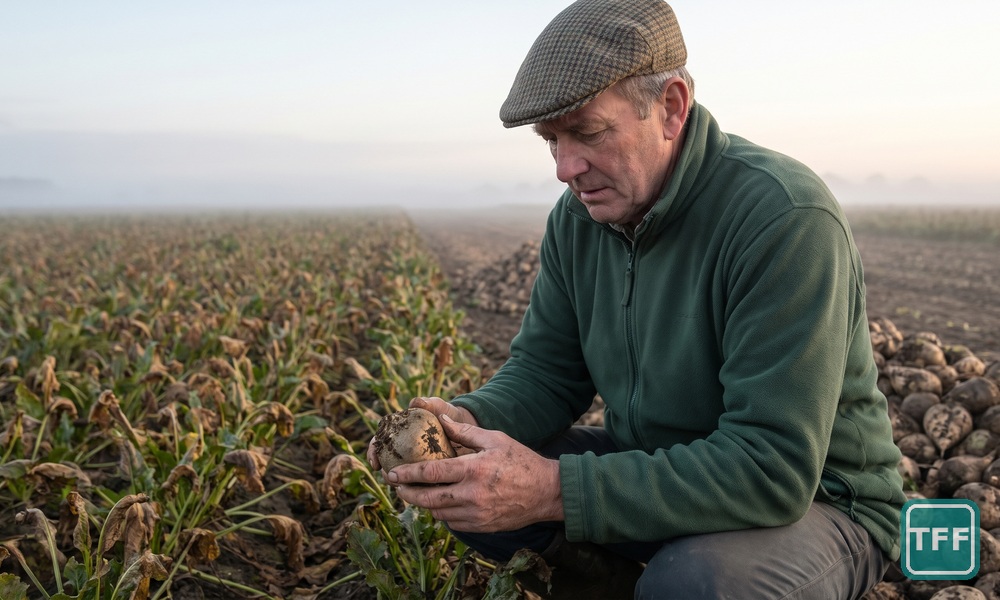
One conversation on The Farming Forum followed the 2026 sugar beet crop from a dry spring in which seed never germinated, through write-offs and poor first lifts, to the lower price growers are being offered for 2027. For every business that sells to beet growers, it reads as a single question: how much of the crop will still be there next spring?
By TFF News | 2 November 2026 | Arable
The conversation ran from 4 March to 31 October 2026 and gathered 290 visible contributions, 19,055 views and 357 reactions, an average of 1.23 reactions per contribution, across 53 active days. The figures describe this conversation only; it is not a representative survey of the sector.
A crop that never came
The conversation opened in March with the season’s virus yellows forecast, and by mid May it had turned into a roll call of seed sitting in dust. One grower put a number on his own: “I am about 40% ungerminated”. Another counted “If I’ve got 26 beet plants germinated across 50ac then that’s all”. Crops that emerged in June, after the first useful rain, stayed behind all summer.
By late September the first write-offs were agreed. One grower walked his crop with the fieldsman and had it written off because almost nothing would stay on the harvester, and his post-mortem was short: “25mm of rain in April would have seen a very good crop.” Farmers Weekly had reported in late August that the national harvest was forecast as much as 25% below an average year, with NFU Sugar board chairman Kit Papworth calling prospects for the crop very poor.
First lifts confirmed the fears
When harvesters started in late September the reports came quickly: “Local reports of 6t an acre and struggling to get them over a cleaner loader without all falling through”, said one contribution, and a load a hectare where a load an acre would be normal, said another. By mid October a regular voice summed the area up: “I’m hearing (and experiencing) shocking yields around here. Beet have not rescued the situation after a dreadful combineable crop harvest”. The year was not uniform: one fen grower reported “Our first field has done 78.5t/ha, how does that compare with others?” without irrigation, roughly half as much again as the figures around him.
That spread is why attention turned to the contract’s yield protection scheme. One grower who had taken the cover worried aloud: “max fund is £250/ha over the insured area, which is just below 10% of the crop. Hopefully there is enough.” Those figures are grower accounts of the scheme rather than published terms, but the worry that a widespread failure year could outrun the pot went unanswered in the conversation.
A lower price landed mid-campaign
Into this landed the 2027-28 contract. NFU Sugar and British Sugar settled in early October, ahead of an arbitration British Sugar had triggered in August, on a fixed price of £28.50/t for up to 50% of contract tonnage, with a market-linked bonus option guaranteeing £25.50/t and an index-linked option starting at the same level. That compares with £30/t for up to 65% on the current crop, and £33/t for up to 70% the year before: down two years running.
The most agreed-with contribution in the conversation reacted to how the offer was built, not its level: “Another ridiculously complicated contract offer…I don’t like being forced into the ‘gambling’ options….why can’t they just release ‘the price’ so we can just either accept or decline…”. Others defended it; one grower worked the options through to an average and pointed out that “I don’t think any farmer in the uk prices 100% of their expected wheat harvest before drilling”.
The real argument was whether the number clears the cost of growing the crop. One long-term grower laid his arithmetic out: “my break even is between 24 and 25£, depending on how optimistic I am with yield predictions”, a margin he judged too thin, and his conclusion carried the weight of six decades with the crop: “The potential reward is not sufficient to entice me to run the risk any more, so I will divert my energies into more lucrative options.” Another grower was blunter about the level the price needed to reach: “It needed to start with a 3, I think I’m out for next year.” The risk argument kept returning to the same point: “I realise I sound like a broken record but acceptable yields are no longer a given.”
The settlement’s cost surfaced in the conversation too. A contribution reported a “12p/t one off levy to come off the agreed price for next year to cover the cost of the negotiations”, a figure the trade press has not published and which stands here as a grower account. One contributor, who said the full story of the negotiation could not yet be told for legal reasons, defended it: “Trust me, i know it probably doesn’t seem like it but the 12p levy is worth it for the price achieved a great many times over.” Another answered for the sceptics: “It doesn’t get told because it’s a fairytale”. Kit Papworth has himself called it publicly a long and expensive process he hopes is not repeated.
Three factories and a short campaign
All of this is happening in the shadow of British Sugar’s proposal, announced on 21 July, to cease beet processing at Cantley from the end of February 2027, taking the network from four factories to three, citing low average European sugar prices, high energy costs and declining sugar volumes. Cantley runs this campaign as normal, and British Sugar’s campaign update on 13 October said it is expected to begin processing in November, in a campaign its agriculture director expects to be relatively short.
The conversation’s final week was about what that means on farm. “Bury due to shut mid jan, I know crops are half what they should be but harvesters can’t go that much faster!”, reported one grower, and another saw the geography straining: “When Cantley opens next week I suspect Bury will struggle to get enough beet. Plenty of beet coming down from the Norfolk coast which is madness.” The commercial line the trade should note was about haulage: “We should not, cannot and will not bear the cost of supplying beet to different factories if they shut factories early.” The new contract does extend the transport allowance to 75 miles for former Cantley growers, against 60 miles elsewhere, which is where some of that argument will be settled.
Who plants beet in 2027?
Some growers in the conversation are already gone: “nothing would tempt us back to growing sugar beet, fodder beet yes!” Asked whether two hard years had put him off, a newer grower answered “Yes we will grow some.” And some moved during the conversation itself: the grower who counted 26 plants across 50 acres had called this his last year of beet, then read the October offer and wrote: “I was all ready to give up after this disastrous year but it may not be such an easy decision now…”
That is the unresolved question this conversation leaves for the trade. Every seed, chemistry, machinery and haulage business in the beet belt prices its 2027 season off the acreage that comes back. The drills go in the ground in March; the decision is being made now.
Read the source conversation and analysis
Read the full conversation on The Farming Forum here.
Download the full conversation analysis as a slide deck: Beet 2026 conversation analysis (PDF).
This conversation had been viewed 19,055 times on The Farming Forum when counted on 2 November 2026. Want your brand in the room when farmers talk arable? Book advertising with Agri Web Media.