
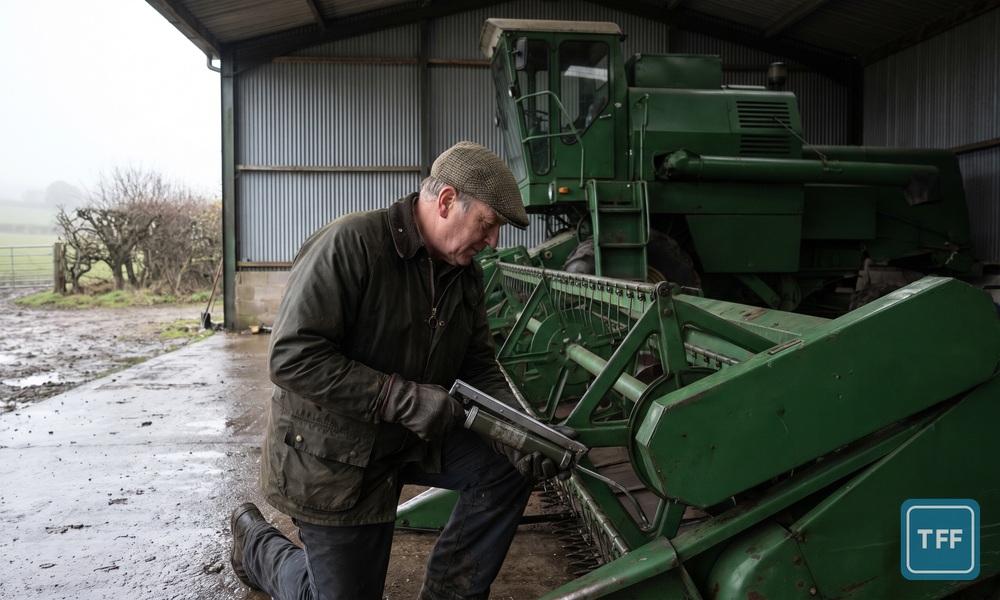
A farmer asked a simple question on The Farming Forum last week: how many new combines have been ordered for harvest 2027? The answer from the trade, as relayed by farmers, is very few. The week that followed was an audit of why: cost per hectare that will not stack up, dealer yards full of stock, and a used market that depends on somebody buying new.
By TFF News | 21 November 2026 | Machinery
The conversation drew 111 visible contributions and 8,019 views between 13 November and 20 November 2026, with 121 reactions, an average of 1.09 per contribution. It peaked on 20 November with 31 contributions. Cost per hectare and depreciation was the largest working theme (26 contributions), ahead of sales volumes (16) and buying and replacement decisions (16); 31 were banter and asides. This is what one conversation said, not a representative survey of UK arable farms.
The order book the trade describes
The first reply set the tone. “With arable farming currently face down in a puddle, ‘used’ is the ‘new new’.” Another contributor put it as “Not many I have been told by the trade”.
The numbers in the room moved quickly. One contributor cited a Farmers Weekly figure of nearly 1,500 new combines sold to the end of October, which drew the most-reacted response of the week: “Find it hard to believe that 1500 new combines sold in the uk.” He withdrew it the next morning, “Having dug deeper I agree, not sure where I got the figure from”. His tractor figure held up: the Agricultural Engineers Association’s own registration figures show 9,182 tractors registered from January to October 2026, up 17.3% on the same period of 2025.
Combines are another story. One contributor gave his reading of AEA statistics as “5 year average combine sales in UK from 19/20 to 23/24 was 520 units. 24/25 dropped to 280 units, a massive 46% drop.” AWM could not find those combine figures published, so they stand as his account, but the direction matches a machinery market review published by Farmers Weekly in April, which quoted the 2024-25 combine season as “probably the worst since the war, certainly the worst in our records” and said the current season did not look any better. Estimates for this year in the conversation ran lower still, from “More like 300 the past couple of years I’d have thought & will fall further still this year.” to the opener’s own “from what i am hearing 150 all makes this year if they are lucky”. Neither is a published figure.
Dealers holding stock
The dealer accounts are second-hand but consistent. “one of my local dealers has not sold a new combine for 18 months”, one contributor said, adding that the dealer principal told him “sales of everything was well down for ag where as the groundcare was booming.” Another was careful to flag his source: “All heresay, but I had heard that a dealership that usually does 16-18 on an average year and 25-28 on a really good year only sold 4 this year.”
A third simply reported what he could see: “Drove past three local dealers yesterday and all the yards were rammed full of tractors, telehandlers and combines.” One contributor expects that stock to move on price, and soon: “There will be some really good deals out there especially after christmas”, because manufacturers “have marketing departments whose real job is to discount unsold combines without destroying the retail price around the world.”
There are buyers. “Claas Trion after some haggling, good deal.”, one contributor reported, and another said a contractor “has ordered 5or 6 combines for next year ,they run them for 1000 hrs then park them up”. That is high-hour contracting and hard bargaining, not the family-farm replacement cycle.
Cost per hectare decides it
The sharpest contribution came from a grower who had done the sum. “Priced up a new x9 1100 to replace 3 combines over 4200 acres. Didn’t stack up at all on acreage costs so put some new paint on old metal and kept things as they are.” He later put the machine’s territory at 4,000 to 5,000 acres; his are spread across ten farms.
One contributor argued the onus is on the seller: “The idea of an X9 is to give the lowest cost per acre/tonne combining possible. If it doesn’t stack up I would be asking them some serious questions.” He put his own figures on the table, “My 5 year old machine has cost about £40ish/ha in depreciation.”, and concluded “So £30-£35/ha depreciation and £30-£35 on operating costs means I think combining costs for the most efficient businesses are in the £60-£70/ha region.”
One contributor worked through a large new machine as “£750000 -£350000 =£400000 over 5 years = £80000 per year over say 3000 acres per year = £26.6 per acre x 2.47 =£65.8 /ha”, on depreciation alone. A Suffolk grower thought “you can probably get to about £55-60/ha total costs sticking 2000 ha through a machine.” The gap between camps was whether a £30/ha advantage is worth the exposure; the sceptic called it “not massive in terms of the capital and risk factors associated with something of that scale”.
The deeper objection is about cropping. Manufacturers’ area claims, one contributor said, assume a spread of crops that may not pay: “They expect farmer to grow unprofitable crops in order to bring the cost per ha down enough to justify their price tag.” He did not blame the price list: “In reality, it’s not the high price of equipment that is wrong, they generally have only kept pace with inflation. It’s the value of our produce that has fallen way behind.”
Reliability is the counterweight. “A high capacity combine has zero output when stopped in season so this has to be avoided as far as possible.” For the rest, the same contributor said, “For smaller farms, say under 2-3000 acres a combine can be made to last well given proper annual and daily maintenance”.
Bigger machines, thinner second-hand market
Part of the fall in units is size. “fewer, larger machines are doing the work of multiple smaller machines”, one contributor noted, and another suggested a better measure: “’Feet of new header sold’ would be a more meaningful statistic.”
That is the opener’s complaint about the manufacturers. In his view they “have forgotten the smaller or medium size farm who want to have control of all operations”, and of the biggest models, “after 3 or 4 years nobody wants one second hand.”
The used market has its own limit, as one contributor put it: “If no farmer ever buys new it will all grind to a halt.” Opinion split on what older kit means. One contributor said “it gives me know pleasure to see kit getting older on farms as it shows an industry in decline/decay”; another answered “Tin need not be shiny!!”
What the trade is left with
The conversation does not say farms have stopped needing combines. It says the case for a new one now rests on cost per hectare across a large, well-spread area, and that fewer businesses can make that case at current grain prices. Contractors running high hours are still buying; mid-sized family farms are servicing what they have. For manufacturers and dealers the open question is whether post-Christmas discounting moves the stock already built, or whether the mid-sized machine the room keeps asking for comes back into the range before the used fleet ages out.
Read the source conversation and analysis
Read the full conversation on The Farming Forum here.
Download the conversation analysis deck (PDF): New combines: conversation analysis
This conversation had been viewed 8,019 times on The Farming Forum when counted on 21 November 2026. Want your brand in the room when farmers talk machinery? Book advertising with Agri Web Media.