
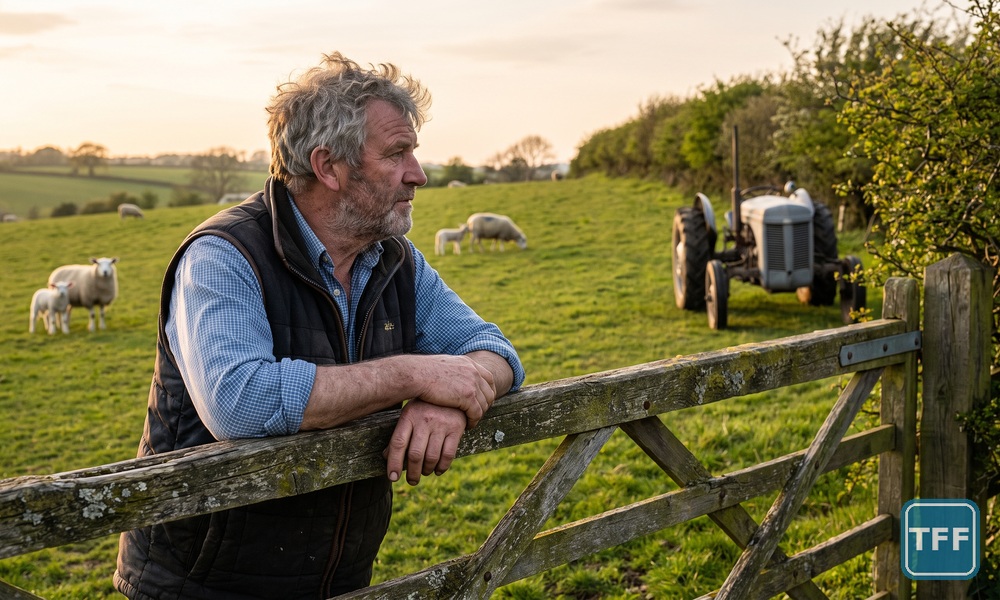
Ask farmers when they plan to retire and very few name a date. A midsummer conversation on The Farming Forum put the question directly, and the answers describe a long wind-down rather than a clean break: stepping back from physical work in the early sixties, simplifying systems to suit older bodies, and carrying on where no successor exists. For machinery dealers, land agents and professional advisers, how that wind-down decade is managed is a commercial question as much as a personal one.
By TFF News | 17 September 2026 | Business
The conversation, started as an informal poll in the Agricultural Matters section, ran from 30 June to 18 July 2026 and drew 222 visible contributions, 11,892 views and 670 reactions, an average of 3.02 reactions per contribution. These figures describe one self-selecting conversation; it is not a representative survey of UK farming.
The backdrop is an industry that skews old. Defra’s agricultural workforce figures for England at 1 June 2025 put 40% of principal farmers at 65 or older, with only 15% under 45. This conversation is what that statistic sounds like when it talks about its own plans.
Slowing down, not stopping
Life after farming was the most-tagged theme, touched on in 93 contributions, yet very little of it meant stopping. With retirement timing (38 contributions) and a phased wind-down (29), the same pattern repeats: shed the heaviest work around the state pension, keep the decisions and paperwork for years beyond it. The contributor who opened the poll set the tone: “Plan to retire from daily physical side at 65 health permitting.”
A day in, one contributor summarised what was emerging: “Interesting to see a reasonably consistent theme here of winding down if able and health permitting in early sixties.” At the far end of the scale sat the oldest voice in the conversation: “83, still live and work 6 till 6 most days and love it, why retire if you love the life you are presently enjoying?”
The clean-break exit was the exception. One contributor who gave up a tenancy last November explained: “I sold the flock and the herd and rouped the machinery. It was definitely the right decision” as waiting five more years would have made the sale physically beyond him. His verdict, the most-agreed-with contribution in the conversation, was that “there is life after farming”.
The successor question
Succession was the biggest substantive theme after life after farming, tagged in 46 contributions, and it splits the room. On one side, a blunt message to those holding on: “Give your kids a chance if you have some would be my message” On the other, a string of contributors with no one to hand over to. One put it plainly: “The current generation aren’t even interested in it, most seem to be happier to take their cut of the inheritance than carrying on the family farm.”
The starkest case was a Norfolk business still advertising for its own future: “Currently 77, have been looking for someone to take on the business for 15 years without success. 550 acres, dairy, arable, cheese, small AD.” Professional advisers and paid advertising had produced good candidates, he said, but none free to move to Norfolk.
Health calls time first
Health and physical capacity ran through 35 contributions, and for many it, not age, draws the line. As one 68-year-old put it, “Health is probably the biggest factor in what happens going forward”. The same contributor described the adjustments that keep the business going in the meantime: “Have cut work load in the last few years by making sheep easier to manage, lowering stocking rate, selling some lambs as stores instead of overwintering, selling hay or silage instead of buying it!”
Others read their own signals: “A few machinery mistakes creeping in with me which I’m taking as a sign to do less”, one contributor admitted. That instinct to redesign the job around an older workforce is a quiet but consistent demand signal for the trade.
Funding the exit
Retirement finance drew 34 contributions, and the range is wide. At one end, a 46-year-old described going back to full-time work off the farm: “From October I will be working five days a week off farm. I expect to do that for 20 years.” At the other, contributors debated targets: “A million pounds in investments/pensions and a paid off house seems like a minimum.”
One contributor cited a benchmark: “Apparently a couple needs £62000 for a comfortable retirement.” That is close to the mark. The Retirement Living Standards maintained by Pensions UK, updated on 3 June 2026, put a comfortable retirement at £62,700 a year for a couple. Solar, converted farm buildings and commercial lets were the favoured routes to that kind of income, with several contributors rating buildings above pension contributions. The state pension itself is a moving target, as one noted: “67 for my wife and I , born 1961/62. They keep moving the goalposts” That is accurate: under the government timetable, the state pension age rises from 66 to 67 between 2026 and 2028.
Tax, red tape and the timing of handover
The poll was prompted partly by what its opener called the changes in tax at death. Since 6 April 2026, 100% agricultural and business property relief has been capped at £2.5m per estate, with 50% relief above that, a threshold the government raised from the originally planned £1m in December 2025. The conversation shows the change still weighing on investment decisions. One contributor wrote: “I’m at the stage of thinking its not worth building more assets that mean a forced sale is required to find the IHT.”
Bureaucracy came up as a retirement trigger in its own right, tagged with tax and care costs in 22 contributions. A 61-year-old looking to finish within three years blamed “More red tape/regulations/HMRC making it unsustainable and downright hard”. One arable contributor saw the decision being taken out of his hands altogether: “To be honest it’s looking more like redundancy will get here before retirement. Commercially viable farming options are shrinking.”
What the wind-down decade means for the trade
The picture this conversation leaves is of an ageing customer base that mostly intends to keep farming, but more simply and with less spending. One 62-year-old arable farmer with no family following on put the commercial consequence in a single sentence: “I’ll keep going until my machinery is beyond reasonable repair I’m not replacing any large items”
Machinery that will not be replaced, flocks made easier to run, buildings converted to rent: each is a signal about where demand goes next. The unresolved question is the one the 77-year-old in Norfolk has been asking for fifteen years. When two in five principal farmers are already past 65, who takes on the farms as their owners finally wind down, and is the trade ready for the decade in which that answer gets decided?
Read the source conversation and analysis
Read the full conversation on The Farming Forum here.
Download the full conversation analysis deck: Planned Retirement Age: conversation analysis (PDF).
This conversation had been viewed 12,218 times on The Farming Forum when counted on 1 October 2026. Want your brand in the room when farmers talk business? Book advertising with Agri Web Media.