Weekly Summary: Politics Section
Date Range: 14th – 20th September 2026
—
Executive Summary
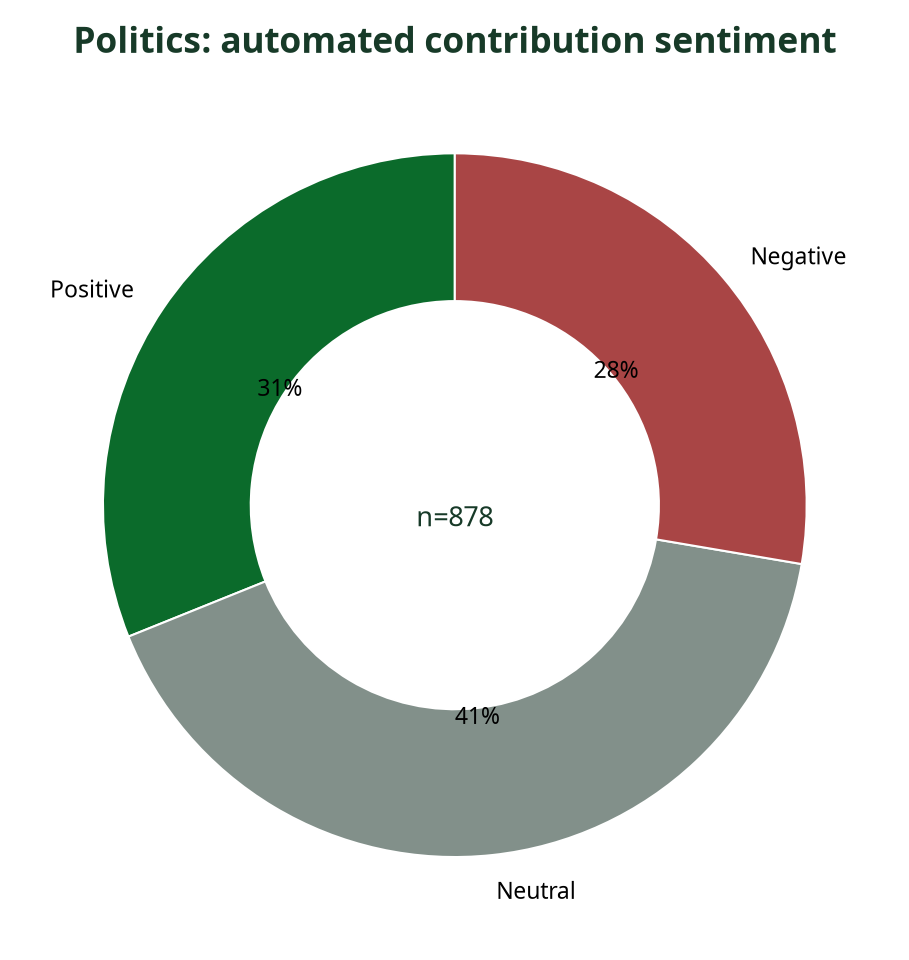
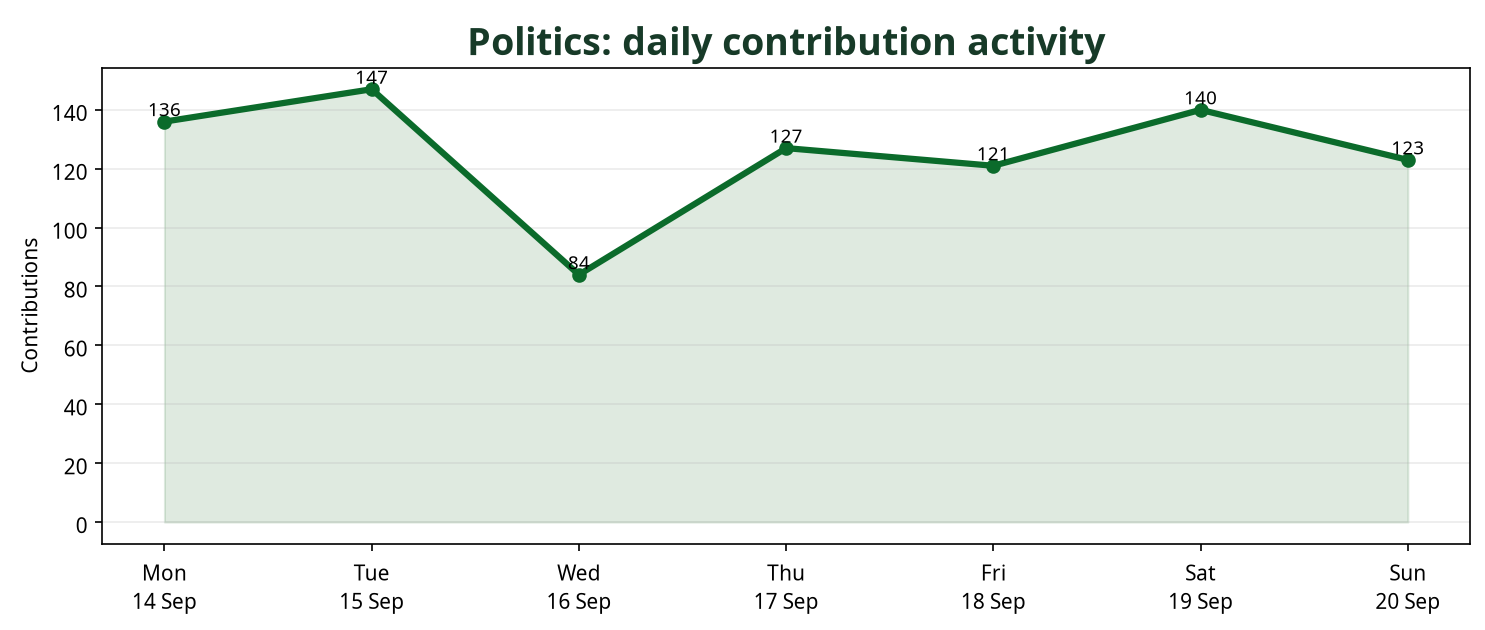
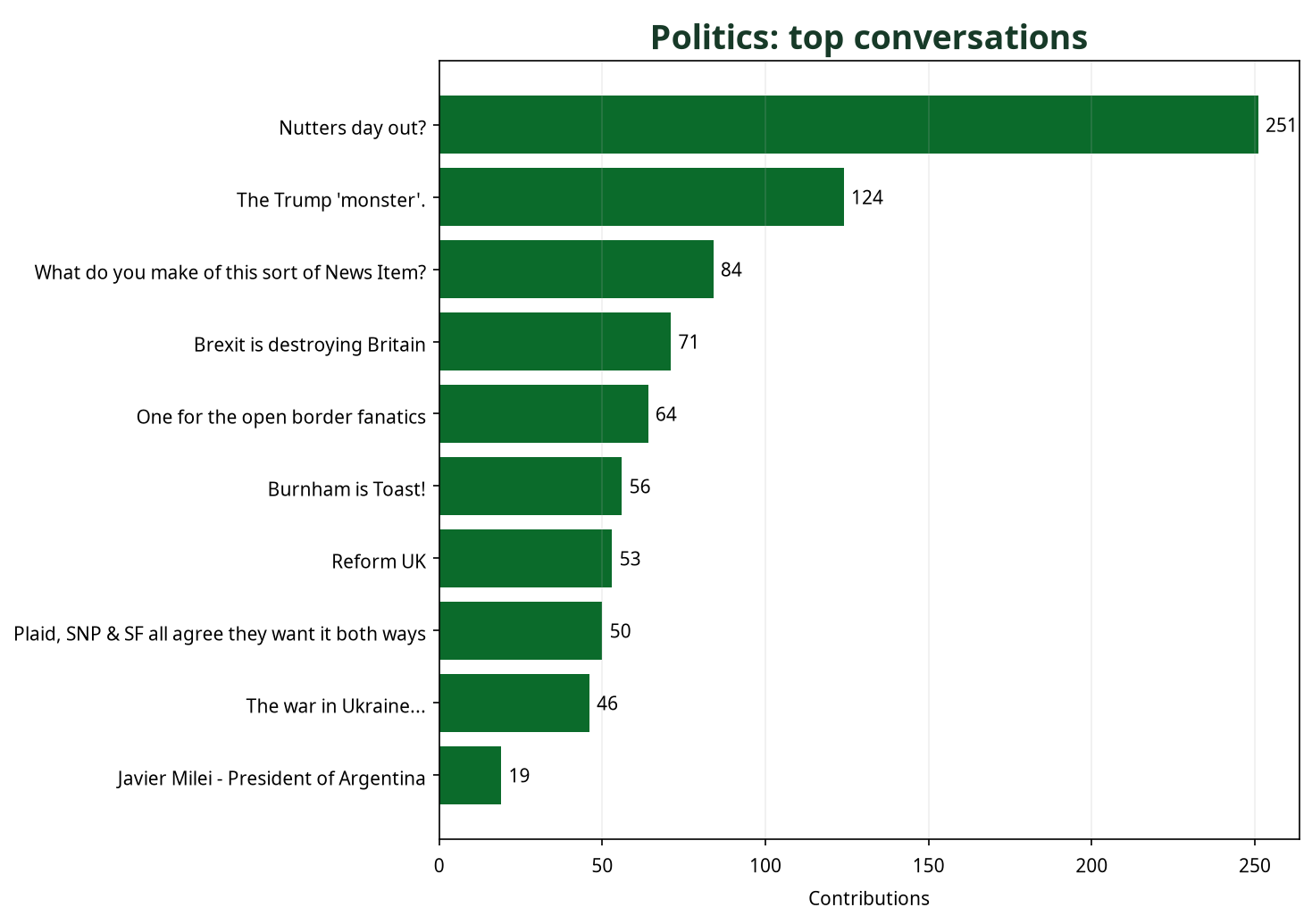
The Politics section recorded 878 contributions across 24 conversations between 14 and 20 September 2026. Four conversations supplying 230 contributions were retained for neutral thematic analysis. They covered interpretations of evidence in the Brexit debate, questions about election timing and party strategy, expectations around political funding and candidate standards, and differing views about devolution and institutional accountability. The source also contained high-volume migration, conflict, medical, legal and allegation-heavy material that was unsuitable for amplification. Those records remain visible in the exact linked table and deterministic charts, but they are excluded from the narrative. The retained material is a record of contributor arguments and perceptions, not a representative survey, verified political analysis or endorsement of any party, public figure or policy position.
—
Conversations at a Glance
| Conversation Name | Contributions | Key Topics |
|---|---|---|
| Nutters day out? | 251 | Other discussion in the source section |
| The Trump ‘monster’. | 124 | Other discussion in the source section |
| What do you make of this sort of News Item? | 84 | Other discussion in the source section |
| Brexit is destroying Britain | 71 | post-Brexit economic debate; interpretation of polling and research; institutional options; public confidence |
| One for the open border fanatics | 64 | Other discussion in the source section |
| Burnham is Toast! | 56 | election timing; party strategy; political accountability; coalition speculation |
| Reform UK | 53 | candidate vetting; party organisation; public trust |
| Plaid, SNP & SF all agree they want it both ways | 50 | devolved powers; institutional accountability; public spending responsibilities; constitutional debate |
| The war in Ukraine… | 46 | Other discussion in the source section |
| Javier Milei – President of Argentina | 19 | Other discussion in the source section |
—
Detailed Conversation Analysis
Brexit debate and the interpretation of evidence
Contributors disputed both outcomes and sources
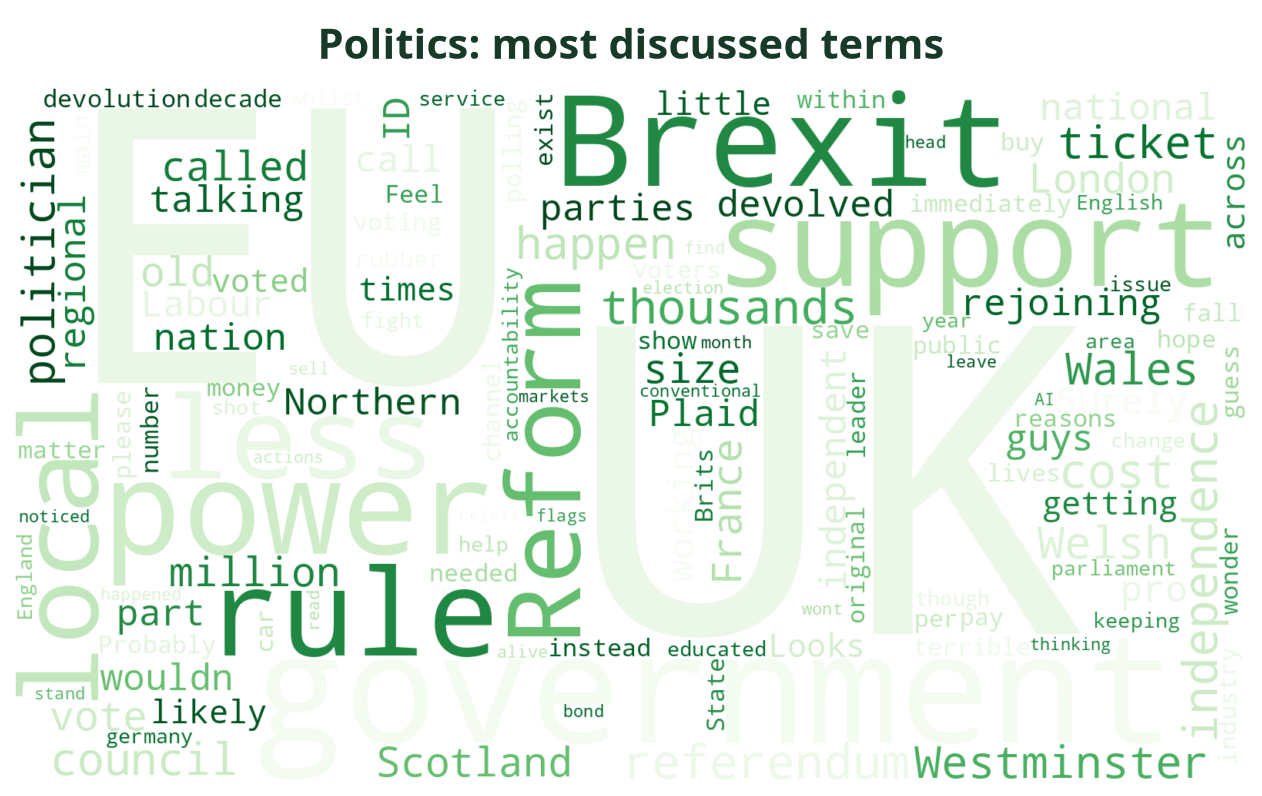
The Brexit conversation generated 71 contributions. Participants debated whether leaving the European Union had harmed the UK and whether closer future relations with European institutions were desirable. A recurring feature was disagreement over how polling, academic research and earlier economic warnings should be interpreted. The thread therefore showed not only disagreement about outcomes, but also disagreement about which evidence should carry weight.
Unsupported claims were excluded from the analysis
The conversation also included contested assertions about migration, currency, individual industries and government conduct. Those claims are not repeated here because the forum material did not establish them. The supported theme is narrower: contributors used different evidence and assumptions to reach conflicting views about Brexit and future institutional choices.
Election timing, party organisation and public trust
Election timing prompted strategic debate
The election-timing conversation received 56 contributions. Contributors debated the possible political advantages and risks of an early election and exchanged views about accountability and party strategy. Some posts treated timing as a question of mandate, while others focused on the uncertainty created by changing political alignments. Economic forecasts, personal criticism and coalition predictions were excluded as unverified or speculative.
Funding and candidate standards formed a separate concern
The party-organisation conversation generated 53 contributions. Participants discussed the transparency of political funding, candidate vetting and the standards expected of party organisations. The source included allegations about named people, disputed quotations and claims about foreign influence, none of which are treated as established facts. The retained theme is contributor concern about organisational standards and public trust.
Devolution and institutional accountability
Responsibility across levels of government was contested
The devolution conversation supplied 50 contributions. Contributors debated the balance between devolved decision-making and UK-wide accountability. They expressed different views about how responsibilities should be understood across national, devolved and local institutions and about the clarity of public-spending accountability. The discussion reflected political preferences rather than a settled account of constitutional arrangements.
Legal and financial predictions were not retained
The thread also contained claims about referendums, fiscal transfers and financial-market consequences. Those assertions were excluded because they were not verified within the source. The evidence supports only a cautious conclusion that contributors were concerned with the visibility of responsibility and held differing views about the appropriate balance between devolved authority and UK-wide institutions.
—
Conclusion
Politics discussion during 14–20 September comprised 878 contributions across 24 conversations, while the safe narrative evidence was restricted to four threads with 230 contributions. The accepted discussions showed disagreement over the evidence used in the Brexit debate, the political implications of election timing, standards around party funding and candidate organisation, and the balance between devolved decision-making and wider institutional accountability. They do not establish policy outcomes, voter intentions or the truth of contested allegations. High-volume material involving migration, conflict, medical claims, personal attacks, legal issues and other inflammatory subjects remained in the exact source record but was excluded from thematic interpretation. The resulting summary identifies the neutral political-process questions that contributors raised during the reporting week without endorsing a party, public figure, constitutional position or forecast.
—
For ongoing updates, readers can follow the active conversations linked throughout this summary.
This summary reflects contributions posted during the stated period. It is not a representative survey and should not be treated as professional, legal, financial, veterinary, agronomic or safety advice.