
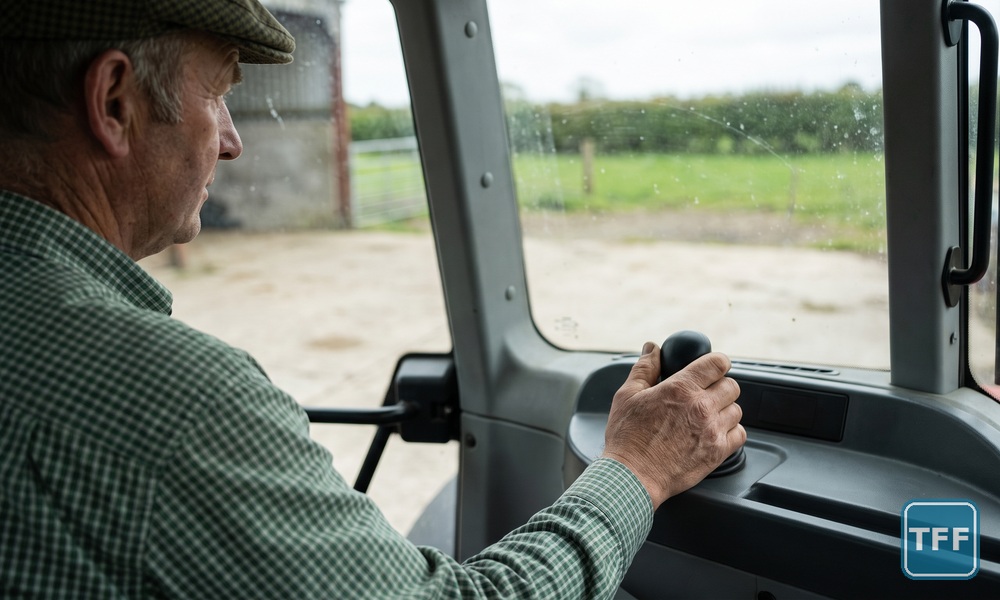
A farmer weighing up a second hand tractor asked a simple question: had anyone moved from John Deere’s conventional AutoPower controls to the CommandPro joystick and regretted it? Two weeks and 113 contributions later he had bought the demonstrator, and the conversation had become a clear account of how control design now splits farm buyers into two camps, defined less by brand loyalty than by who drives the tractor and how often.
By TFF News | 26 September 2026 | Machinery
The conversation ran on The Farming Forum’s Machinery section from 2 to 16 June 2026, drawing 113 visible contributions, 6,141 views and 105 reactions, an average of 0.93 reactions per contribution. As with any self-selected discussion, these figures describe this conversation only and are not a representative survey of the sector.
One question, two control philosophies
The opener runs steep ground and worried about engine braking: “we farm some very steep hills and some say it’s harder to make the transmission engine brake with command pro”. He was happy with his existing tractors but found conventional AutoPower controls hard to find on newer tractors, pushing him towards the joystick whether he wanted it or not. CommandPro, rolled out across the 6R AutoPowr range from 2018, puts drive, hitch, PTO, spools and guidance on a single stick with 11 programmable buttons, as Profi reported at its launch. The programmability is exactly what divides opinion.
Regular drivers learn it and refuse to go back
Among contributors who put a full season into the joystick, conversion stories were consistent. One described his first: “I hated it at first, could of ripped it out and thrown it through the window.” Then: “After about a month I started getting used to it, would never ever go back to the little stick now.” Another was blunter about the payback period: “Command pro for sure, but definitely takes a few hrs to get your head around it, but once you’ve got used it, you’ll never go back”.
The pattern behind the praise was labour structure. A contributor who came to it from New Holland’s equivalent said “if it was a tractor to jump on and drive down the road it wouldnt bother me, but any amount of field work the command pro wins every time”, and later added that “we tend to stick to one tractor each so when you can change between settings for each implement its brilliant for me at least, makes the 14 hour days just that bit easier”.
Employers with mixed fleets see cost and risk
The opposing camp was not nostalgia. It was operational. A contributor running one joystick tractor and two conventional ones summed up the split on his own farm: “In short- I find it a bit of a faff, but for things like drilling and triple mowers, it’s quite nice to use once it’s all set up.” His full time driver requested the same again; the casual users avoided it. Another reported the same divide on a sprayer tractor: “Older worker avoids it like the plague and sticks to the autopower.”
The strongest objection was safety, and it came with an example. One employer described reprogrammed controls dumping three tonnes of potatoes on the floor after a driver remapped the spools for his own convenience: “Driver had swapped blue and yellow round on the screen so he could use the mudguard control to tip the trailer without getting back in with mucky hands.” His conclusion was categorical: “I detest all the customise/personalise nonsense, it makes everything a memory test and its a nightmare unless a one driver only machine.” He returned to the point later in the conversation: “If I need to stop the PTO I press the PTO button, I don’t have to remember what I allocated it to”.
Notably, the criticism was not brand tribal. The same contributor argued that “JD and Ford gathered market share in the 80’s and 90’s by being so utterly idiot proof that anyone could jump on and go, now they’re a memory test mystery machine that makes simple things complicated.” Others turned the same charge on Massey Ferguson’s wake-up sequences, and a Massey user conceded the point while defending Deere’s basic layout: “We could never just put anyone on the 74, but the Deere what you see is what you press, anyone can jump on and get it going.” As a contributor with experience across several makes put it, “Not rocket science but still silly little things to trip up the uninitiated.”
Automation still stops short at the headland
A practical product gap surfaced once the opener had his demonstrator. John Deere’s iTEC headland management automates PTO, linkage and spools in a recorded sequence, but triggers the steps by distance travelled, as Farmers Weekly’s coverage of the system describes. Several contributors wanted the trigger tied to hitch position instead, because headland turns happen at different speeds. One recalled a far simpler machine doing the job: “I had a case twenty years ago and just had a simple auto pto switch, set the height you want it to come on once and never had to touch it again in the 5 years I had it and it worked perfectly everytime.” It is opinion from one farm, but a specific, repeated ask that manufacturers might note.
The hill question got answered in the field
The opener’s original worry, downhill control, was echoed by a sprayer operator: “Touch the brakes and it cuts the transmission. Always seem to be fighting with the joystick to maintain the correct speed.” Another contributor relayed a dealer tip about unlocking the brake pedals; the sprayer operator tried it and reported back, “Pressing the right hand pedal applies the trailer braking and doesn’t cut the transmission.”
The demo closed the sale
The commercial arc matters most for the trade. The opener started sceptical, took a 6R 150 demonstrator, worked through the setup frustrations in public, and ten days in wrote: “Got this here at the moment and don’t think it will be leaving other than to have a loader fitted, I’m sold on command pro.” What won him over was the drivability: “What I like about the command pro though is you can go seemlessly from driving on the pedal to the stick and back again”. Even a contributor who prefers the conventional layout admitted the direction of travel: “I really do prefer standard autopower but I think the next one will be command pro for that reason”.
The unresolved question is the one the opener started with. If conventional control layouts are getting scarce on newer used tractors, the control spec a farm orders today is also a bet on what the next buyer wants in five years, and this conversation suggests the market for jump-on-and-go simplicity has not gone away, particularly on farms with casual and seasonal drivers. As one early contribution put it, “as with all things, personal preference is a large part of the decision, buy what you’re comfortable with”. For dealers, the lesson is simpler: a week’s demonstration converted a sceptic into a buyer, in public, in front of 6,000 readers.
Read the source conversation and analysis
Read the full conversation on The Farming Forum here.
Download the full conversation analysis as a slide deck: Command Pro or Auto Power conversation analysis (PDF).
This conversation had been viewed 6,220 times on The Farming Forum when counted on 1 October 2026. Want your brand in the room when farmers talk machinery? Book advertising with Agri Web Media.