
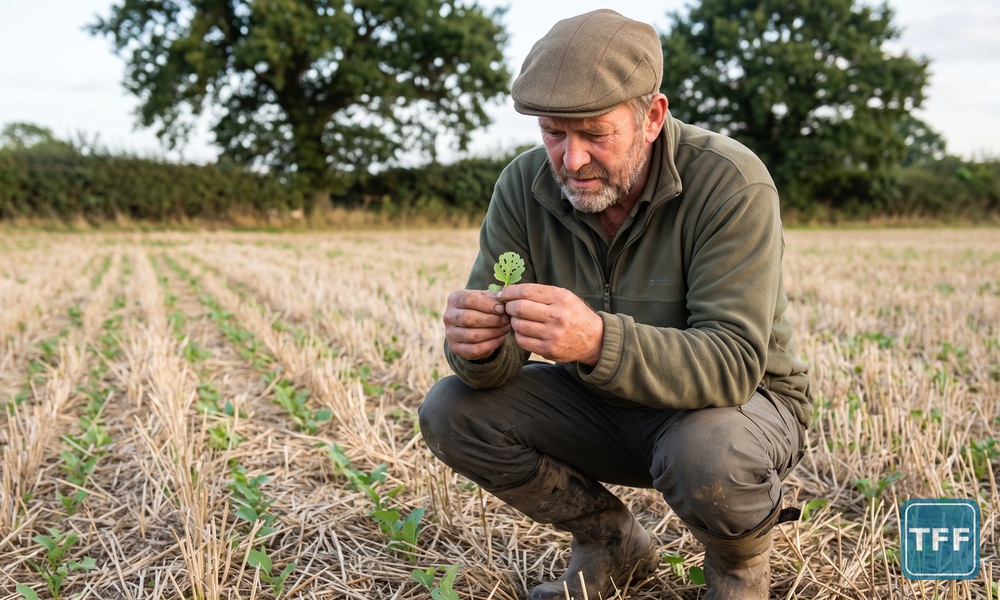
The 30% rebound in the oilseed rape area was meant to be the arable story of the autumn. A conversation on The Farming Forum tells a harder one: cabbage stem flea beetle arrived late and in force, eating through new sowings from Lincolnshire to the Essex coast. Growers describe write-offs from eight hectares to 300, a £15,000 bill on a single field, and a question the trade thought it had put behind it: whether the comeback crop survives its first real test.
By TFF News | 28 September 2026 | Arable
The conversation drew 106 visible contributions and 8,560 views between 6 and 27 September 2026, with 98 reactions at an average of 0.92 per contribution. Contributions ran 23 negative to 10 positive, the rest neutral. These figures describe one conversation; they are not a representative survey of the sector.
A quiet start, then a September siege
The opening week read like an all-clear, with one contributor noting on 7 September “Zero CSFB caught in the AHDB traps so far”. That changed in the second week. From mid Lincolnshire: “CSFB within the last 5 days here in Mid Lincs has exploded to leave crops that were developing nicely under severe pressure. Some have already been re-drilled and some written off.” A Shropshire grower reported the same day that “having had no activity the last few days have seen them arrive on mass.”
The timing fits the pest’s known behaviour. AHDB’s flea beetle guidance puts peak adult migration between late August and mid September, and advises sowing either side of that window. Several contributors who drilled to that plan found emergence stalled by dry seedbeds instead, leaving cotyledons exposed at exactly the wrong moment: “I thought late drilling was the answer to flea beetle?!”
Write-offs from eight hectares to 300
The losses escalated as the conversation ran. It opened with an eight hectare field in trouble and headed for a redrill. By the final weekend, one grower had abandoned a 38 hectare field after two sowings, two rollings, repeat insecticide and a buckwheat companion crop: “Well, it wasn’t for lack of trying, but it’s cost me somewhere around £6,500 in seed, £2,850 in DAP, 2 full sprays, 1 cultivation (Terrano), 2 sowings, 2 rolls. Roughly £15k+ written off.”
Another contributor answered with a figure that dwarfs it: “Ive written off 300ha.” He is salvaging what he can, with seed on payback deals and the fertiliser carried into following crops, but ended plainly: “Its pretty distressing though.”
Those still holding damaged crops were warned the beetle is only half the bill: “You are no where near past the ‘total loss stage’ larvae will do as much if not more damage than the beetle. Been there, done that, got the t shirt, along with a 100k hole in my budget!” Another contributor was briefer: “Don’t grow OSR anymore after losing 70 acres few years ago.”
The comeback question
Behind the damage reports sits the season’s bigger commercial story. AHDB’s Early Bird Survey forecast the harvest 2026 oilseed rape area at 316,000 hectares, up 30% on 2025’s 42-year low of 243,000, driven by a better margin outlook than cereals and good 2025 yields. The conversation shows that logic at work, and the doubt underneath it: “I dont understand people going back to OSR. The reason we all had to stop growing it was because of the devastation caused by csfb. That risk hasnt gone anywhere!”
The defence of the crop was put in margin terms: “Show me a break crop other than SFI that shows a margin higher than 30 cwt/acre of osr north of £400/t.” But after three weeks of beetle pressure, one adviser contributing to the conversation predicted the swing would not hold: “OSR area will be back down next year.”
Seed rates: the old textbook is dead
The busiest strand of the conversation, 24 contributions, was a running revolt against decades of low seed rate advice. AHDB’s guidance recommends around 50 to 60 seeds per square metre to build plants that tolerate larvae. Several contributors now treat seed as insurance and go further: “We drilled 9.5kg Ha last year of Campus HS. Every seed grew. 4.7t/ha over the weighbridge. Better than hybrids grown at 50 seeds.” That is one farm’s own record, not a trial result, but the mood was widely shared: “The theory of low rates is good, but it’s just not realistic now with the pests.” The grower behind the 9.5kg rate reduced the debate to one line the seed trade should note: “Establishment is 95% of it, everything else is window dressing (and that includes variety, fungicides etc)”
What growers say still works
Amid the frustration, the conversation audited the cultural toolbox. On post-harvest cultivation of rape stubbles, one contributor argued: “There is only been one thing that has firm evidence in reducing flea beetle migration and that is to cultivate rape stubbles asap after harvest.” The evidence backs him: AHDB reports trials in which shallow cultivation cut emerging beetle numbers by 49% to 85%, and deeper cultivation by up to 98%. Another contributor reported all three neighbouring rape growers had cultivated their stubbles after harvest. It did not save his crop.
Direct drilling into long stubble drew repeated support as camouflage for seedlings, summed up as “The longer the stubble the better.” The most unexpected finding was mechanical: two growers rolled crops under severe attack as a last resort, both reported feeding easing, and one concluded: “but what I have learnt is that rolling osr when it’s small won’t kill it.” Neither claimed proof, and another contributor promptly asked for volunteers to run it as a proper trial.
The chemistry vacuum
Running under everything is the absence of effective chemistry. AHDB describes pyrethroid resistance in the beetle as widespread in England, and contributors treated sprays as an anti-feeding stopgap at best. The grower who lost the 38 hectare field traced his loss to the seed treatment ban directly: “All for want of a neonic seed treatment.” Others pushed back on the idea that the old dressings would still be working: “Resistance had started to be picked up before they banned it here”.
The Cruiser SB question surfaced too, with one contributor observing: “The Labour government won’t licence Cruiser in beet any more so it is effectively banned.” The verified position is close to that: Defra refused the emergency authorisation for Cruiser SB on sugar beet in January 2025, citing pollinator protection, and pointed growers towards resistant varieties and integrated pest management instead. Nothing in that decision suggests a route back for oilseed rape.
What the trade should watch
For the input trade this conversation is a ledger of doubled seed orders, insurance sprays and redrill decisions, and of who carries the risk when they fail. Seed sold on payback deals, and whether those deals are honoured, was raised directly. One contributor described the month simply: “It’s incredibly stressful watching a crop disappear!” The unresolved question lands in February, when larvae counts decide whether the crops that survived September were worth keeping, and whether the 316,000 hectare comeback holds. The answer will shape seed, chemical and fertiliser demand for autumn 2027.
Read the source conversation and analysis
Read the full conversation on The Farming Forum here.
Download the nine-slide conversation analysis deck (PDF).
This conversation had been viewed 9,013 times on The Farming Forum when counted on 1 October 2026. Want your brand in the room when farmers talk arable? Book advertising with Agri Web Media.