Weekly Summary: Business Section
Date Range: 21st – 27th September 2026
—
Executive Summary
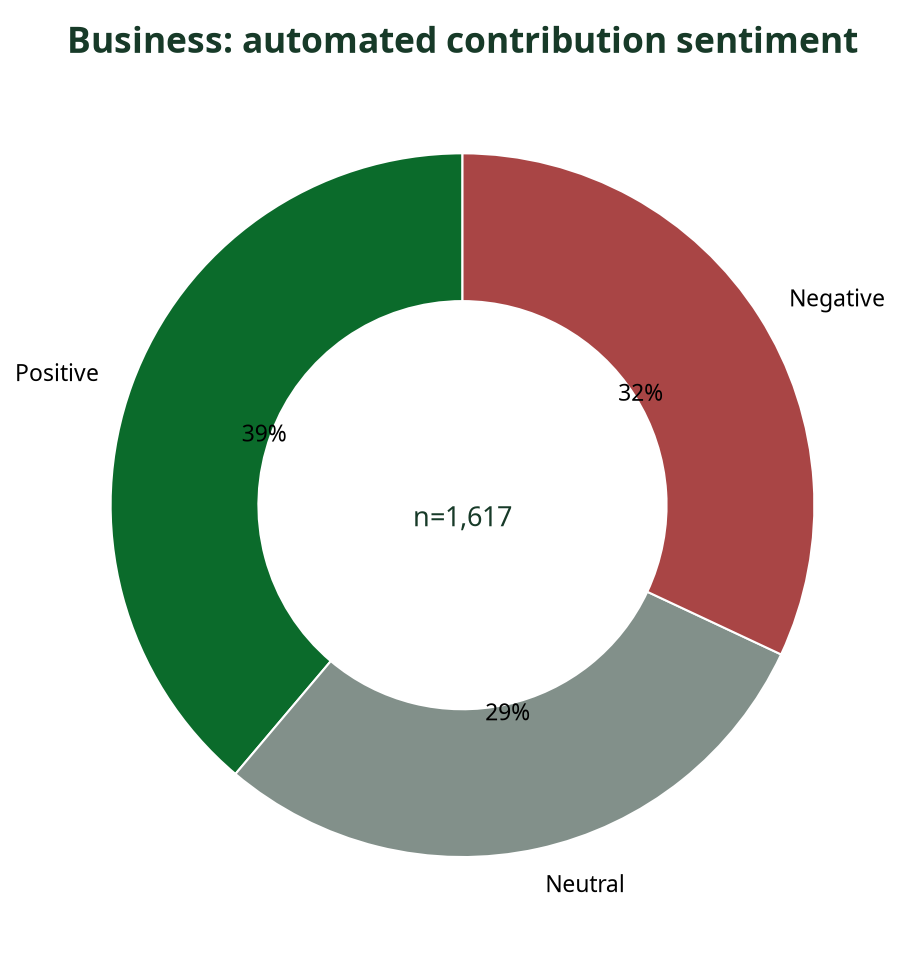
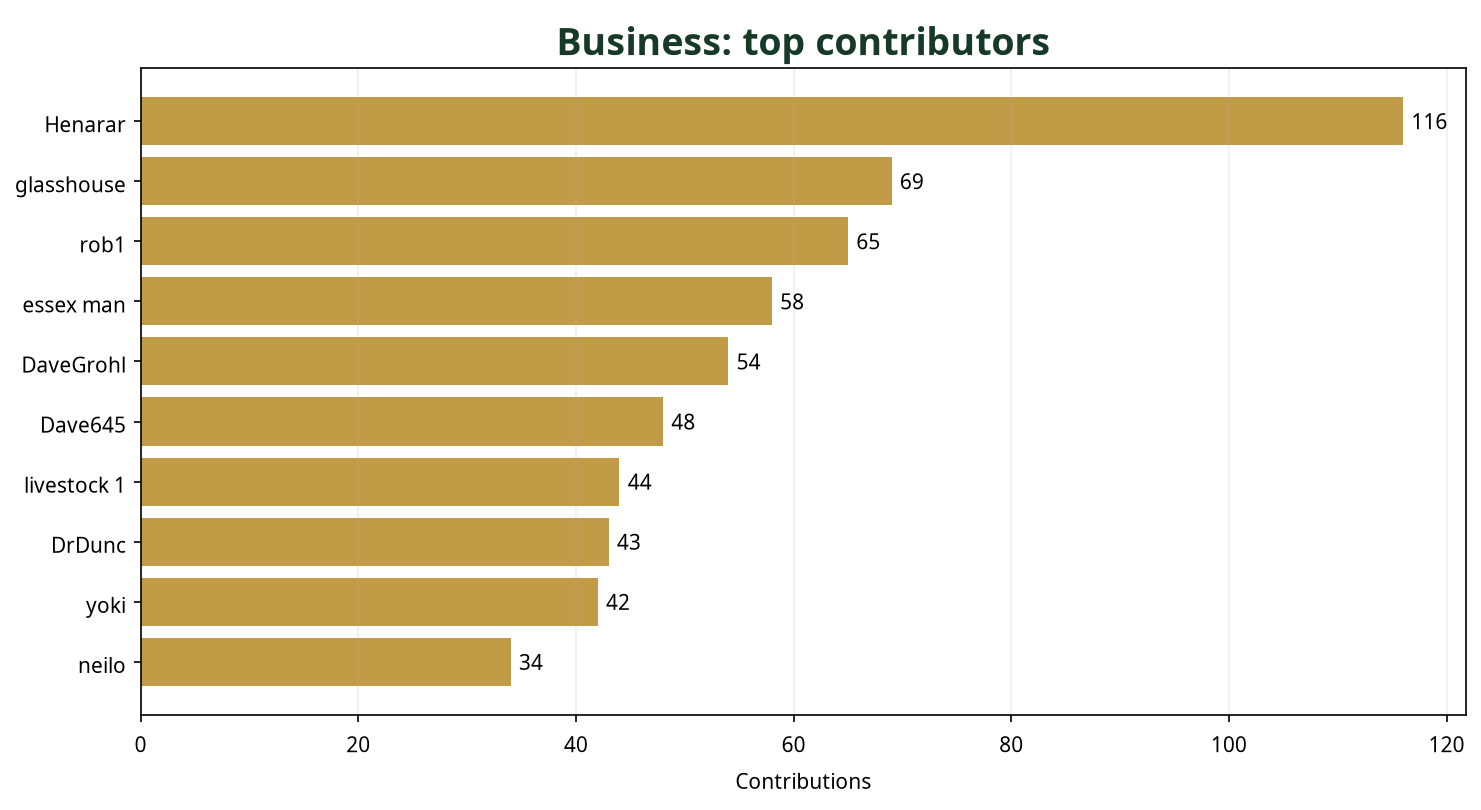
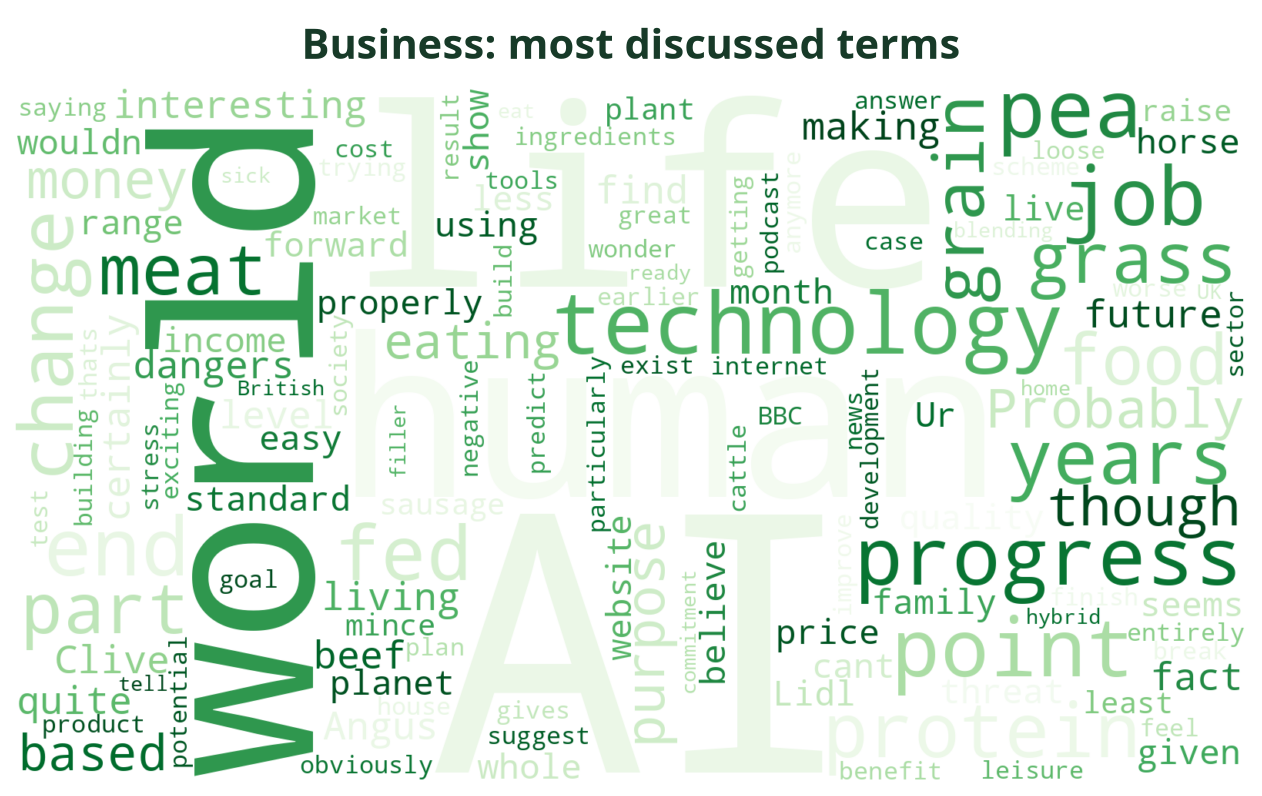
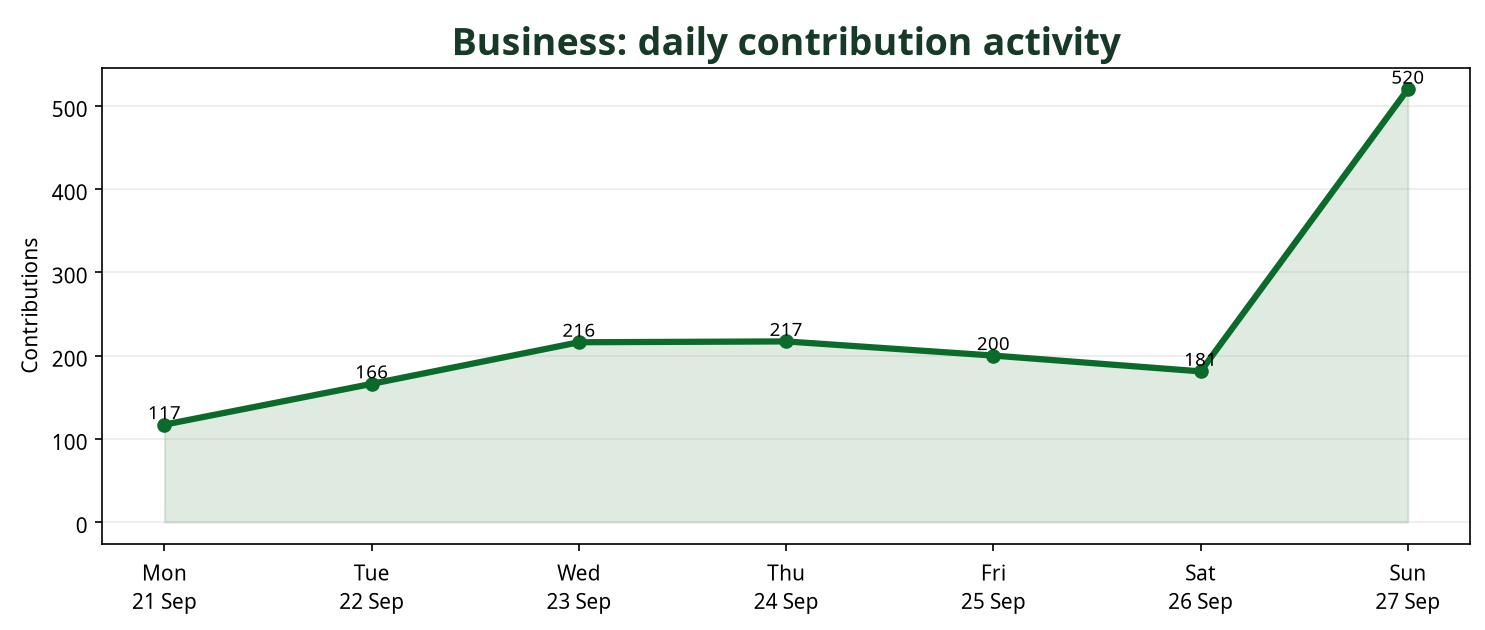
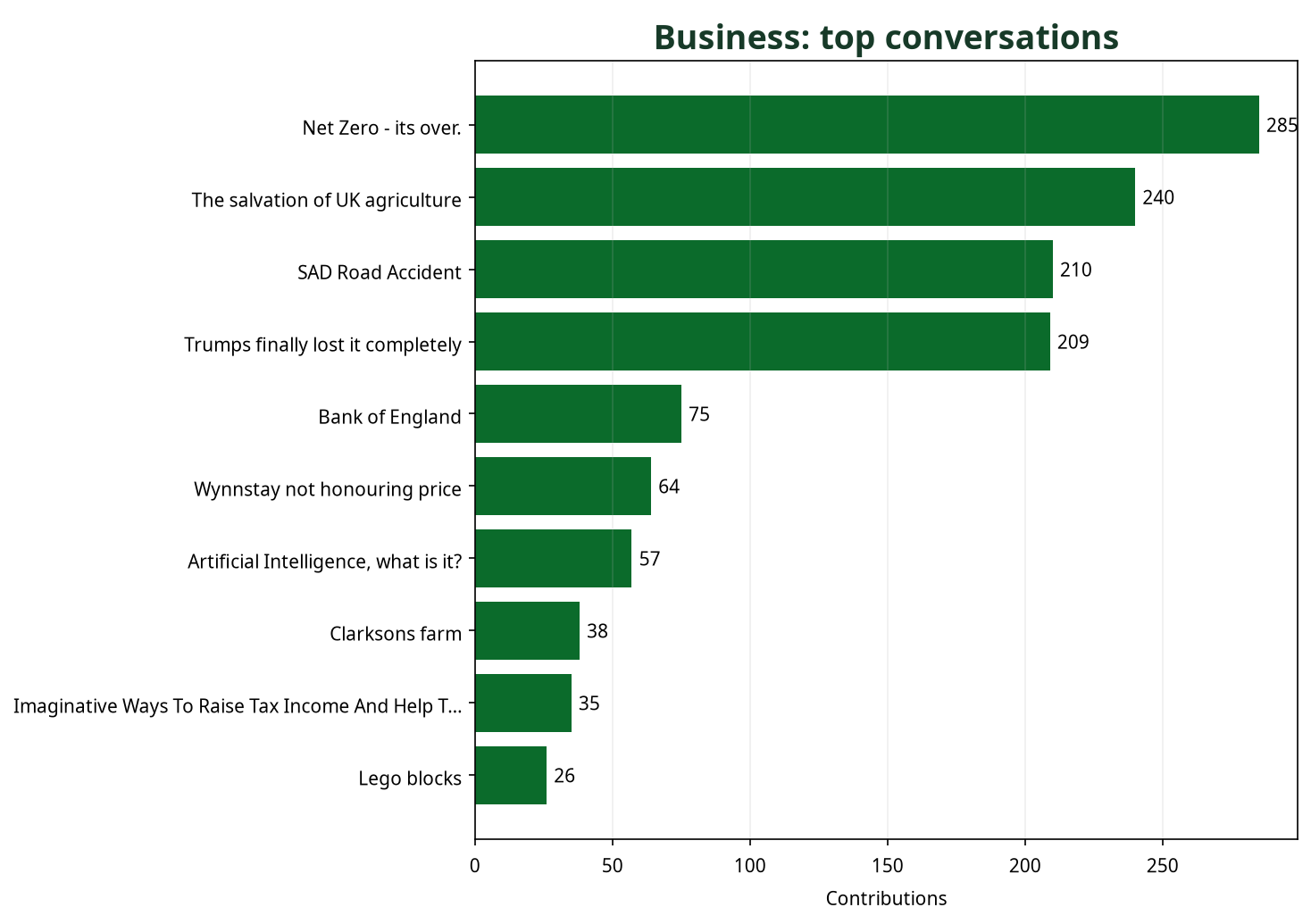
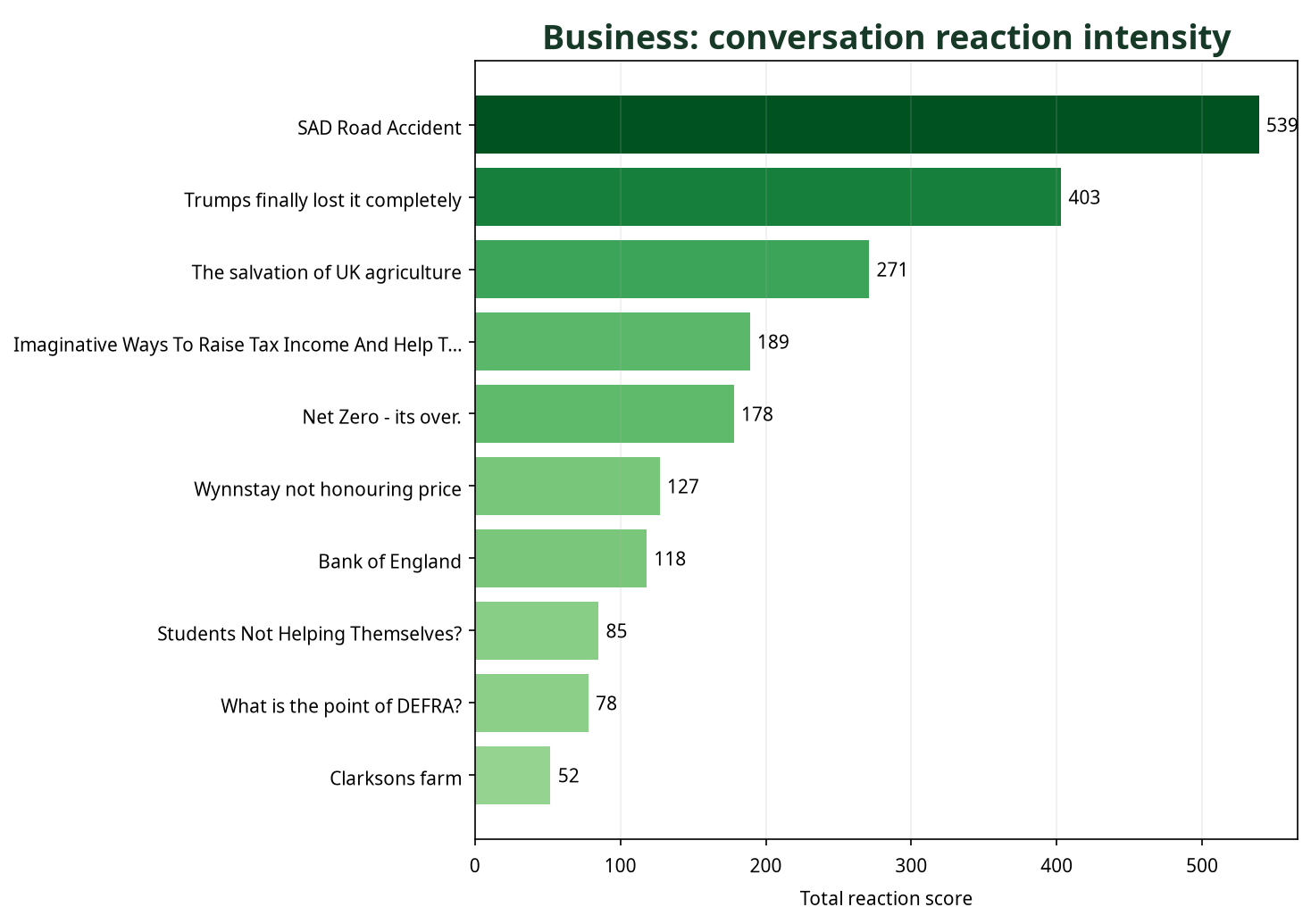
The Business section recorded 1,617 contributions across 81 conversations between 21 and 27 September 2026. The majority of the leading records concerned politics, accidents, disputes, tax, personal matters, health or other sensitive subjects and remained below the 0.65 confidence threshold after the permitted GPT-5 fallback. They are preserved in the exact activity table and charts but excluded from narrative analysis. Two discussions provided a sufficiently supported and neutral business lens. A 57-contribution thread considered current uses of artificial intelligence, the limits of present tools and the importance contributors placed on experienced human oversight. A 23-contribution food discussion examined how product composition, labelling and provenance can shape consumer perceptions of value and trust. Both threads were anecdotal; speculative technology forecasts, employment projections, health claims, brand allegations and product-performance judgments were removed.
—
Conversations at a Glance
| Conversation Name | Contributions | Key Topics |
|---|---|---|
| Net Zero – its over. | 285 | Other discussion in the source section |
| The salvation of UK agriculture | 240 | Other discussion in the source section |
| SAD Road Accident | 210 | Other discussion in the source section |
| Trumps finally lost it completely | 209 | Other discussion in the source section |
| Bank of England | 75 | Other discussion in the source section |
| Wynnstay not honouring price | 64 | Other discussion in the source section |
| Artificial Intelligence, what is it? | 57 | current business use of AI; capability limits; skills and oversight; uncertainty about future effects |
| Clarksons farm | 38 | Other discussion in the source section |
| Imaginative Ways To Raise Tax Income And Help The Environment | 35 | Other discussion in the source section |
| Lego blocks | 26 | Other discussion in the source section |
—
Detailed Conversation Analysis
AI use in current business activity
Productivity claims and capability limits
A 57-contribution discussion explored what artificial intelligence currently means for users in business and technical work. Some contributors said that AI could accelerate parts of digital development or reduce the time required for routine tasks, but those reports were personal observations rather than measured productivity studies. The accepted evidence also stressed that current tools still require experienced review and do not replace professional judgment. Claims about broad cost savings, workforce substitution or investment returns were excluded. The retained theme is cautious experimentation with tools whose useful scope and limitations are still being assessed by individual users.
Skills, oversight and uncertainty
Separating present experience from speculation
The AI thread mixed reports of present-day use with much broader speculation about future technical and social change. For this report, only the former is treated as narrative evidence. Contributors raised questions about maintaining skills, checking outputs and understanding where automated systems may be unreliable. They also differed sharply over the pace and scale of future effects. Assertions about uncontrolled systems, economy-wide job losses or sweeping social outcomes were excluded because the forum record does not verify them. The discussion therefore indicates uncertainty and interest, not a settled forecast for agricultural or rural businesses.
Business governance questions
Participants repeatedly returned to human responsibility for deciding how AI-generated work is used. The source supports a general observation that contributors valued oversight, clear accountability and knowledge of a tool’s limits. It does not establish a compliance framework, data policy or recommended implementation plan. Detailed claims about security, regulation, legal liability and workforce planning were not used. The thread is best understood as a peer discussion about how businesses might evaluate an emerging technology while retaining human checks, rather than as evidence that a particular adoption strategy will improve performance.
Product composition and consumer response
Labelling, provenance and perceived value
A 23-contribution food discussion considered how contributors reacted to a blended meat product. The accepted evidence was limited to opinions about composition, labelling, provenance and eating-quality expectations. Views differed, and the conversation did not constitute product testing or a representative consumer survey. Brand-specific criticism, allegations about hidden information, health assertions and claims about farming-system effects on flavour were removed. The supported business theme is that product description and provenance information can influence how participating consumers interpret value and trust, without establishing a wider market response.
Evidence limits across wider Business activity
Ranking remains separate from interpretation
The week’s most active Business conversations included contentious political, accident, finance, dispute and tax material. Some source files also contained unrelated promotional and health-product spam. Exact conversation titles, links and contribution counts remain visible in the activity table where required, while unsafe table topics are neutralised. Those records were not converted into analysis merely because they attracted large volumes. This separation allows deterministic reporting of what was active while preventing allegations, discriminatory language, legal or financial advice, personal information and unsupported market claims from entering the editorial narrative.
—
Conclusion
Business activity during 21–27 September was high in volume but narrow in safely usable evidence. The accepted discussions showed contributors testing the boundaries of current AI tools and debating how product information affects consumer perceptions. AI comments supported cautious conclusions about experimentation, capability limits and human oversight, but not forecasts of widespread job displacement or guaranteed productivity gains. Food-product comments supported a limited theme around composition, labelling, provenance and trust, but not health, legal or product-performance claims. All other leading records were excluded from interpretation when confidence remained below threshold or the subject matter carried political, personal, safety, financial or reputational risk. The report is therefore a transparent, non-representative account of two supported discussion themes rather than a market forecast, technology strategy, legal assessment or business recommendation.
—
For ongoing updates, readers can follow the active conversations linked throughout this summary.
This summary reflects contributions posted during the stated period. It is not a representative survey and should not be treated as professional, legal, financial, veterinary, agronomic or safety advice.