
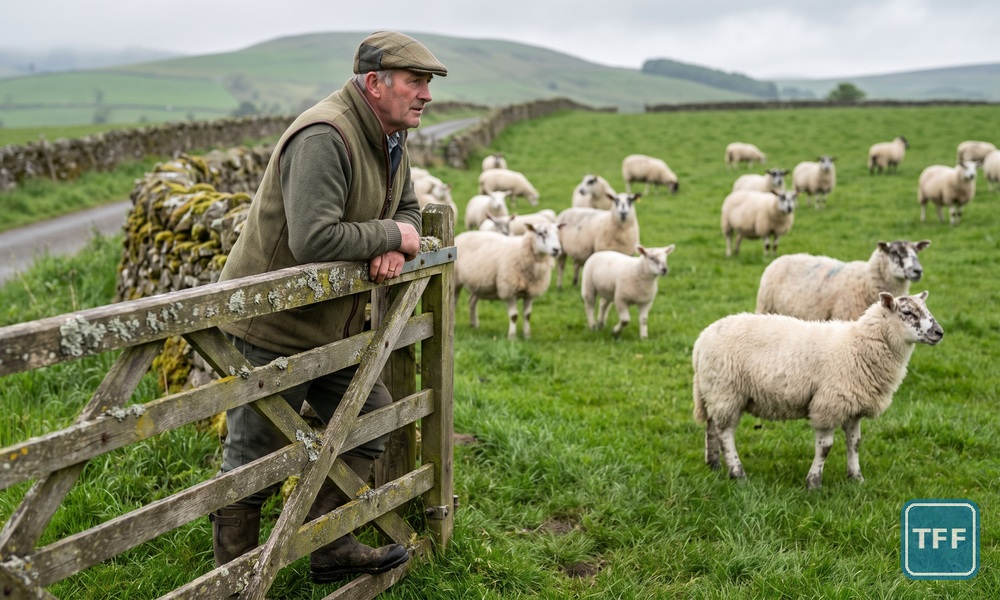
When a Scottish flock asked The Farming Forum whether a crossbred tup on crossbred ewes could breed his own replacements, given what breeding females now cost, the verdict came back fast and it was blunt. What followed was a genetics seminar, a shortlist of crosses that do stack up, and a commercial row over what the name on a sale ticket promises the buyer.
By TFF News | 4 October 2026 | Livestock
The conversation drew 115 visible contributions, 4,021 views and 305 reactions between 18 and 25 May 2026, averaging 2.65 reactions per contribution. The figures describe one conversation among the farmers who chose to join it; this is not a representative survey of the sheep sector.
The arithmetic pushing buyers to ask
The opening contribution put the question plainly: “Has anyone used a greyface (mule) tup on greyface ewes to breed your own replacements Given the runaway trade for gimmers?” The same contributor reported the spring trade that prompted it: “At stirling sale today, gf hoggs with lambs up to £200 /life”.
One contribution worked the sums, treating a hogg with a lamb at foot as a breeding female bought near fat lamb money: “even at £130-£140 for the fat lamb when sold your paying £200-£210 for the female which will be cheaper than gimmers in August. Alright bit of cost in getting it there but cheaper than £280-£300 which is what gimmers could be.” The opener was unconvinced by spring buying at those levels: “Paying that sort of cash at this time is a fools errand.”
The autumn sales have since proved the direction of travel. At the North of England Mule Sheep Association sale at Hawes on 16 September 2026, 18,626 mule gimmer lambs averaged £209.01 with a top pen at £820 a head, in what Farmers Guardian reported as a flying trade. Replacement cost is no longer a line item commercial flocks can wave through.
A blunt verdict on breeding mule to mule
The breeding answer was close to unanimous. One contribution summarised it: “breeding a Mule back onto another leaves you with mongrels – some look like Mules, some look like Blackies.” Another spoke from observation rather than theory: “any time I have seen a mule on mule it has happened by mistake and it has thrown lambs varying from things that resembled blackies to BFL and everything in-between.”
A contributor who used to breed Greyface ewes and formerly taught genetics explained why: “Hybrid vigour only goes 1 generation F1.” She warned that the occasional standout from such a mating proves nothing: “It is possible with mongrel cross-breeding and inbreeding to get a super specimen. Blazingly outstanding in all respects. And almost certainly unable to pass any of them on because they came from weird and random combinations of recessive factors.”
The science backs the contributors. SRUC sheep geneticist Dr Jo Conington has described hybrid vigour as a non-additive part of performance that is not passed on in full to the next generation, with first-cross animals showing around a 12 per cent gain in maternal traits and uniformity worsening in the second cross, in Farmers Weekly’s examination of crossbred breeding. The same logic reached composite cattle in the conversation, with the ex-geneticist noting of stabiliser-type breeds: “The theory is that after many generations of selecting uniform offspring that don’t favour either parent, you’ve created a new breed. And lost your hybrid vigour in the process. Mule breeders know this.”
What self-breeders would use instead
Rejecting the crossbred tup did not mean rejecting self-bred replacements. Alternatives came quickly: “Doesn’t work, Cheviot tup would be a lot better” from one contributor who had lambed shearlings bred that way, and “Why not use NZ Texel or Suffolk on the Mules to breed replacements. Or if you want hardier Lleyn, Romney or Cheviot.” Another kept it to five words: “Texel x Mule is a good ewe”.
For hill ground the Lleyn cross Blackface drew the warmest testimony: “Lleyn cross blackie are a tough productive ewe in my experience.” A former breeder of the cross called it “a very hardy ewe and excellent forage converter on a poor/unimproved grass hill. And the Texel lambs off them always sold well.” The ex-geneticist offered the opener a route that keeps hybrid vigour without leaving his existing genetics: “why not put an unrelated type blackie on your GF’s. I think you’d be breeding in hardiness without creating an all sorts breed from going to a different breed tup.”
The name on the sale ticket
The largest single strand of the conversation, 48 contributions, was an argument over what a greyface actually is, and it ran hot enough that several exchanges turned personal. Beneath the heat sits a real commercial point about what buyers think they are bidding on. One contribution set out the traditional line: “On this side of the Irish Sea a Border Leicester crossed with a Blackie is a ‘Greyface’ and a Blue Leicester crossed with a Blackie is a ‘Mule’.” That matches the breed societies: Farmers Weekly describes the Scotch Mule as the Bluefaced Leicester cross out of Blackface ewes, while the Border Leicester society lists the Greyface ewe among its own recognised crosses.
In the rings the labels blur. One contribution reported that “H&H certainly use the code gf on invoices for mule sheep”, and another that “there are one or two breeders down here in Devon putting a Cheviot tup on a mule and describing the ewe lambs as Cheviot Mules!” The Irish contributor argued the true Greyface is scarce for a reason that should interest ram breeders, blaming “the current trend towards men using mongrel bred so called ‘Blue Leicester rams’ chasing coloured heads and height has resulted in producing mules that are too fine boned and not having the same robustness of the Greyface ewe.” These are contributors’ opinions of a breeding fashion, not findings about any named business, but the demand signal is clear: buyers say they would pay for the older, plainer type if anyone still bred it.
The question left with the trade
Nobody in the conversation defended breeding a crossbred to a crossbred, yet nobody disputed the pressure behind the question either. As one contribution put it, the whole system rests on a happy accident: “The first ever cross of a blackface ewe and a blue headed Leicseter tup must have been an accident I reckon but what a cracking mother they are”.
The unresolved question is for the breeding trade itself. The stratified system survives because the first cross is worth paying for, and this conversation shows commercial buyers testing every way around the price of it. If gimmers hold at this autumn’s records, the names, the codes and the crosses that promise a cheaper replacement female all become live commercial territory for ram breeders, auction marts and breed societies alike.
Read the source conversation and analysis
Read the full conversation on The Farming Forum here.
Download the nine-slide conversation analysis deck (PDF)
This conversation had been viewed 4,021 times on The Farming Forum when counted on 4 October 2026. Want your brand in the room when farmers talk livestock?
Book advertising with Agri Web Media.