
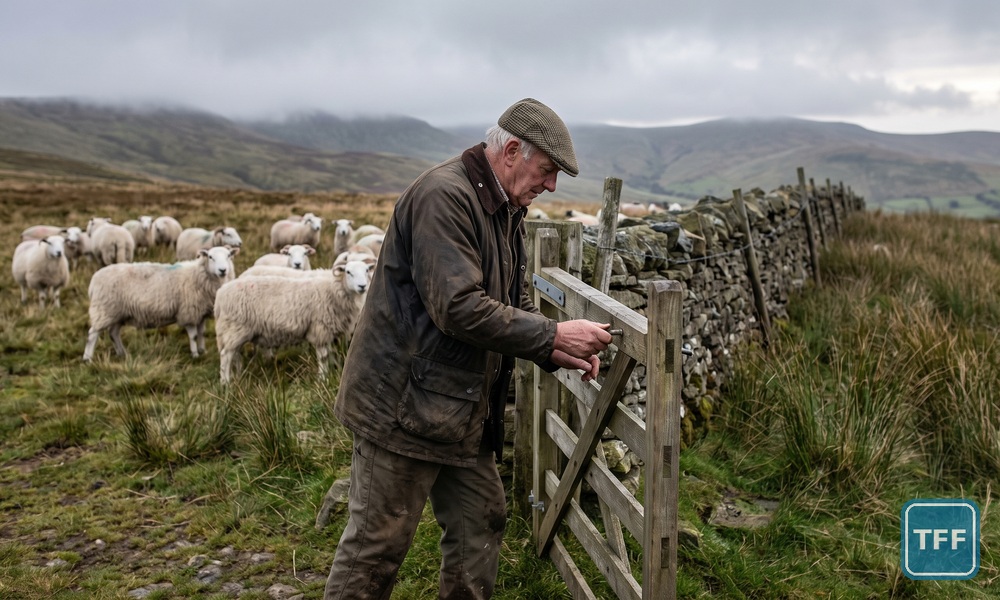
A hill farmer with 450 breeding ewes asked The Farming Forum a blunt question this week: how do you keep a small upland flock going when the support money stops? His Countryside Stewardship Mid Tier agreement ends in December, his Sustainable Farming Incentive application missed the September window, and the farm is about to lose £15,000 a year. What followed tells the trade where upland customers plan to spend, and where they plan to stop.
By TFF News | 3 October 2026 | Livestock
The conversation drew 129 visible contributions between 29 September and 3 October 2026, and had been viewed 3,831 times on The Farming Forum when counted on 3 October. Contributions attracted 423 reactions, an average of 3.28 per contribution. These figures describe a single conversation among the farmers who chose to take part. They are not a representative survey of the livestock sector.
A £15,000 hole and a decision to press on
The opening contribution set out the position plainly: a small owned hill farm on severely disadvantaged area land, and the agent’s SFI applications unfinished when the window closed.“I don’t want to give in , we spent a small fortune building the farm up from scratch but we are effectively losing £15k p/a after December.” His answer was to carry on, use the farm’s moor rights and do every job except shearing and baling himself.
The timing is cruel. Defra’s own Window 2 figures show 72 per cent of the roughly 12,200 September applicants held an agri-environment agreement expiring by February 2027, exactly the group this farm belongs to. One contributor who did get in offered hope: “you’re mid tier/sfi situation may not be as bad as you speculate”, pointing to a possible further window next year.
Others saw a longer arc. “Subs are going, just a matter of how slowly (& painfully) they get phased out”, wrote one experienced sheep voice, and another recalled being warned at decoupling, twenty years ago, that direct support would one day be withdrawn. The opener went further than most would expect: “To be honest and again unpopular.., ditch all the subsidies or make them fair.”
Official forecasts give the exchange weight. Defra’s Farm Business Income forecast of 8 September puts average 2025/26 income on Less Favoured Area grazing livestock farms at £37,000, down 8 per cent despite livestock output forecast up 13 per cent, a fall driven by the delinked Basic Payment and lower agri-environment income. Precisely the hole this conversation is about.
The profitability argument nobody settled
The largest strand, 38 contributions, argued over whether sheep pay at all. “I doubt there are many farmers making a profit from sheep without some sort of nature money or diversification, even with prices as they are.” drew an immediate challenge: “Lamb price has been excellent for a few years now…just need to keep costs ( including labour) to an absolute minimum”.
Two observations cut through. “What’s noticeable with sheep farming is the majority of people I know have a second job.” And the most-agreed-with line of the conversation: “The other thing to remember is that having the farm means a lot of living costs are paid through the farm instead of from after tax income”, to which another replied “To be quite honest if it wasn’t for that, farming would be a non starter.” Even the good news, wool at a pound a kilo, was costed back to nothing once gathering and haulage were counted; the figure is real, with British Wool projecting core types above £1/kg for 2026 after a 70 per cent rise last year.
Fixed costs do not shrink with the flock
Fifteen contributions itemised the overheads that stay whatever the ewe count does. “Insurance always double RPI uplift. MTD means I have to “rent” software and that’s now £40 a month – that’s half a suckler calf just for that”, wrote one suckler keeper. That line is coming for much of the customer base: Making Tax Digital for Income Tax became mandatory from 6 April 2026 for sole traders with qualifying income over £50,000.
The opener put his own books on the table: “We did a rough guesstimate of outgoings last night .. nearly £22k it’s frightening.”, with £5,000 of that insurance and £1,900 of bluetongue vaccine, against income from lambs, culls and support he said has run at about £44,500 a year.
Feed the lambs or sell them cheap
The sharpest commercial exchange, 22 contributions, was about hill lambs averaging £70 as stores while AHDB’s England and Wales store average ran at £108 a head in late August. “I’m not being funny but if you’re only averaging £70 for stores this year then you can feed a hell of a lot to make them better sheep.”, wrote a lowland finisher who feeds 2,000 lambs a year on pellets.
The arithmetic was laid out in the open: “tonne of pellets £300, finished lamb £3/kg at 7-1 conversion ratio it costs £2.10 tp put a kilo on a lamb so your getting 90p/kg back for those kilos gained if you sell at £3/kg.” Against the cost-cutting instinct stood a plain warning: “Personally I think cutting feed back is a false economy.” By the end, the opener, long proud of selling grass-fed stores, had three tonnes of fattening pellets in the shed and 40 lambs inside as an experiment. More upland lambs will be fed this winter than their owners planned in spring.
Redrawing the system: lambing, selling, improving
The rest was a working audit of system change. Outdoor lambing to cut straw, labour and concentrate was the biggest move: “If you can rotationally graze, a pre-lambing graze saves feeding concentrates. It’s almost free grass, as it responds to the grazing and comes back very quickly.” A caveat came with it: “Also remember lambing outside requires dryish fields. That and the current obsession from the public to interfere has stopped outdoor lambing for us.” On marketing, contributors pressed the opener to benchmark his private buyer against the live ring: “I would put a pen of the best, worst and Middle into a market and see how he compares.” On the land, spend narrowed to provable return, led by phosphate correction, lime and rush control.
What the trade should take from it
This is what the end of area payments looks like from inside a hill flock: not an exit but a line-by-line re-costing of everything the farm buys. Feed becomes an investment tested against the conversion ratio, fertiliser narrows to products that prove themselves, and marketing loyalty is suddenly negotiable. The unresolved question: when a well-run hill farm loses a third of its income in December, do its suppliers, marts and hauliers lose a customer, or keep a leaner, sharper one? “You are not obliged to fill Supermarket shelves at your expense and there is no point in working yourself to death trying to.”, as one contributor put it.
Read the source conversation and analysis
Read the full conversation on The Farming Forum here.
Download the full conversation analysis as a slide deck: Sheep farming after subsidies: conversation analysis (PDF).
This conversation had been viewed 3,831 times on The Farming Forum when counted on
3 October 2026. Want your brand in the room when farmers talk livestock?
Book advertising with Agri Web Media.