
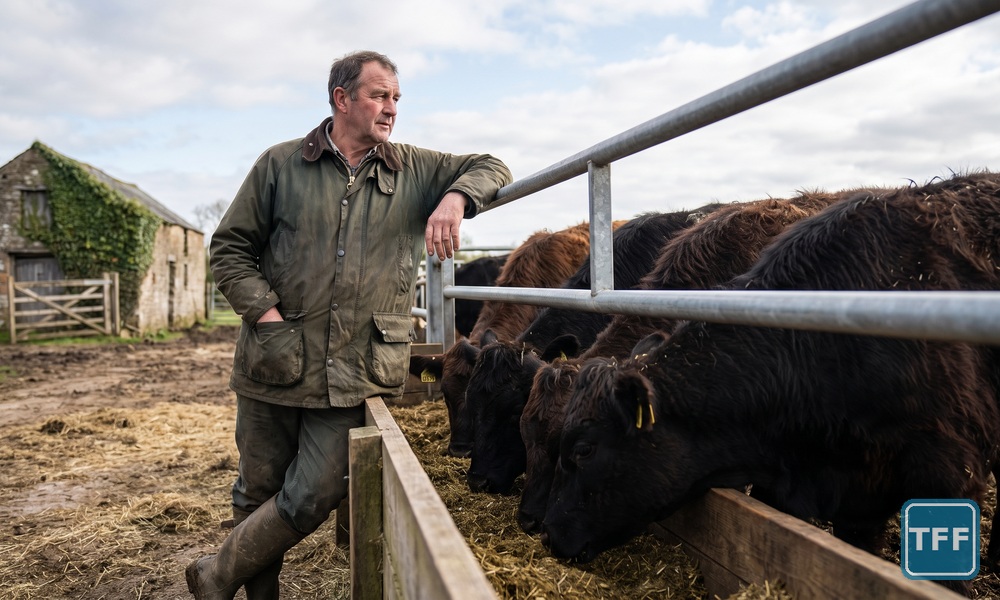
A beef price that had just dropped 20p in three weeks was all it took. In early May a livestock farmer asked The Farming Forum whether anyone else was fed up with not earning money, and the conversation that followed audited the mood of an industry at a strange moment: record livestock returns, collapsing arable incomes, and a room that agreed on almost nothing except keeping its hands in its pockets.
By TFF News | 9 October 2026 | Business
The conversation ran from 5 to 10 May 2026 in the Agricultural Matters section and drew 210 visible contributions, 12,836 views and 1,023 reactions, an average of 4.87 reactions per contribution. The figures describe one self-selected conversation on The Farming Forum. They are not a representative survey of UK farming.
A price fall lit the fuse
The opening contribution set the terms: “Anyone else just fed up with the not earning money? The amount of effort and time that goes in and beef price has dropped 20p in 3 weeks and calf prices are still stupid.” The complaint was not imagined. AHDB’s beef market update of 29 May put the GB deadweight R4L steer at 603p/kg in the week ending 23 May, down 53p since the first week of January and 87p below the same week a year earlier, and noted that store and calf values kept rising while finished prices fell, the exact squeeze the opener described. By mid June, Farmers Weekly reported, prime prices had steadied near £6/kg after falling more than 30p during May. The conversation caught farmers at the moment a two year bull run first wobbled.
The gloom lost the room
Of the 210 contributions, 66 were negative in tone against 35 positive, with the rest neutral. But the positive contributions drew an average of 8.26 reactions each against 4.85 for the negative ones. The sympathy was real; the agreement went to the pushback. The most reacted-to reply told farmers a few years in an ordinary job would teach them what a privilege a living off the land is. “so many people are really trapped in rubbish jobs they can’t get out of so I’m actually much luckier than most.” offered one contributor. Another kept it shorter: “Things could always be worse, could be gutting chickens in the chicken factory.”
The sharpest challenge came on the numbers rather than the mood: “Well, if cattle aren’t enjoyable at the moment, I’d pack in and do something that is. How will it ever be better than last 18mths or so?” The reply that followed carried its own warning for the trade: “the last 18mts were ok , the next 18 might be painfull!”
Profitable, but not spending
Underneath the argument about attitude sat a harder commercial signal. Contributors who said the job had paid well were the same ones declaring they would not spend. A contractor put it plainly: “I don’t have a penny outstanding on finance just now and I’ve no intention of buying anything that requires it either.” A retired contractor offered the maxim of the whole conversation: “ive always said if you’re making nawt stop spending (sometimes easier said than done)”.
A Scottish suckler and sheep farmer reported the best returns he has known, and the same reflex: “In sucklers and sheep past 2 years have been best ever. Selling store cattle at £500/head more than 2023 and fat lambs recently at £200.” Then, in the next breath: “However I also know how not to spend any money in difficult times when I had no subsidy, battered pickups, old tractors and just patching stuff up.” One contributor named the underlying asset the trade is really selling against: “Plus courage is a finite asset. You get to a point where you don’t want the risk, particularly if you don’t have children following on.”
Two industries on one set of books
The split in the conversation matches the official forecasts almost exactly. Defra’s Farm Business Income forecasts for 2025/26, published in March, put average cereals income down by roughly two thirds to about £17,000 while dairy rises 45% to about £224,000 and lowland grazing livestock gains 8% to about £45,000. “Mixed livestock farming over the last 5 years has being very good. The 5 before that weren’t bad either! Eggs are seriously profitable for people in it, there all expanding.” reported one mixed farmer. On the arable side the verdict was blunter: “It is clear that some arable farmers are going backwards, talk of fallow, all SFI etc, ultimately their business is in decline whether they realise it or not.”
Some arable growers in the conversation were already acting on it. One had left combinable crops for livestock on his light land: “I’m not fed up anymore now that I’m off the treadmill of pushing high input cereals on light and dry unsuitable soils and the addiction to expensive machinery.” Another had done the budgeting with his accountant and concluded that the easiest 2027 was to fallow about half his acres and break even: “I’m completely fed up with the job. IHT/BPR, nitrogen costs, fuel increases, low commodity prices” For input suppliers and machinery dealers, land that is fallowed or grassed down is demand that does not come back next season.
Wanting in, easing out
The privilege argument cut deepest on entry: “there are lots of part-time farmers renting ground, working on other people’s farms, doing all sorts and working absolutely stupid hours who would love to be able to farm full-time but simply can’t” “Round here, when farms come up to rent there’s no shortage of younger people wanting them, trouble is the rents are so high they need another income to pay it.” agreed another.
At the other end, exits are quiet rather than dramatic. “We had a go in 2019 at finding a joint venture partner for the farm, got some nice people, but no success and still trying to retire at 77” wrote one contributor. Another summed up his district: “Not many bust – but lots of downsizing/retirement/exiting sales locally …this Spring” The agents’ data backs them: Strutt & Parker’s Farmland Database recorded 177 farms launched for sale in England in the first half of 2026, the highest first half total in almost 20 years.
The question the trade is left with
The most considered contribution refused both camps: “I think working in agriculture has undoubtedly become more stressful and less enjoyable in general.” it said, before ending “And the good bits can be brilliant.” That is where the conversation left the trade too. Livestock farms have just had their best run in years, yet the loudest spending signal in the room was restraint: no finance, no borrowing, stop spending when it tightens. Businesses that sell to farmers are left with the question the conversation never answered. When customers can afford to buy but have decided not to, which moves first, the confidence or the price list?
Read the source conversation and analysis
Read the full conversation on The Farming Forum here.
Download the nine slide conversation analysis deck (PDF).
This conversation had been viewed 12,836 times on The Farming Forum when counted on 9 October 2026. Want your brand in the room when farmers talk business? Book advertising with Agri Web Media.