
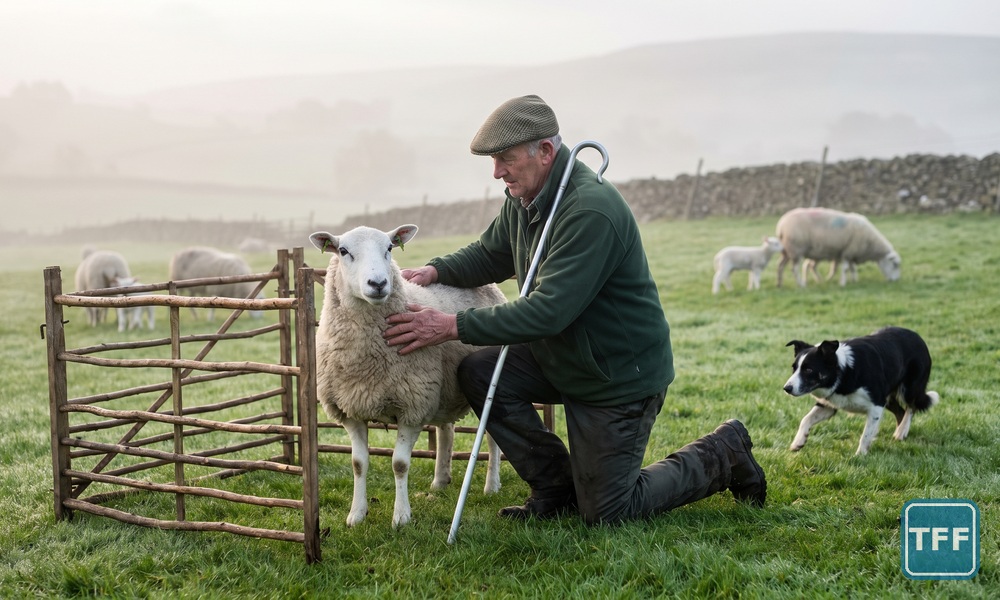
Outdoor lambing is the sheep sector’s standing answer to shed costs and scarce labour, but one job refuses to get easier: catching the single ewe in trouble in an open field. When a hill flock lambing Welsh ewes on the moor asked The Farming Forum how others manage it, the conversation became a working audit of the catching trade: the crooks, restrainers and pens that earn their place, the catch dog as the cheapest labour on the farm, the quad against the buggy, and whether breeding should remove the problem altogether. For firms selling handling kit, ATVs or shedding genetics, it is a map of where outdoor lambing’s money goes.
By TFF News | 21 October 2026 | Livestock
The conversation ran from 10 to 15 April 2026, drawing 138 visible contributions, 4,283 views and 500 reactions, an average of 3.62 per contribution. 37 contributions were banter and asides. As ever, this is what the farmers who chose to contribute said, not a representative survey of the sector.
The kit that earns its place
Catching kit and pen craft led the conversation, raised in 54 contributions. The opener set the problem: “So … if I go around in the buggy , I get mobbed by sheep expecting to be fed !” The replies rated the kit. One contributor: “the New Zealand catching sticks with the little clip are far better than the alloy jobs, as long as you can get within a few feet.” The cheapest restraint cost nothing: “A loop about the length of your forearm, front legs through, lift the bottom of the loop up over the legs, stick her head through until the loop is behind her ears, and not even my insane Lleyn or ferrally psychotic Blackie ewes can escape”
Pen craft mattered as much as hand kit. “Small pen with run in made of 20 to 30 yds of rylock net usually coming out of a corner is what we use in a couple of fields.” One flock skips pursuit entirely: “I use a decoy pet lamb in trailer behind gator or hunch down in field holding lamb by leg. Inquisitive sheep comes up and I grab her. Did this at 11 o’clock at night last week.” The most agreed-with find was improvised from the cattle yard: a ring feeder dropped over a caught ewe as an instant field pen. “It worked so well I’ve carried on doing it, next year I might well chuck a ring feeder in most of the lambing fields, we have loads from when we ran more cattle” The opener penned newly lambed ewes the same way and found they would then mother orphan lambs: “as truly as I write this they all took an orphan lamb without so much as a sniff”
A good dog is the cheapest labour
Dogs carried 22 contributions, and the economics are blunt. One catch dog came with no pedigree at all: “No paperwork, grandfather possibly a kelpie and bought for £100 as a pup. Cheapest thing I’ve ever bought” But the fleet ages like everything else on the farm: the opener’s best catch dog is past the work, and several flocks admitted to running on one ageing dog with an unproven youngster behind it, a thinner margin than they would accept in any machine.
Quad, buggy or boots
Vehicles drew 21 contributions and a clear pecking order. “I find the quad is just king at lambing for this very reason, you can follow ewes, wear them down and cut them out, then let the dog do the catch.” The same contributor finds his side-by-side too remote from the job. A minority will not have a bike at all: “seriously, I watched a generation of us put on 2 stone when they got a bike, and decided it weren’t for me.” Behind the banter sits a workforce fact the trade already knows: Defra’s June 2026 survey puts 36.1% of England’s principal farmers at 65 or older, with 18.5% under 45. Several contributors described their catching days as numbered, and the kit, the dog and the vehicle are what stand between an ageing flockmaster and a system that depends on sprinting.
Breeding away the problem
The structural answer drew 24 contributions: breed sheep that do not need catching. “The whole point is you shouldn’t have to catch them. Not always what happens in practice mind but sheep aren’t much good at reading rules at the best of times!” One contributor, helping about two ewes a year in a flock of 120, runs the selection policy most of the room endorsed: “Don’t keep anything that needed help at lambing as a replacement.”
Wool-shedding breeds split the room on temperament. One sceptic would rather pay the shearer: “I’d swap having to get someone once a year to shear a sheep with having a sheep that is wild, uncatchable, probably unfencable and a pain to handle for the other 364 days of the year” A critic reported a harder failing in his own bought-in sheep: “The biggest problem I had with pure Exlanas was running off and deserting their lambs, without any intervention.” Breeders answered from experience: “To be fair, except for some fun and games catching (mainly shearlings) at lambing, the rest of the year my exlanas aren’t any of the trouble you describe.” Even the critic conceded it is perfectly possible to breed shedding sheep that behave normally.
The commercial forces behind that debate have moved since April. Contributors called the wool return an embarrassment, one reporting: “I have never seen hoggs split their fleeces like this last fortnight. Quite a few are sheared!!” Wool has in fact rallied: British Wool’s average farmer return rose from 40p/kg to 68p/kg for the 2025 clip, a ten-year high, and many core grades are expected to reach £1/kg or more for 2026, against a typical NAAC shearing rate of £1.93 a head, Farmers Weekly reported in May. The labour side points the other way: the visa concession admitting around 75 southern hemisphere shearers, who shear 1.5 to 2 million UK sheep a season, was first refused, the National Sheep Association reported in February, then granted one final season to 30 June 2026, not to be renewed for 2027. The UK EasyCare society and its Irish affiliate meanwhile report 250 member flocks and growing, Agriland reported in June. With tups going out this month, those are the numbers under every shed-or-shear decision for 2027 lambs.
The question the trade is left with
Nobody disputed the destination: a flock that lambs outside and rarely needs hands on a ewe. “I’m lambing more and more ewes outside and the mules are proving ideal, only a few we’ve had to help (mostly breach lambs)” said one contributor of his own system. Yet every flock still carries the kit, keeps the dog and runs the bike, because the odd breech or oversized lamb must still be caught, whatever the breeding. The question for the trade is which side of that bet to stock for: today’s catching economy of crooks, pens, ATVs and trained dogs, or the genetics that promise to shrink it. On this conversation’s evidence, flocks are buying both at once, and will be for years yet.
Read the source conversation and analysis
Read the full conversation on The Farming Forum here. A nine-slide analysis of the conversation, with theme, sentiment and contributor charts, is available as a PDF: download the conversation analysis deck.
This conversation had been viewed 4,283 times on The Farming Forum when counted on 21 October 2026. Want your brand in the room when farmers talk livestock? Book advertising with Agri Web Media.