
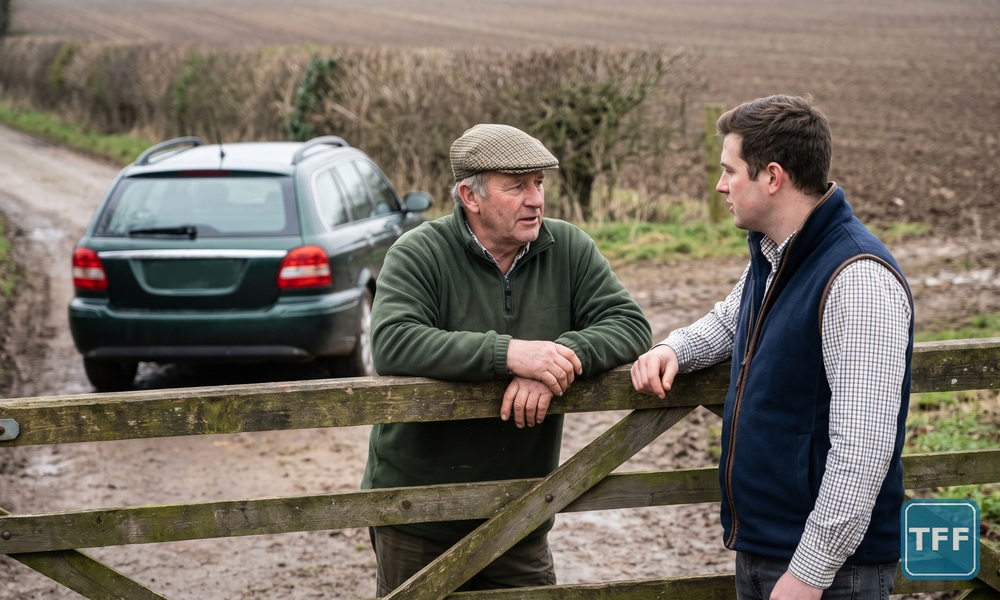
A farm adviser’s new Land Rover Defender would once have passed without comment. On The Farming Forum this spring it opened a sharp argument about whether the vehicles the supply trade arrives in are read by farming customers as a mark of competence or as a price list. It began with a secondhand gripe at the height of the spring input shock, and ended somewhere more uncomfortable for everyone who sells to farmers: the room largely refused to blame the adviser, and turned instead to what squeezed farms can afford to keep buying.
By TFF News | 26 October 2026 | Business
The conversation drew 159 visible contributions on The Farming Forum’s Agricultural Matters board between 27 March and 5 April 2026, and had been viewed 10,331 times when counted on 26 October 2026. Contributions earned 584 reactions, an average of 3.67 per contribution. Around 48 contributions were banter and asides, and 19 drifted into politics and energy policy, which this analysis leaves aside. These figures describe a single self-selected conversation and are not a representative survey of UK farming opinion.
A gripe that found few takers
The opening contribution reported, secondhand, a large potato grower burning an extra £3,000 a day in fuel to plant a new crop while a neighbour sat on 2,000 tonnes of unsold old crop, and that “his agronomist rolled up in a new 50k defender”. The verdict: “This can only end in tears.” The account is secondhand and names nobody.
What followed was not sympathy. The most agreed-with contribution flatly refused to begrudge: “What does it matter what other people have? If you want what they have, get a job like theirs!” Another put it more bluntly: “Yeh the agronomist probably didn’t inherit land and a business.”
The case against the Defender
The opener stood his ground, and his restated case is not about envy. It is about who pays: “the 50k defender is being paid for by the margin on the chemicals agronomist sells”, he argued, with every upgrade ultimately recovered from customers who cannot raise their own prices. Another contributor reframed the gripe the same way: “the value of vehicles is being used as a crude indicator of the cost of doing a job”, adding “if you are being heavily squeezed, it is appreciated if the businesses you deal with look to also make savings which they can pass on to you.”
One contributor suggested advisers “done the Agronomy in a Skoda and drive the Defender out of hours and out of sight”. Another recalled an early-1970s local secretary who stuck to an old Morris Traveller: “he said if he turned up in anything better farmers would think he was making money out of them. He was, but he still stuck to his Morris.”
Competence, not the car
The counter-camp held that reading anything into a vehicle is a mistake. A contributor who had building work done watched young lads arrive in £50,000 vans while the joiner came in an estate Passat and did the best work on site: “There’s no correlation between the quality of workmanship and the vehicle a tradesman drives.” An employer agreed: “I employ people based on their competence not what car they drive”.
Others worried about the opposite signal: “Id be worried if someone giving advice could not afford a decent car”. The sharpest jab at the vehicle itself was about reliability rather than price: “I’d be more worried that if my agronomist had a new defender they would be spending more time taking it back to landrover than walking crops.”
The lease maths behind the badge
Contributors could not even agree that £50,000 buys a new Defender. One who priced one at a dealership laid out why advisory businesses run them: “this Defender which is seemingly 50k is actually 14k for the 36 months contract, or £4500 ish per year no repairs or servicing and tax deductible”. The old-car camp answered with their own ledgers: “A car bought for £6k in 2018 with 60,000 miles on and still running regularly from Yorkshire to Central London at 65mpg eight years later at 205,000 miles beats that hands down.” Both sides were doing the same sum and reaching different answers.
The squeeze that set the tone
The timing explains the temperature. The conversation opened on 27 March 2026, the day AHDB reported granular urea at £618 per tonne, up 36% on February, and UK-produced ammonium nitrate at £504, up 25%, as conflict in the Middle East squeezed shipping through the Strait of Hormuz, the route for around 35% of global urea exports. One contributor had just bought ahead: “The nitrogen cost is £1.43 kg/N, and I paid £1 last year for the same product.” His own arithmetic put the extra cost at £86 per hectare on wheat, and another relayed a haulier whose weekly fuel bill had risen £20,000 in a month.
Underneath sat thinner farm accounts. Defra’s March forecast put average cereal farm business income for 2025/26 at around £17,000, down about two-thirds on the year. A potato grower in the conversation described the whiplash: “But all comes down with a bump, we’re approx 80% down on revenue compared to a year ago.” One farm had already acted: “It’s ended with us stopping arable production until circumstances improve.” Another reported the exit trade visible from the saleground: “there is a hell of a lot of farms quitting and selling all their stock/ machinery, local auctioneers have one online sale a day for machinery dispersals”. The auction data backs the impression: Cheffins sold over £23m of machinery in the second quarter of 2026, up 30% on the year, and said roughly half of its forthcoming autumn auctions were full dispersal sales as farmers retire or leave the industry.
Doing without the adviser
The uncomfortable thread for the supply trade: when margins vanish, the adviser’s fee is a cost some farms start to question. “We used to grow potatoes without agronomists, perhaps stop feeding the hangers on and there might be a bit more profit in the job.” One arable farmer had already moved: “Reined in my agronomist slightly this morning he must think we have one of them money tree’s also.” Another asked directly: “Why does anyone even need an agronomist? A reasonable understanding of crop nutrition and pesticides is good enough or if you dont have that just ask chat gpt” Others pushed back that modern varieties will not stand low-input treatment, and these were opinions about a farm’s own choices rather than evidence that bought-in agronomy fails to pay.
The question the trade is left with
Seven months on, with farms pricing inputs and renewing agronomy arrangements for 2027, the conversation leaves the trade a live commercial question. Half the room read visible prosperity as reassurance that the adviser is good; half read it as proof of a margin being taken off them, at a moment when, as one contributor put it, “You’re in business, if it doesn’t pay stop doing it.” The vehicles in the yard have become part of the price conversation. The trade can decide what it drives, but it no longer decides how that is read.
Read the source conversation and analysis
Read the full conversation on The Farming Forum here.
A nine-slide analysis of the conversation, with engagement, sentiment and theme data, is available as a PDF: download the conversation analysis deck.
This conversation had been viewed 10,331 times on The Farming Forum when counted on 26 October 2026. Want your brand in the room when farmers talk business? Book advertising with Agri Web Media.