
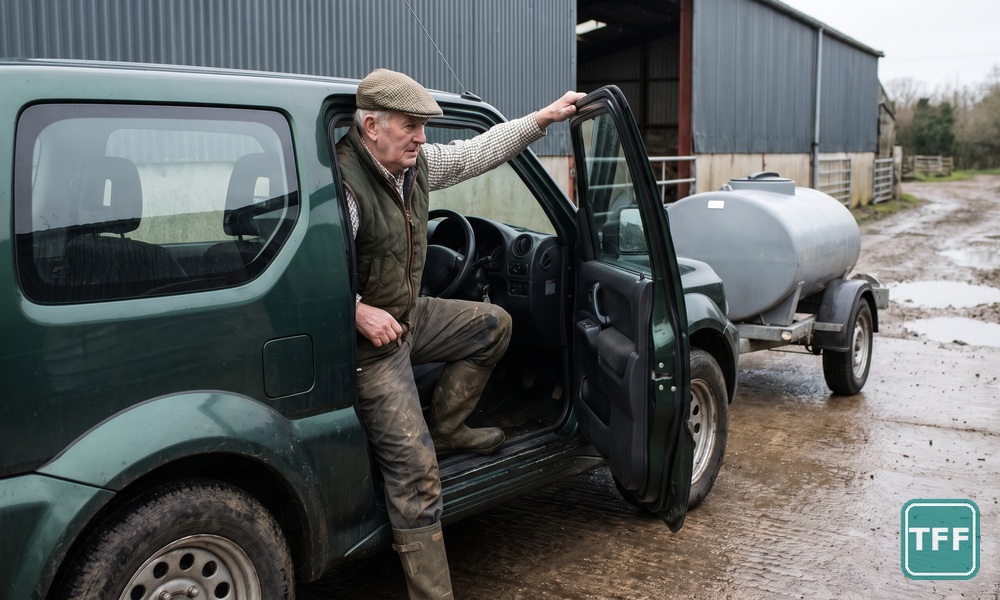
When a farm went looking for an older SUV to run as a pool vehicle, the brief had little to do with badges: an automatic gearbox, enough pull for a water bowser, around 3,000 miles a year, a budget of £5,000 to £10,000, and seats that two drivers with bad backs could get into without folding themselves. The conversation that followed in the Machinery section of The Farming Forum became an unusually honest map of the budget end of the farm vehicle market, and of what actually keeps an ageing 4×4 in work.
By TFF News | 7 November 2026 | Machinery
The conversation drew 106 visible contributions between 21 February and 4 March 2026 and has been viewed 4,820 times on The Farming Forum. Contributions attracted 78 reactions, an average of 0.74 per contribution, with activity peaking on 22 February. As with any open conversation, the figures describe who chose to take part and are not a representative survey of the sector.
A brief written by bad backs
The opening requirement was blunt: “It must be an SUV as two of the drivers suffer with bad backs and its easier for them to step up into a car and then step down out of it”. The farm also wanted something that would “start when required and not rot away” while sitting idle for most of the week. One contributor recognised the problem at once, describing how he and his wife chose their last vehicle: “We did a tour of garages just getting in and out both front and back.” A Ford Kuga won that test, and the couple have now bought two of them.
For the trade, the detail worth noticing is that entry height was the first filter, ahead of price or badge, and it was settled in the showroom rather than on a spec sheet. The second filter was simplicity. For a vehicle doing two or three thousand miles a year, one contributor argued the deciding factor against bigger machines was “the complexity of the machine for sitting about compared to more basic vehicles”.
Verdicts from the yard, not the brochure
Model recommendations led the conversation with 40 contributions, and 38 carried first-hand reliability accounts to back them up. The pattern was clear: what earned a recommendation was not specification but survival. One Kuga owner put it plainly: “First one I had did 185000 miles before a truck reversed into it and wrote it off!” A Hyundai Santa Fe owner approaching 300,000 kilometres on oil and filter changes summed up the ideal farm pool car in four adjectives: “Boring, comfortable, reliable, reasonably economical. I'll find another one the same when/if this one stops.”
The left-field candidates came with the same working logic. One contributor offered the SsangYong Rexton on the grounds that “It will tow 3.5 tonnes. Easy to work on and bodies are rust proof – but check the chassis.” Towing capacity ran through the whole exchange as a quiet filter of its own, ruling models in or out before comfort was even discussed.
The last four wheeled bargain
The liveliest argument was over the first-generation Land Rover Freelander. Its defenders run theirs as deliberately cheap workhorses and report prices firming: “word must have got out that they were the last 4 wheeled bargain”, as one put it, before admitting “I often walk past my Range Rover to go somewhere in the freelander”. Another contributor runs a commercial version bought cheap during lockdown: “On 140000 miles it’s had a new clutch and that’s it.”
The counter-case was just as direct. One contributor passed on the verdict of the mechanic who rents a workshop unit from him: “Last year he went through 23 of them and he says possibly one of the worst vehicles on the roads today.” The same account ended with advice the conversation kept returning to: “He says anything Toyota would be a safe bet and drives them himself.”
That split widened into an argument about reputation itself. One contributor blamed “Marketing perception and brand snobbery.” for premium 4×4 sales, while another pointed to Land Rover placing above Volkswagen and Audi in the latest American JD Power dependability study and concluded “It's fashionable to bash Land Rover I suppose.” Both survey citations were contributors’ own readings of published rankings, and the conversation itself noted that such studies count minor electronic faults alongside serious mechanical ones.
A tax cliff decides which year to buy
Road tax shaped buying advice in 14 contributions, because the cars under discussion sit either side of a sharp line. One Freelander owner warned: “don't get one of the last ones as the road tax is a lot higher if registered after a date in April 2006”. The date he was reaching for is 23 March 2006. Under the current rate tables, a car first registered between 1 March 2001 and 23 March 2006 with CO2 emissions above 225g/km stays in band K, £445 this year, while the same car registered after that date falls into band L or M, £760 or £790, according to the official rate tables as summarised in the AA’s current guide. Contributors quoted the bands from memory, but the shape of their warning is right.
Not everyone saw the higher band as a deal-breaker, because it is priced into the cars. As one contributor argued: “But your only paying the difference extra which is £3-400 a year, and if the purchase price is lower does it matter?” Another made the same trade explicit at the heavier end of the market, where a Touareg or Q7 can be bought cheaply precisely because “However road tax is brutal £760 and they like their diesel.”
Toyota faith closes the deal
Through all of it ran a steady current of Toyota confidence, from the blunt “Buy anything with the word Toyota in it……” to the detail that carried real commercial weight: “if you buy from a Toyota dealer you will get a warranty upto 100k miles”. That matches Toyota’s published Relax scheme, which extends warranty cover by 12 months with each franchised service up to 10 years or 100,000 miles, as set out in Toyota’s own announcement of the programme.
It settled the matter. Eleven days after asking, the opener returned: “Thanks everybody. Were on the look out for a Rav4. The local toyota dealer thinks they can source something with a warranty.”
The question the trade is left with
The farm pool car is real money spent reluctantly, and this conversation shows how it gets spent: on entry height, towing weight, tax band and the word of whoever fixes these vehicles locally, with the franchised dealer only entering the story when a warranty is on the table. Several contributors argued that the simple diesels which created this bargain generation are no longer built, and the stock that remains is rusting away. The unresolved question is what farms will run as the sub-£10,000 yard vehicle when that generation is gone, and which dealers will want a market that looks small on margin but quietly decides which badge sits in the farmyard when the bigger cheques get written.
Read the source conversation and analysis
Read the full conversation on The Farming Forum here.
Agri Web Media’s nine-slide analysis of the conversation, with theme, sentiment and contributor breakdowns, is available as a PDF: download the conversation analysis deck.
This conversation had been viewed 4,820 times on The Farming Forum when counted on 7 November 2026. Want your brand in the room when farmers talk machinery? Book advertising with Agri Web Media.