
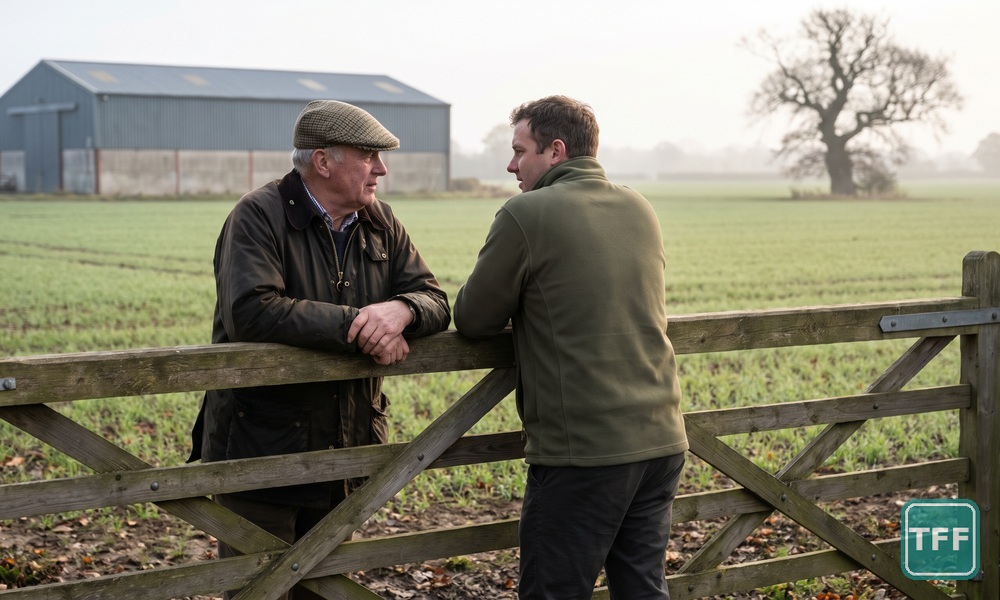
The one route that might have forced the Treasury back to the drawing board on the inheritance tax changes ran through the Royal Courts of Justice, and in May it closed. A conversation on The Farming Forum followed the judicial review of the agricultural and business property relief reforms from the first question in February through two days in court to the judgment, with first-hand reporting from the public gallery. It shows the trade farmers who expected little, got less, and have moved on to arguing about what pressure, if any, still works.
By TFF News | 10 November 2026 | Policy
The conversation drew 109 visible contributions between 17 February and 3 June 2026, has been viewed 10,518 times and collected 168 reactions, an average of 1.54 per contribution. Activity peaked on 12 May 2026, the day the judgment landed, with 14 contributions. Classified by tone, 53 contributions read as negative, 55 as neutral and 1 as positive. As ever, this is one conversation on one forum, not a representative survey of the sector.
Two days in court, then a long silence
The case, brought by a Cambridgeshire farming father and son with the campaign group Farmers and Businesses for Fair Tax Relief, was heard over 17 and 18 March at the Royal Courts of Justice, with supporters gathered outside. One contributor who had been through a judicial review over a wind turbine had already set expectations: “A successful JR usually forces the ‘authority’ to repeat (or abandon) the process that led to the original decision.” Another contributor kept the aim in proportion: “I dont think the judicial review is to reverse tax policy, its about the government’s consultation process, or lack of.”
A contributor who attended the first morning reported the claimants’ argument back to the room: “The position was that the consultation, that only covered trusts was not wide enough to access the effects of the new tax policy and this did not follow government protocol.” He admitted “it was difficult to follow at times, with the amount of case law being referenced”, with much of the hearing taken up by whether the courts could rule on the matter at all. Then came the wait, with the room told that recently published judgments had taken six months or more from hearing to hand-down.
Refused on every front
The answer arrived on 12 May 2026. Sitting as a Divisional Court, Lady Justice Whipple and Mr Justice Fordham refused permission for the judicial review, finding no clear and unequivocal promise to consult on the reliefs, commitments that were essentially political rather than legally binding, a claim brought too late, and a question that fell within the parliamentary process of setting tax policy. The full reasoning rested on each of those grounds independently, which is what made an appeal so unattractive, and the judgment is published.
Reaction was resigned rather than surprised. One contributor read the result as confirmation that “So basically the Government can make changes to an entire industry without knowledge or understanding of the sector.” The contributor who had reported from court called the timing point decisive and concluded, “But I’d say this is the end of the road for this option.”
Expectations were modest from the start
Few had predicted a different outcome. Asked in March what the review might bring, one contributor answered “Nothing at all!”, and the most hopeful framing on offer was about delay, not reversal: “I think a win is a delay of any kind.” Another agreed: “It might just buy some time, that could be valuable for some” The sharpest scepticism called the case a “Complete waste of everybody’s time & money” and said the courts would never involve themselves in tax policy, which is close to what the judges eventually decided.
The question of who was behind the case ran through the conversation too. “Do we know who actually is bringing this? NFU involvement?” asked one contributor. The contributor reporting from court answered that “NFU have refused at all times to support this effort.” That is his account rather than the union’s; what is on the record is that the NFU had ended its own campaign against the changes once the government raised the 100 per cent relief cap from the original £1m to £2.5m per estate, £5m for married couples and civil partners, with 50 per cent relief above that.
The argument over what actually works
Almost a third of the conversation is an argument about tactics rather than law, which is really an argument about where farming’s leverage now sits. One side held that visible, repeated pressure is the only mechanism left: “media coverage shapes public opinion, and public opinion is what eventually changes government policy, or changes governments”, as one contributor put it, adding “Sitting back and saying everything is pointless guarantees failure.” The other side held that protests and court cases spend effort the industry cannot spare on routes government can safely ignore, and that only economic leverage changes policy. A long strand argued over whether refusing to spread treated sewage sludge would have been that leverage; the conversation never settled it, and one of the more even-handed voices summed the position up: “It is not to say the effort by all has not been appreciated, it is just to say it has not been terribly effective.”
Planning carries on under rules that will not move
The changes came into force on 6 April 2026, and the conversation’s practical strands are the ones advisers will recognise. One contributor warned early that “sadly trusts don’t fix the 7 year issue”, because gifts into trust sit inside the same seven-year rules. Another raised the position of unmarried partners: “My kids are being discriminated against because I’m not married .” The contributor reporting from court had flagged in March where the pressure lands next: “the first framer to die after the 6th April is going to become a very interesting test case”
And the policy backdrop keeps pushing in one direction. One contributor put the incentive plainly after looking at his options: “I had a look at SFI and I think I could unlock £70K-£90k for our small 250 acre farm, if I gave up producing food. How very sad.”
Where that leaves the trade
With the courtroom closed off, contributors were left pointing at the ballot box. “Role on the next election. Its the only thing that’s going to change the trajectory, for good or bad.” wrote one as the conversation wound down. The practical reading for the trade is more immediate: the rules now in force are the rules, succession and ownership decisions parked pending the case have no reason left to wait, and the advice, valuation, insurance and restructuring work that goes with them is live now. The unresolved question is whether a sector that spent two years fighting the policy will now spend the next two planning around it, and who gets that work.
Read the source conversation and analysis
Read the full conversation on The Farming Forum here. A nine-slide analysis of the conversation, with contribution, sentiment and theme breakdowns, is available as a PDF: download the conversation analysis deck.
This conversation had been viewed 10,518 times on The Farming Forum when counted on 10 November 2026. Want your brand in the room when farmers talk policy?
Book advertising with Agri Web Media.