
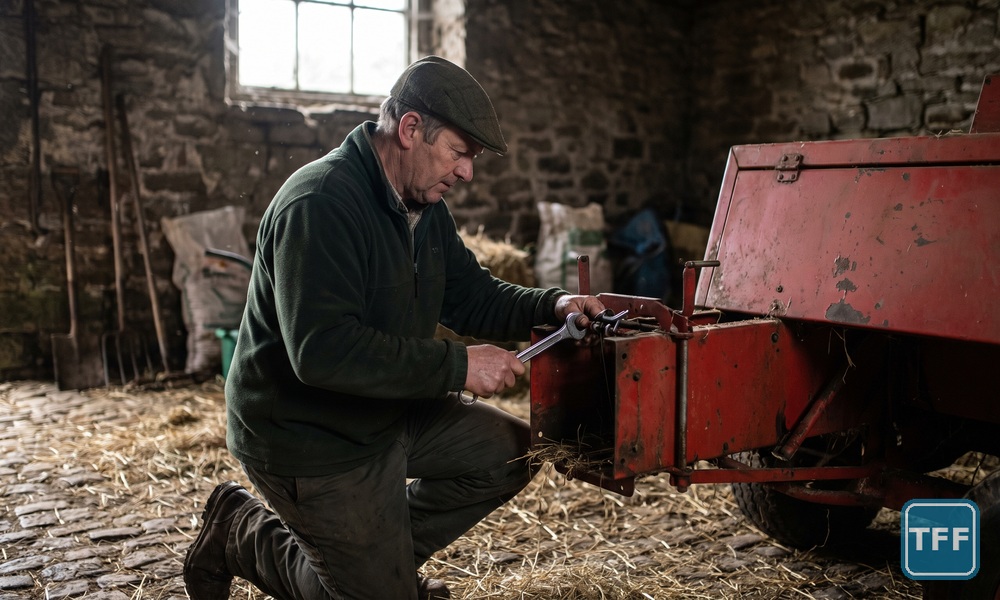
Ask a machinery audience which machine they miss most now it is no longer available and the answers read less like nostalgia than a demand audit. A spring conversation on The Farming Forum produced a shopping list the trade may want to study: simple balers, lightweight sprayers, telehandlers without electronics and cabs with switches a driver can find without looking. The machines span forty years, but the reasons for naming them are strikingly consistent.
By TFF News | 12 October 2026 | Machinery
The conversation ran from 19 April to 8 June 2026 in the Machinery section and drew 151 visible contributions, 13,702 views and 524 reactions, an average of 3.47 reactions per contribution. Tractors led the naming on 25 contributions, with drills and cultivation kit on 22, balers and harvest kit on 17, simplicity and build quality on 15, lightweight sprayers on 12 and cab controls on 9. Roughly a fifth of contributions were asides and banter. These figures describe one conversation among its participants and are not a representative survey of UK farming opinion.
Simplicity drew the loudest agreement
The most reacted contribution in the whole conversation named no machine at all. It asked for “Engines where the exhaust manifold was just connected to a turbo then on to a pipe with a bit of a silencer in it.” That single sentence drew 34 reactions, nearly ten times the conversation average. Another contribution summarised the mood as “Anything made of metal before 2006”.
The pattern held across the classifications: contributions critical of modern machinery averaged 6.12 reactions against 2.86 for positive ones, so the complaints drew roughly twice the agreement. One contributor put the underlying belief plainly: “lots of us are of the opinion that anything new that you buy is just a bit worse than what you had before”. The counter view was present and worth weighing. One contribution argued “I cannot for one minute think of a machine in the past was better than the stuff on the bank now”, and several contributors defended the current machines they run. What the simplicity camp actually described, again and again, was serviceability: a John Deere 4040S was praised with “No Gizmos. Simple easy to use Quad Range gearbox.”
The baler gap has a new answer
The conversation opened with the Welger conventional baler, “Absolutely the best small baler full stop and still nothing close. Tragic.” Whether spares support continues under AGCO, which bought Lely’s forage division in 2017, was asked in the conversation and not answered.
What the exchange showed is that the small bale market is being answered from two directions. One contributor pointed to the Canadian built Marcrest 210, “A small baler built like a large baler”, adding “I think Bale Baron UK are importing them but sit down please before asking the price as I believe it’s circa £130k !” The price and import arrangement are his account, but the machine is real: Marcrest of Listowel, Ontario launched the 210 in July 2024, built to keep its Bale Baron bundler fed, with a claimed 1,000 to 1,200 bales an hour. Another contributor replied that “The Marcrest 210 would be the daddy. One sold in the uk so far for this season”, while committing to the other direction himself: a new Massey Ferguson, “when I fire up the Massey 1842s that lands on Monday”. That machine is current production, launched by Massey Ferguson in 2022 as a premium inline baler running at 100 strokes a minute, and Farmers Weekly reported in May 2026 that it sells around 30 units a year in the UK at about £28,000, with small bales still earning farmers and contractors real money.
Lightweight sprayers and the weight problem
The most detailed market gap in the conversation was the lightweight self propelled sprayer. The Frazier Agri Buggy was remembered as a “True light weight machine. Travel over the wettest ground. Cost pence to run.” A former Chaviot 2000 operator recalled “I managed to spray 425 acres in one good day with it something I have never achieved it with any machine since.”
The complaint was not that nothing similar exists, but that the modern equivalents have grown. One contribution put today’s lightweight machines at around six tonnes unladen, “Rather different to the 3.6 tons a Chaviot 2000 is plated at.” The published record supports the direction of travel: Farmers Weekly reported in May 2024 that the Agribuggy had gained almost two tonnes in a decade, with the latest 3,000 litre V300 at 6,400kg unladen and £220,000, and that the whole lightweight niche sold in single figures the previous year. As one contributor put it, “Everyone just wants BIG these days. Got to cover as much ground as quick as possible.”
Cabs want their switches back
A strand on controls carried some of the sharpest frustration. “I absolutely detest the current obsession with miscellaneous personalizable buttons in tractors – it makes everything a memory test.” Another contributor offered the image of the conversation: “I remember seeing an m8 nut glued to a button on the sideconsole in a jd 6170r.”, glued there so the driver could find four wheel drive by touch. A third missed “dedicated switches. Not having to go though a display to switch a certain light on or off”.
The car industry is already turning. From January 2026, Euro NCAP requires physical controls for functions such as indicators, wipers and the horn before a car can earn its top five star safety rating, on driver distraction grounds. Tractor cabs are not tested by Euro NCAP, but the conversation suggests manufacturers who bring back dedicated switches would find a receptive audience.
Keepers, and what the used market says
Where no new equivalent exists, the conversation showed owners simply refusing to sell. A Manitou MLT 628 owner called it “simple reliable no electric gizmos”, and another agreed: “Certainly up there as one of the best telehandlers ever built. It’s a keeper. And if I ever see another I will buy it.” A John Deere 3420 telehandler owner “bought mine new 22years ago and would have replaced it by now if there was anything better”. The money follows the sentiment: one contribution linked a John Deere 7710 at an auction and noted it “Went for £27250 + £1000 fees”, a price that speaks for itself on a tractor of that age.
Sentiment or an order book?
Of the 151 contributions, 34 were critical in tone, 37 positive and 80 neutral, so this was no wall of complaint. It was a list, and lists are cheap to write and expensive to act on. The verified numbers attached to the gaps are small: around 30 small square balers a year, lightweight sprayers in single figures. Against that, the Marcrest 210’s arrival, the MF 1842S’s steady order book and the money paid for the simplest used tractors suggest that simplicity, light weight and serviceability still carry a premium when someone builds for them. The question the conversation leaves for the trade is which of these gaps is a real order book, and which manufacturer will be first to find out.
Read the source conversation and analysis
Read the full conversation on The Farming Forum here.
Download the nine slide conversation analysis deck (PDF)
This conversation had been viewed 13,702 times on The Farming Forum when counted on 12 October 2026. Want your brand in the room when farmers talk machinery?
Book advertising with Agri Web Media.