
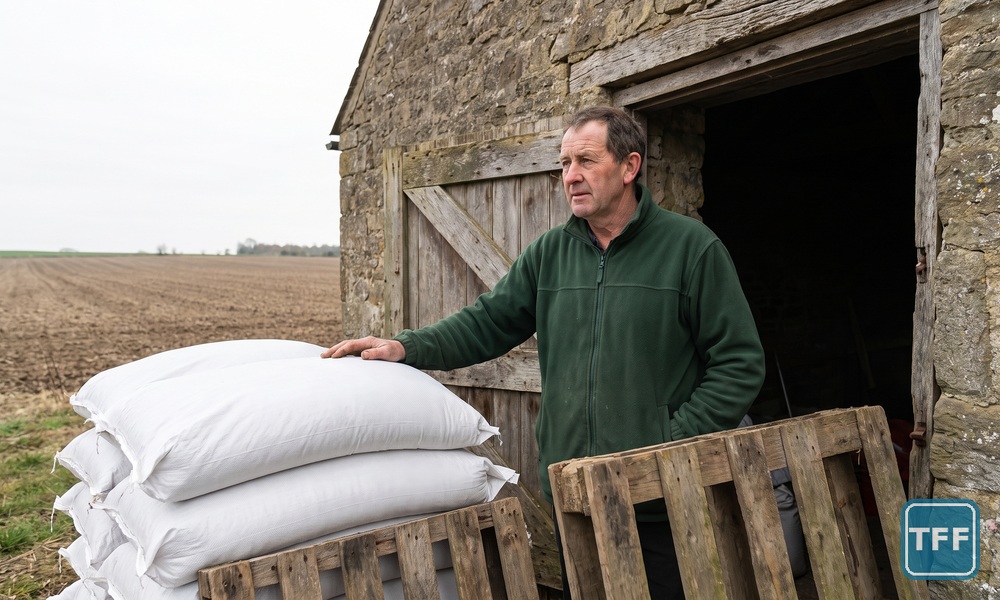
Quoted around £200 a tonne more for nitrogen than they had just finished spreading, farmers on The Farming Forum faced an uncomfortable choice: buy fertiliser for harvest 2027 at the new money, or sit tight and risk there being none to buy. The conversation, started on 20 April as supply fears rippled out of the Gulf, became a working audit of how UK farms handle an input shock.
By TFF News | 11 October 2026 | Inputs
The conversation drew 135 visible contributions between 20 April and 7 May 2026, and had been viewed 12,533 times when counted on 11 October 2026. Contributions attracted 318 reactions, an average of 2.36 per contribution. These figures describe one conversation among the farmers who chose to take part. They are not a representative survey of the sector.
A £200 jump between seasons
The numbers tell the story plainly. One arable contributor set out the gap: “Was quoted £620 urea but at the moment I can't justify it for grain at £180. Urea at £415 this years price was strong enough.” A dairy farmer reported the same move: “I have bought one load of Urea at £625 for next year, it was delivered last week. Paid £410 for the same stuff we have just finished spreading this spring.” Another had rung round and walked away: “Spoke to 3 suppliers yesterday and today and its going to be £500/t upwards for nitrogen so told them I’m not buying at that.”
Those figures match the published record. AHDB’s late March market analysis had granular urea at £618 a tonne, up 36 per cent on February, and noted that around 35 per cent of global urea exports move through the Strait of Hormuz. The week the conversation ran, India booked a record emergency purchase of 2.5 million tonnes of urea at $935 to $959 a tonne, close to double what it had paid two months earlier. Hence one contributor’s relayed trade talk that “no UK importer is bidding for Urea fert as to compete against India at the moment it would be at least £800/t on farm to make it worthwhile”, a secondhand account rather than a quoted farm price.
Buy a third and hope
Those who bought almost never bought the lot: “Have just bought 1/3 of next years requirements. It will either be right or wrong.” Another contributor staged it through the fortnight, 15 per cent first, then up to half his liquid nitrogen. A livestock farm took a blend on a limited offer at £480 a tonne: “Almost a relief as I feel this is an acceptable gamble.” For the dairy farmer who paid £625, the logic was continuity, not price: “I see it as a business insurance policy for providing enough forage for my 320 cows.”
One arable business was fully covered after quietly building nitrogen stock over three years; the reply pointed at the next pinch point: “sulphur fert could be a bigger problem than N”. That warning has aged well. By September, AHDB reported only 75 per cent of nitrate sulphur orders being filled within 28 days, with delivery times up to six weeks.
The case for sitting tight
The waiting camp argued a price has to be earnable before it is payable: “Buying fert now is just locking into cost, which comes with the danger it may not be recovered”, and “I will wait , if there’s no margin, I won’t be drilling.”
Memory did a lot of work here. “Pretty sure most people who bought at the inflated levels post Ukraine war wished they'd skipped a year.” One who had been there said so: “I bought too early when the Ukraine War started. It had dropped about 30% by November. Once bitten.”
Cutting rates and finding nitrogen elsewhere
The single largest theme, carried by 38 contributions, was how to need less of the product everyone was arguing about. One contributor ran the AHDB nitrogen adjustment calculator at the new prices, which gave “a 20-25% reduction in planned fert rates for this year, so my plan is to keep that in stock for next season”. Clover, legume fallows and pulses all got their outing. Muck was suddenly worth doing sums on: “we put muck on beet land that was "worth" around £300/ha in nutrients at current fert prices”.
Some farms step back from cropping
The most reacted-to contribution in the conversation was not about buying at all. It was about stopping: “I've reached that point and have only sown a bit of spring cereal for home use. No rt, no fertiliser, no spray or drying charges and less stress. I've put everything I can into SFI.” The same contributor closed with the line that drew the agreement: “I'm sick of paying everybody else in the supply chain while taking all the risk.” The farmer who refused the £500 quotes landed in the same place: “I’ve got enough in stock to grow barley, maize and grass for the cattle so I think thats the plan to have a year off.”
Others pushed back that stepping out is a luxury not every balance sheet allows: “Can’t mothball the farm for 12-24 months. Can husband resources and reduce input spend in short term, but will be building problems for the future if goes on more than 1 season.”
The grain-selling gap
The conversation ended somewhere the trade should notice: farmers trying to buy grain forward for feed and finding the door shut: “only found one independent merchant who could do a spot load of barley for me recently, all the others try to think up excuses why they can’t do it.” One, whose family business has traded since 1912, described being rebuffed by three merchants and platforms, in one case over credit-worthiness, and gave a verdict reported here as his opinion: “The whole grain trade is an absolute racket.” The futures alternative drew a dry warning: “The farming bit would quickly turn into a mug's game if it turned out you were any good at calling it.”
Who called it right?
Five months on, the patient look right, so far. China returned to the export market over the summer, and by late August urea offers into India had fallen to about $390 a tonne, 58 per cent below April’s peak. AHDB’s GB fertiliser price series had granular urea at £483 a tonne in the week ending 2 October, far below the £620 to £625 paid in April but still some £70 above where the 2026 season was bought. The feared £800 boats never landed. But prices stopped falling in September and are edging up again. The question the conversation leaves with the trade is the one its buyers were already acting on: whether selling a farm its whole nitrogen programme in one order is finished, and staged buying in thirds and halves is now simply how the job is done.
Read the source conversation and analysis
Read the full conversation on The Farming Forum here.
Download the full conversation analysis as a PDF slide deck: Fertiliser buying conversation analysis (PDF).
This conversation had been viewed 12,533 times on The Farming Forum when counted on 11 October 2026. Want your brand in the room when farmers talk inputs?
Book advertising with Agri Web Media.