
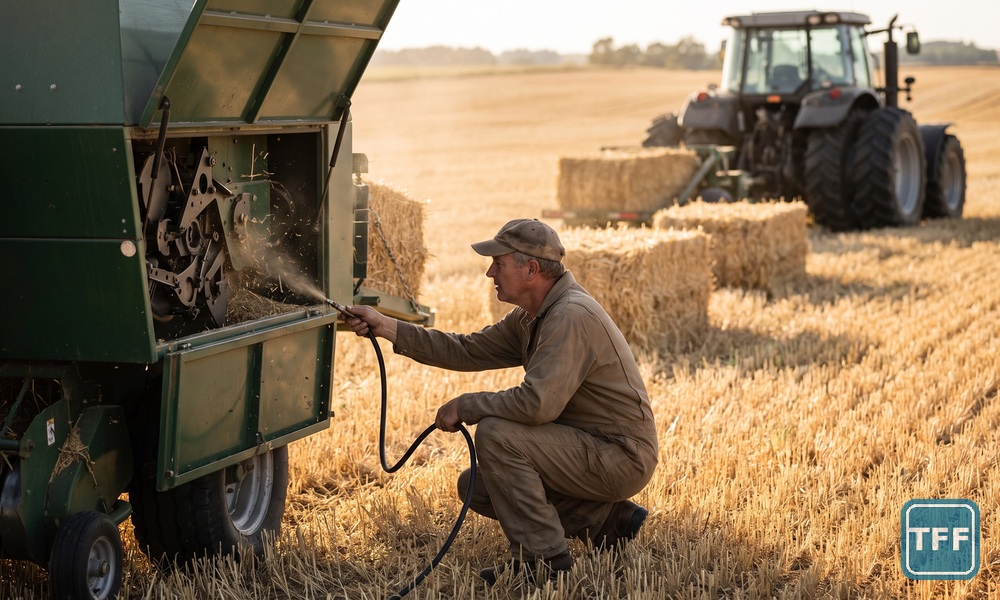
A buying question, which 120 by 90 high density square baler is best, ran for seven weeks on The Farming Forum and turned into an audit of the big baler trade: power requirements far beyond what the last generation needed, a bone dry season that stripped hundreds of kilos off bale weights, knotters that reward obsessive maintenance, and a straw trade that now prices the combine that cut the crop as carefully as the baler that packed it.
By TFF News | 1 October 2026 | Machinery
The conversation ran from 9 August to 30 September 2026 in the Machinery section and had been viewed 5,396 times when counted on 1 October 2026. It carried 105 visible contributions and 92 reactions, an average of 0.88 reactions per contribution, peaking on 14 August in the middle of straw carting. These figures describe one conversation among the farmers who chose to take part, not a representative survey of the sector.
The entry ticket is power
The opening contribution set out a straightforward ambition: “considering buying my own big square baler to bale straw, would be after a 120 x 90 HD one, what’s best makes etc and what to look out for”. The practical advice was less about badges than running costs. One contributor put the baseline plainly:“Most new HD balers will weigh around 12t empty so steep stuff you’ll want big hp flat land 200hp min at a guess”. Another relayed what a salesman had told him about one maker’s high density model: “New Holland hd baler needs a minimum 300hp rep told me and to get working 400hp”. That figure is the contributor’s account of a sales conversation, not a published specification, but nobody argued it down.
The power inflation was summed up in a line that drew strong agreement:“I think it takes 250hp to do what 180 used to do.”. Contributors traced the change to heavier balers, denser bales, faster forward speeds and the wider rows left by modern combines.
A dry season strips weight out of the bale
The conversation was baling through the driest conditions contributors could remember, and the effect on bale weight became its central argument. One contributor declared “No one is getting good bale weights this year with any make of baler”, describing an operator whose high density baler, on a 400hp plus tractor, was still turning out bales of around 250kg. Others answered with weighbridge evidence. A buyer taking delivered loads reported “Massey baler & averaged 493kg. Load that just turned up was from an 8 string Krone pulled by a 400hp JD. They felt heavier…weighbridge put them at 550kg”, though even those heavier bales were at the limit of their twine: “Doesn’t take much to pop strings, even if you don’t touch them with a tine.” A seller with an older short chamber machine reported “We had a load away this morning and they’re 390kgs per bale he probed a few all 9% or less”. A high density operator explained the spread: “You can’t go fast and get high weight bales any year. High speed increases wad size and reduces wads/bale.” In a dry year, he argued, the only route back to weight is slowing down.
The backdrop checks out. Farmers Guardian reported in late July that a relatively small straw crop was expected to push prices up and that the exceedingly dry weather had produced a wide range in quality, and Farmers Weekly’s harvest round up recorded disappointing barley straw yields. Yet by late September AHDB’s hay and straw price series had big square baled barley straw at £89 per tonne and wheat at £74, each slightly below a year earlier: the squeeze expected in July had not reached the national average price.
Knotters decide whose day it is
Reliability, and knotters above all, was the biggest theme of the conversation, touched by 37 contributions. The tone was set by a contributor wrestling with an older machine: “If any machine could break a man its a square baler!” Dropped knots, blocked billhooks and bales emptied out by hand ran through the conversation, and the extreme dryness made it worse. The fix, on newer machines, is routine rather than luck. One contributor described his:“Not dropped a knot today and punched out 700 ish. Straw is dry 10% which for us is crazy dry. Blow it off completely every 200 or so bales and it sings.” Others swear by factory knotter blowers, a compressor or a leaf blower between loads. For the trade, knotter care kit and dealer familiarity with knotter setup are live selling points, not afterthoughts.
The combine row now has a price
Several contributors now treat the type of combine that cut the field as part of the straw’s value. Rows left by some rotary machines were criticised as peaked, uneven and prone to heavy losses if they catch rain, and one contributor said he would not buy straw baled behind an axial flow machine at all. Defenders answered with results.“6 banded is what you need, my contractor uses a yellow one, other flavours are available.”, wrote one, arguing that a six twine baler copes with rows that upset smaller machines. Another, baling behind one of the criticised models, reported “Out of one of the problem lexions that you talk of and not a single issue caused by row shape”. A third described the local reality: “Not much choice around here now. Nearly all have AF combines or rotary’s. Only bale behind one straw walker an it’s the best by a mile.” If buyers discount straw by the combine that cut it, a combine choice starts to carry a straw penalty, and a baler’s ability to swallow poor rows becomes a selling point.
Does high density pay?
Manufacturers sell high density balers on output and haulage: New Holland claims up to 22% higher density than conventional large square balers for its BigBaler High Density range. The conversation was not convinced the premium always survives a dry field. One contributor offered a weigh off:“Know someone who weighed 18 HD 6 string bales of straw against a load of 27 4 string bales of straw, and the 6 strings HD only weighed a total of 500kgs more than the 4 strings!” Set against the extra tractor, fuel and purchase price, that gap looked thin to several, though others countered that density pays in haulage, with eight string bales hitting 550kg when standard machines managed under 500kg.
The closing advice to the original buyer was about neither density nor badge. “Square balers are a specialist thing so buy what you have back up for”, wrote one contributor, and nobody disagreed. The question left for the trade is whether the high density arms race, with its 12 tonne machines and 300hp tractors, still pays its way in a year when the crop refuses to make weight, and whether the next round of baler orders will be decided in the showroom or in the dealer’s workshop.
Read the source conversation and analysis
Read the full conversation on The Farming Forum here.
Download the full conversation analysis as a slide deck: Square baler conversation analysis (PDF).
This conversation had been viewed 5,451 times on The Farming Forum when counted on 1 October 2026. Want your brand in the room when farmers talk machinery? Book advertising with Agri Web Media.