
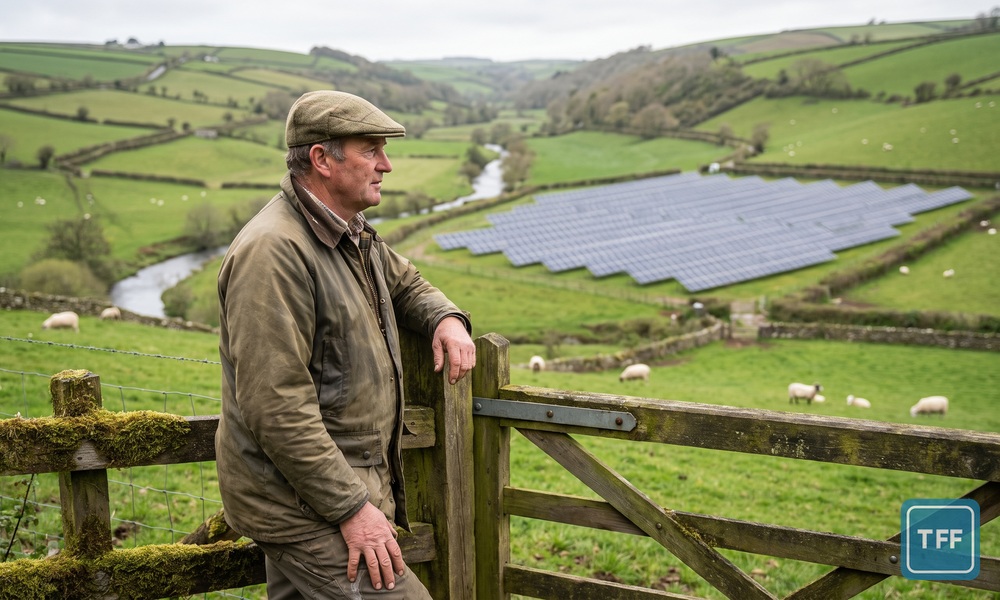
A proposed 850 acre data centre campus beside the Tarka Trail and a national scale solar park a few miles away have pushed land use to the top of a two month conversation on The Farming Forum. Farmers from Devon to Lincolnshire weighed lost farmland, jobs claims they do not believe and rents that outbid any rotation. The sharpest finding for the trade is not the opposition, it is how openly some farmers said the sums now favour handing land over.
By TFF News | 18 September 2026 | Land
The conversation ran from 29 June to 30 August 2026 and had been viewed 4,059 times on The Farming Forum when counted on 18 September 2026. It carried 113 visible contributions and 145 reactions, an average of 1.28 reactions per contribution. These figures describe a single conversation among people who chose to take part; they are not a representative survey of farming opinion.
Two proposals put one corner of Devon on edge
The conversation opened with a farmer describing what is planned around him in west and north Devon: “they have planned to nick 800 acres of farmers and turn into a mega data centre, total unspolit countryside in the middle of nowhere”, alongside what he recalled as a 2,800 acre government backed solar park along the road.
Both schemes are real, and the recollected figures are close. Xlinks is proposing the Devon Data Campus at Alverdiscott near Great Torrington: an AI data centre and 1.8GW battery storage scheme on around 850 acres of farmland, up to 1.5GW of compute, £12.2 billion to £13.8 billion of capital investment and 600 to 1,200 permanent roles, according to Farmers Guardian and the developer’s own project page. The applications went to Torridge District Council, with public consultation over the summer. The solar scheme is Beacon Solar near Holsworthy, around 2,700 acres promoted through the nationally significant infrastructure route; local press reported in February that it was withdrawn from the Planning Inspectorate’s pre-application service and placed on hold for a redesign, though contributors clearly expect it to return.
The unease was not confined to one district. A contributor from south Devon pointed to a village where “80 acres of solar panels adjacent to the village now in place – absolute eyesore.” Another summed up the mood at the start of the AI build out: “This race for processing power and data storage is just insane.”
Jobs claims meet a sceptical audience
The employment case, 650 to 1,200 jobs in the reporting contributors shared, was the most contested number in the conversation. One contributor set the tone:“Maybe I’m just too cynical but apart from a couple gardeners and security guards, I expect the rest of the ‘jobs’ will be in an office somewhere taxing people for this valuable asset.”
A contributor watching a data centre go up on a brownfield site in Buckinghamshire agreed: “The cynic in me thinks they include the construction workers in these figures.” A third backed him with an American example: “You’re not being cynical you’re being realistic. Staffing levels for data centres are low.”, citing a large American site he said runs with 50 permanent staff, a figure the conversation did not verify.
Even contributors resigned to the technology drew a line at scale. A Lincolnshire resident wrote: “As a normal local resident I have tolerated the ones around 20 to 30 acres that are about but object to these 100s to 1000s acre sites being pushed through here in Lincolnshire.”, arguing a significant share of revenues should go into a local community pot. Another accepted the development near him was well sited but held that “data and battery ‘campuses’, are the dark underbelly and dirty secret of the ‘technology’” for their land, energy and emissions footprint.
The investment case gets a hearing
A minority argued the trade should look at what the money buys. One Devon contributor wrote: “The North Devon area needs employment and investment and that’s a massive investment to make.”, adding “I’d rather see some here in the UK than rely on China etc.”, and argued the fight should be over infrastructure upgrades and guaranteed employment, not the principle.
A contributor with a consented solar scheme of his own pointed to Lincolnshire as the counter example: “The site at elsham (434ac) is expected to end up with c. 600 post construction jobs with average salary over £50k. This is in area of significant deprivation.”, figures he took from the planning committee papers. That scheme has since moved: North Lincolnshire Council approved the Elsham Tech Park in March 2026, with up to 1GW of computing capacity, a projected 900 to 1,200 long term operational jobs and a greenhouse complex using waste heat from the data halls to grow tomatoes.
Profitability is the open door
The most commercially telling strand was the argument over why developers find willing farmers at all. One arable contributor put numbers on it: “If arable farming was even making say £600/acre, then that would be competitive against solar at £1,000 and difficult inheritance tax situation.” Another, farming marginal land, asked “There’s lots of complaints about wasting productive farmland but we can’t continue growing cereals with low yields at a loss.”
The contributor with consented solar was blunter still: “I find solar on my land less offensive to me than the idea that I should merrily grow food to make a loss to feed the ungrateful.” He also offered a view of policy that drew agreement: “Government often speaks of food security, but its policies are actively against it. Thats all brands of govt for many years.” These are opinions, but the rent gap they describe is the mechanism the whole conversation turns on.
Water, power and the agrivoltaics gap
Late in the conversation the dry summer sharpened a practical objection. One contributor noted: “Data centres need drinking quality water. Devon is under a hosepipe ban at the moment.” That ban is real: South West Water imposed hosepipe restrictions from 8 August across Devon, Cornwall and parts of Dorset and Somerset after the driest July on record in southern England. Another contributor replied: “Combine that with the endless push for ever more houses in Devon & somethings got to go wrong!”
On the energy side, several contributors wanted generation distributed rather than concentrated in giant blocks, and saw a missed opportunity in how solar is being built:“What’s saddest about the rush to solar is how its potential for proper agrovoltaics has been overlooked.” The contributor building a scheme confirmed the barrier sits in the planning system itself: “UK schemes are not pushing for agrovoltaics as they are encouraged to use the minimal land take for the panels”, because designs that widen rows for cropping increase land take and get pushed back by planning authorities.
The question the trade is left with
Nobody disputed that the money on offer is transformative; the argument was over who captures it and what farmland is worth once compute and energy are bidding for it. If arable margins stay where they are, the rent gap the contributors described will keep opening doors for developers, and every acre that goes takes its seed, feed, machinery and agronomy demand with it. The unresolved question for the trade is whether data centres and national scale solar remain a Devon and Lincolnshire story, or become a structural competitor for the land its customers farm.
Read the source conversation and analysis
Read the full conversation on The Farming Forum here.
Download the conversation analysis slide deck (PDF)
This conversation had been viewed 4,059 times on The Farming Forum when counted on 18 September 2026. Want your brand in the room when farmers talk land? Book advertising with Agri Web Media.