
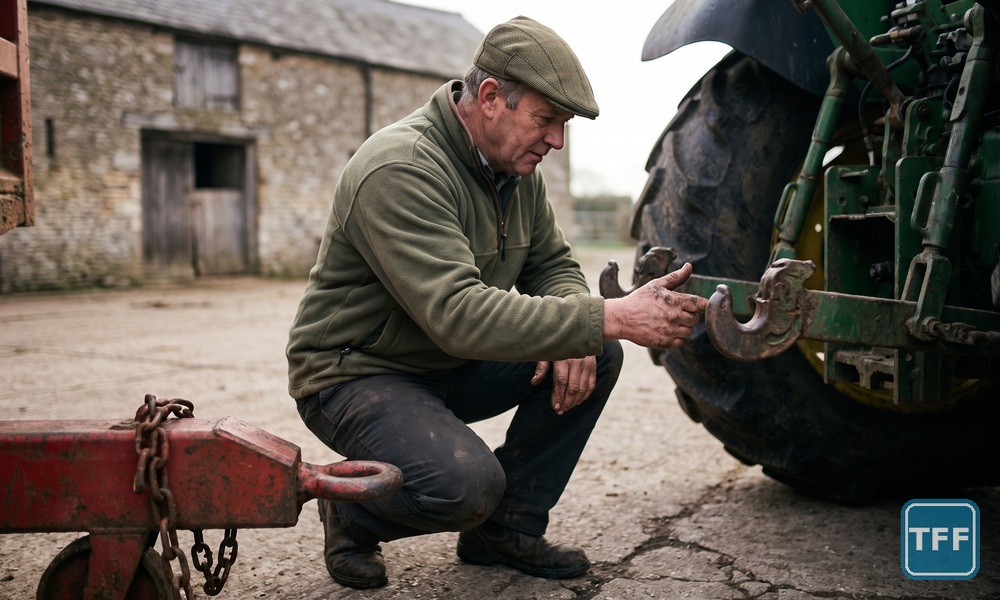
A television reconstruction of a fatal trailer detachment sent farmers out to their hitches in June. The conversation it started on The Farming Forum became a month-long audit of the weak points in farm haulage: worn hooks and rings, the price of replacing them, brakes that fail dangerous rather than safe, and a statutory test that does not exist.
By TFF News | 30 September 2026 | Machinery
The conversation ran in the Machinery section from 1 June to 1 July 2026 and drew 104 visible contributions, 6,040 views and 114 reactions, an average of 1.1 reactions per contribution. Most contributions were measured in tone: 71 neutral, 32 negative and one positive. These figures describe this one conversation and are not a representative survey of farmers or the industry.
Checked in the morning
The trigger was an episode of the Channel 5 series Forensics: Crash Scene Investigation, which contributors said reconstructed the death of a motorist after a loaded trailer came off a tractor on a hill, with the hitch hook and towing ring found badly worn and the driver given a suspended sentence. Those details are the contributors’ account of the programme rather than this publication’s own reporting of the case, and the conversation named nobody involved.
What matters for the trade is what farmers did next. “I think we have one ring that would benefit from changing but all the hooks are good. I’ll be checking in the morning.” wrote one contributor. Another kept the recommendation simple: “I think anyone who ever hitches a trailer should watch it !”
One contributor admitted “It’s shocking how little is actually holding the trailer and tractor together.” Another called the case “a warning to everyone. It does really emphasise the need for a secondary attachment, it wasn’t the first trailer to be lost off, and it won’t be the last.”
A £900 hook against a £125 one
The first commercial strand was the cost of putting wear right: “Dealers dont help. I priced a new hook for case tractor, £900!!!!!!” and said weeks of hunting across dealers and breakers produced nothing for that model. Others put aftermarket prices on the table: “New dromone hook is £125.” and “Can get a new cbm pickup hitch hook for £ 150 ish”.
These are contributors’ own price reports rather than published list prices, but the spread they describe between a franchise dealer part and an aftermarket equivalent, with availability varying sharply by tractor model, is exactly the gap parts suppliers compete in. A safety story on national television is also a demand signal: contributors went looking at hooks and rings within a day of the broadcast.
No test, no inspection, no HSE
Running under the whole conversation was the regulatory gap. Vehicles used solely for agriculture are exempt from roadworthiness testing, and agricultural trailers carry no annual test, although the law still requires them to be roadworthy on the public road, as set out in the government’s guide to tractor regulatory requirements. The same guide caps a tractor and trailer combination at 31 tonnes, with the trailer limited to 18.29 tonnes including the load imposed through the hitch. Contributors relaying the programme’s figures said investigators put the trailer’s gross weight at 18.63 tonnes.
Enforcement drew equal frustration. One contributor observed that “If it’s a road traffic accident HSE don’t want to know. Literally, “not within our scope”!” That matches the HSE’s own guidance, which states that the police and DVSA enforce road traffic law and the police lead investigations into incidents on public roads, with HSE involvement generally reserved for serious management failures.
The gap is not new to the industry: the voluntary Tilly Pass scheme, an 18-point professional trailer inspection set up by Jane Gurney after her son Harry Christian-Allan was killed in 2014 by a poorly maintained trailer, exists precisely because no statutory test does. One contributor also worried about who carries the reputational cost when non-farm operators run farm kit: “It’s easy to pile on, but waste operators using ag kit to do the job on the cheap will get us all a bad name.”
The fail-safe braking argument
The largest single strand, 33 contributions, was a technical argument about why a detached farm trailer keeps rolling at all. One contributor set out the difference plainly: “Agri air brakes use air pressure to apply brakes in the same way oil does. No air no brakes.” while lorry systems hold the brakes off with air against a spring, so losing the trailer locks its wheels.
The most reacted-to analysis in the strand landed on the irony at the centre of it: “Ironically agri brakes as a fail safe system rely on high maintenance standards which in the majority of cases of trailers coming off puh it’s lack of maintenance or checking that’s the reason for them coming off.” The fail-safe, in other words, depends on the same maintenance culture whose failure it is meant to catch.
By the end of the conversation the argument had become a product request: “They should actually do spring breaks for ag trailers with hyd pressure to keep them off, not on.” Another contributor pointed to a manufacturer document showing spring-applied dual-line hydraulic systems already on the continental market. Whether UK trailer buyers would specify and pay for them is the open commercial question.
Chains need somewhere to hitch
The other engineering fix contributors kept returning to is standard practice elsewhere. “In Canada, just about all implements have safety chains, and they actually use them.” noted one contributor, and another, farming in New Zealand, explained that “the regs say each chain must be rated to the maximum gross of the trailed load”. The New Zealand Transport Agency’s inspection requirements confirm it: a permanently attached safety chain with an identified breaking strength of at least the gross mass towed.
UK adoption is not straightforward. Contributors questioned what chain could absorb the shock load of an 18-tonne trailer breaking loose, and one concluded that “If safety chains are the way forward there needs to be a proper place to attach them.” Nothing on a current UK tractor is designed as a rated anchor point for a chain matched to an 18-tonne trailer.
The coupling itself divided the room, with a case for the drawbar because “When you physically have to put a pin in, you are ( hopefully ) observing any wear.” while another contributor reported “I have seen a few hooks pulled right out towing these big 3 axles trailers were the gross weight with the tractor is over 50tons”.
The question the trade is left with
Farm trailers have grown to lorry weights while their couplings, brakes and inspection regime have not, and this conversation shows farmers know it. The fixes discussed all exist already as options or as law in other markets. The open question is which hitch, trailer or parts manufacturer turns that awareness into a specification farmers are asked to choose, before another broadcast or a regulator does it first. As the contributor who priced the £900 hook put it, “I deliver loads up and down some very steep and busy hills, that programme has got me worried.”
Read the source conversation and analysis
Read the full conversation on The Farming Forum here.
Download the full conversation analysis as a slide deck: PUH hooks and ring hitches conversation analysis (PDF).
This conversation had been viewed 6,082 times on The Farming Forum when counted on 1 October 2026. Want your brand in the room when farmers talk machinery? Book advertising with Agri Web Media.