
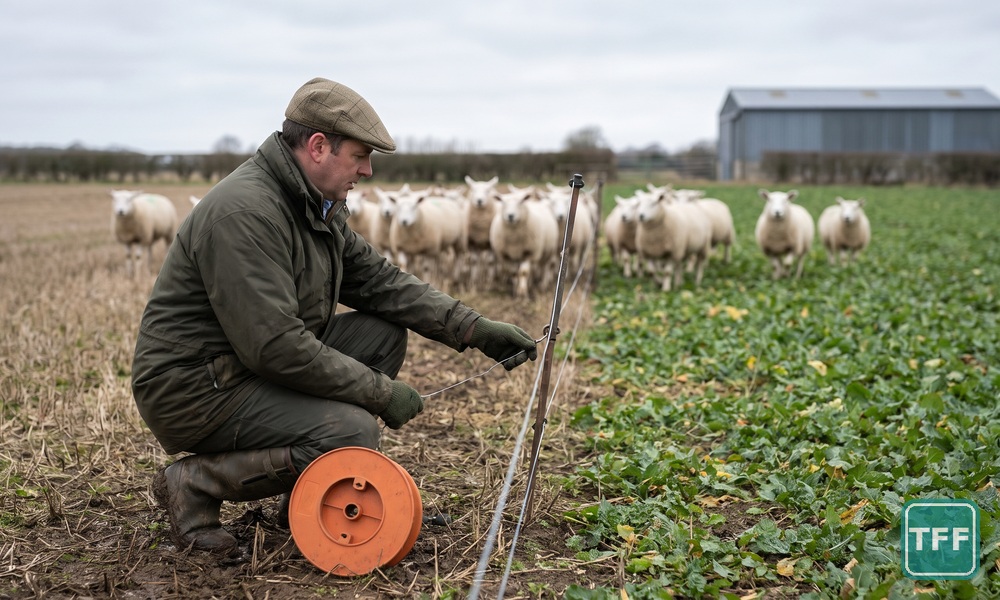
When a university student asked The Farming Forum what stops livestock being integrated back onto UK arable farms, the room answered with a working list: fencing that costs as much as a tractor, marts and abattoirs that are hours away, labour already committed to the drill and the combine, and grazing agreements that fall apart over rent and security. For the trade, the conversation maps where mixed farming’s return will be won or lost.
By TFF News | 6 November 2026 | Livestock
The conversation ran from 24 February to 5 March 2026 and drew 106 visible contributions, 3,898 views and 361 reactions, an average of 3.41 reactions per contribution. The figures describe this single, self-selected conversation and are not a representative survey of the sector.
The bill arrives before the stock does
Capital came up before anything else. One mixed farmer set out the ground: “Lack of knowledge, skills and confidence be the main barrier, along with infrastructure – fences, handling facilities etc and some areas are now hours from marts and further again from abattoirs.” His own farm grazes winter covers with sheep behind electric fencing, but “to go and fence our land again for cattle would be prohibitively expensive”.
Others put the same arithmetic more bluntly. “if the arable men fenced their farms they wouldn’t have money to stock them or visa versa”, one contributor wrote, while another noted you could “put up a lot of fencing for the cost of a new tractor”. A contributor who attended a conference on the subject recalled its conclusion: “The biggest hurdles were lack of infrastructure, especially the cost for putting in something for cattle as opposed to sheep, and the lack of knowledge and expertise.”
The supporting trades have thinned out too. One contributor listed “Dwindling support infrastructure ; livestock markets in arable areas, abattoirs, large animal vets, hauliers, contractors etc” among the main barriers.
Mindset, skills and who does the work
“Mindset is the biggest issue and worrying about what the neighbours think.” The theme ran right through the conversation. “Livestock is a 24/7 job; arable farming isn’t.”, wrote one livestock farmer in a longer list of barriers.
The role of advice drew sharper comment. A sheep farmer observed: “I was amazed the other month when I was at a farming do, how many arable farmers will only do exactly as the agronomist tells them.” Another put it more pointedly, as his opinion: “Biggest hurdle is the agronomist who would sooner sell chems than use sheep and cattle to control weeds and pests in autumn”.
The closing contribution took a longer view, arguing that “the skills get lost when moving away from say livestock on what the public would consider a traditional mixed farm”, and that rebuilding them takes time.
Where the deals break down
The sharpest material concerned the arrangements themselves. “Land agents are a major obstacle”, one contributor stated flatly, recalling a deal from twenty years ago in which a stock farmer offered to fence, reseed and graze arable land: “Seemed a fair deal till the agents demanded £200 per acre / per year in rent.”
A sheep farmer approached to graze arable covers described the same pattern today: “It all stalled in both cases when the money the arable unit expected meant I was either working for nothing or subsidising the sheep on their spot with my others.” Where the terms are right, it works: “we work with 3 sizeable arable units providing the sheep to complement their rotations over the winter and it works brilliantly”.
Security was the other deal-breaker. “The arable farmer just has to change his mind, or some scheme looks better and they’re off.”, one contributor argued, calling stock a high-risk investment with no guarantee of keep the following year. The fix offered was cultural as much as contractual: “you need both parties to be properly invested in the success of all enterprises”. As one contributor put it, “The value of grazing livestock on arable soils is way under-estimated.”
Proof it can work
Against the barriers, the conversation carried a run of working examples. “Just moved this group of ewes on to a fresh bite of wheat the arable farmer wants chewed off. Rappa is your friend.”, wrote one sheep farmer, arguing fencing need not be the obstacle. “Some round here using GPS collars on cattle and ‘moving’ them by app!”, added another.
A contributor wintering 80 calves on arable ground in North Hampshire summarised the exchange: “Arable farmer gets soil improver, stock farmer gets winter keep.” A 600-acre farm in the south west is going further, returning to mixed farming outright: “I’m hoping that the investment into sheds and fencing will actually ensure we survive another 20 years”, its owner wrote, and later argued that “there are a lot of arable units out there which have underutilised acres that a young and keen livestock farmer would give their eye teeth for”.
The feed is often already there. One arable farmer finished lambs on volunteer oilseed rape at next to no cost: “There’s a lot of free or cheap food going to waste at the moment for the sake of a bit of effort.” An experienced grazier described how the arrangements mature: “We now try to influence what is planted in the Cover crops and so there is a greater benefit to both parties. We also do have around 40 miles plus of Rappa fencing.” A livestock farmer advising arable entrants was realistic: “It is not an easy game but it is doable.”
The policy lever left unpulled
Several contributors argued that scheme design, not agronomy, keeps grazing animals off arable land. “If the arable SFI options for fallow stipulated they had to be grazed by stock that would concentrate their minds”, one suggested. Another went further: “If they wanted to encourage mixed farming, they should have paid more to graze not less.”
The payment rates bear the point out. When the conversation ran, the Sustainable Farming Incentive paid £593 per hectare for legume fallow against £382 for herbal leys, the option more likely to be grazed. The SFI26 reform Defra announced on 24 February 2026, the day the conversation started, cut legume fallow to £532 and herbal leys to £224 for new agreements, and the legume fallow action on GOV.UK confirms the reduced rate. The gap between the ungrazed and the grazed option has widened, not closed.
A market waiting on terms
Read as a whole, the conversation is not an argument about whether livestock belong back on arable land. The agronomic case was barely contested and the working examples kept coming. What stands between appetite and uptake is capital and terms: who pays for fencing and water, what the keep is worth to each side, and what happens when the host farm changes its plans in January.
For fencing and handling suppliers, collar and seed businesses, auctioneers, vets and land agents, that is the question this conversation leaves open: demand for integration is visible on both sides of a fence that does not yet exist, and whoever makes the arrangements cheap, secure and simple will unlock it.
Read the source conversation and analysis
Read the full conversation on The Farming Forum here. A nine-slide analysis of the conversation, with theme, sentiment and engagement figures, is available as a PDF: download the conversation analysis deck.
This conversation had been viewed 3,898 times on The Farming Forum when counted on 6 November 2026. Want your brand in the room when farmers talk livestock?
Book advertising with Agri Web Media.