
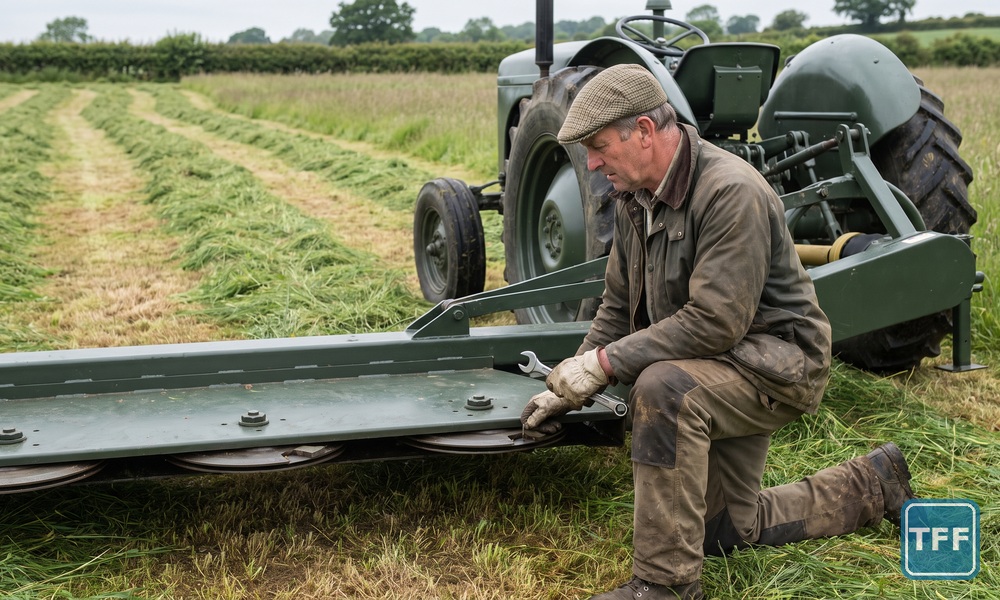
A farmer asking which mower conditioner could survive his ridge and furrow ground set off five weeks of frank machinery testimony on The Farming Forum, and the result reads like an unpaid market audit. Contributors ranked the big grassland brands on strength and ease of repair, defended machines their critics had written off, weighed mounted weight against tractor linkages, and argued over whether a revived sickle bar design deserves a place on modern farms.
By TFF News | 20 September 2026 | Machinery
The conversation drew 129 visible contributions between 4 June and 17 July 2026 and has been viewed 10,534 times. Contributions attracted 230 reactions, an average of 1.78 per contribution, with activity peaking on 5 June when 40 contributions arrived in a single day. These figures describe one conversation among the farmers who chose to join it. They are not a representative survey of the sector.
Brand reputations are made in the field, not the brochure
Brand reliability and build quality was the largest theme, raised in 42 contributions. The most detailed assessment came from a contributor who services machinery for a living: “I’ve bought, sold and worked on just about every make of mower.” His pick for his own money was Kverneland or Krone: “By far the easiest and simplest to work on and new parts reasonable.”
Krone drew the most praise for outright strength, but not unanimously. One contributor described the same brand defeated by heavy wet grass: “The Krone would just burn out the slip clutch, often without even getting the headland finished.” Brands that took blunt criticism from some contributors were defended by long-term owners with service records to hand. One runs a John Deere machine bought new a generation ago: “We have a JD 1350 that is 26 years old this year, bought new and other than blades it has needed one bearing on a disc.” A Kverneland loyalist made the same case in acres: “I’ve cut thousands of acres over the years with Kverneland mowers, on my fourth now and only ever had to change the knives and the oil and occasionally conditioner belts”.
The most reacted verdict of all cut across the brand argument entirely: “From what I’ve seen over the years any decent mower will give years of reliable service if driven and maintained intelligently.” These are individual experiences and opinions, and the conversation itself shows almost every marque with both satisfied and dissatisfied owners.
Parts access weighs as heavily as cut quality
Serviceability featured in 15 contributions, and it is where buying advice became most concrete. The engineer contributor priced a full bearing rebuild on a Pottinger in his workshop: “They’re special bearings but available from local shop. 22 bearings for £520.” Whether bearings and seals are standard sizes from a local factor, or dealer-only items, ran through several accounts of which machines are cheap to keep going.
Design protection systems got specific scrutiny. One contributor endorsed Krone’s breakaway disc arrangement because “it’s a five minute job to replace the roll pins that allow the disc to rise up” after a stone strike. That matches the manufacturer’s own description of the system: Krone’s SafeCut specification says a shock load shears a roll pin and threads the disc 15mm up the drive shaft, out of the orbit of its neighbours. A former SIP man, retired after 46 years in the trade, offered the seller’s caution to every buyer in the conversation: “All mowers bar none will find certain fields, crops that they don’t like cutting clean.”
The mower is only half the purchase
Fifteen contributions turned on what the machine hangs off. Heavy mounted mowers were repeatedly blamed for wrecked linkages, with the strongest advice framed around the tractor rather than the implement: “A krone mower on a well designed tractor will withstand abuse from the roughest of ground”, wrote one contributor with three of them, “But krone will quickly reveal a poorly designed tractor”. Others said they would only run trailed machines, on wear and on safety grounds.
Road transport, not field work, was named as the real killer: “Trailed don’t suffer from transport damage. They aren’t crashing about on link arms at 50k.” The same contributor’s wider point about operators drew agreement: “Too many folk think 50k is a target not a theoretical maximum”. For buyers matching machine to power, the conversation’s working rule was offered plainly: “I think 10hp per foot is the rough rule of thumb with mower conditioners so that’s about right for 90hp.”
A sickle bar revival splits the room
The most unexpected running argument, in 24 contributions, was over double-action sickle bar mowers, a design most of the room thought had been buried decades ago. One convert, cutting with an Italian-built bar mower after 30 years on discs and drums, urged doubters on cost grounds: “Parts are simple and cheap.” A contributor from the continent said the type is returning there “mostly for environmental readons so to speak, less destructive to wildlife they say”, while conceding: “They are going to have some work convincing the older generation who worked with the single acting ones and where delighted to see the back of them.”
That older generation duly reported for duty: “The first time I used a drum mower I thought I’d gone to paradise.” A £12,500 price reportedly quoted for a finger bar machine at Scotgrass was met with open disbelief, with contributors pointing out a modern disc mower can be had for similar money. The revival’s commercial test, on this evidence, is price rather than principle.
Where the money goes
Buying decisions and dealers featured in 18 contributions, and the value end of the market came out well. The engineer contributor put a new Irish-built Malone through his workshop and judged it “Very simple with plenty metal in the right places.” That squares with how the trade press positions the brand: Farmers Guardian’s buyer’s guide to plain disc mowers lists fourteen manufacturers competing in the UK market and describes Malone as building robust, mechanically straightforward machines. SIP and SaMASZ earned similar owner endorsements, and a SaMASZ representative joined the conversation directly to offer stock and demo photographs, a small sign of how openly manufacturers now sell into these peer discussions.
On used machines the room split between caution, “Try not to buy a used mower, you are generally buying someone else’s problem”, and pragmatism about buying from the right source. And the single most reacted contribution of the whole conversation was a two-word answer to the opening question of which mower is best: “your neighbours”. Twenty-five reactions suggest plenty of farmers intend to let someone else carry the depreciation.
The question the trade is left with
Nobody in the conversation disputed that a well-maintained mower from almost any serious manufacturer will last decades. What divided them was where the premium belongs: in the badge, in the steel, in the dealer’s parts shelf, or in nothing at all beyond the neighbour’s shed. With farm margins tight after two dry summers, the open question for the grassland machinery trade is whether the next replacement cycle rewards the premium marques or the simple, serviceable machines that this conversation kept circling back to.
Read the source conversation and analysis
Read the full conversation on The Farming Forum here.
Download the full conversation analysis as a slide deck: What mower is best? Conversation analysis (PDF).
This conversation had been viewed 10,534 times on The Farming Forum when counted on
20 September 2026. Want your brand in the room when farmers talk machinery?
Book advertising with Agri Web Media.