Weekly Summary: Politics Section
Date Range: 2nd – 8th November 2026
—
Executive Summary
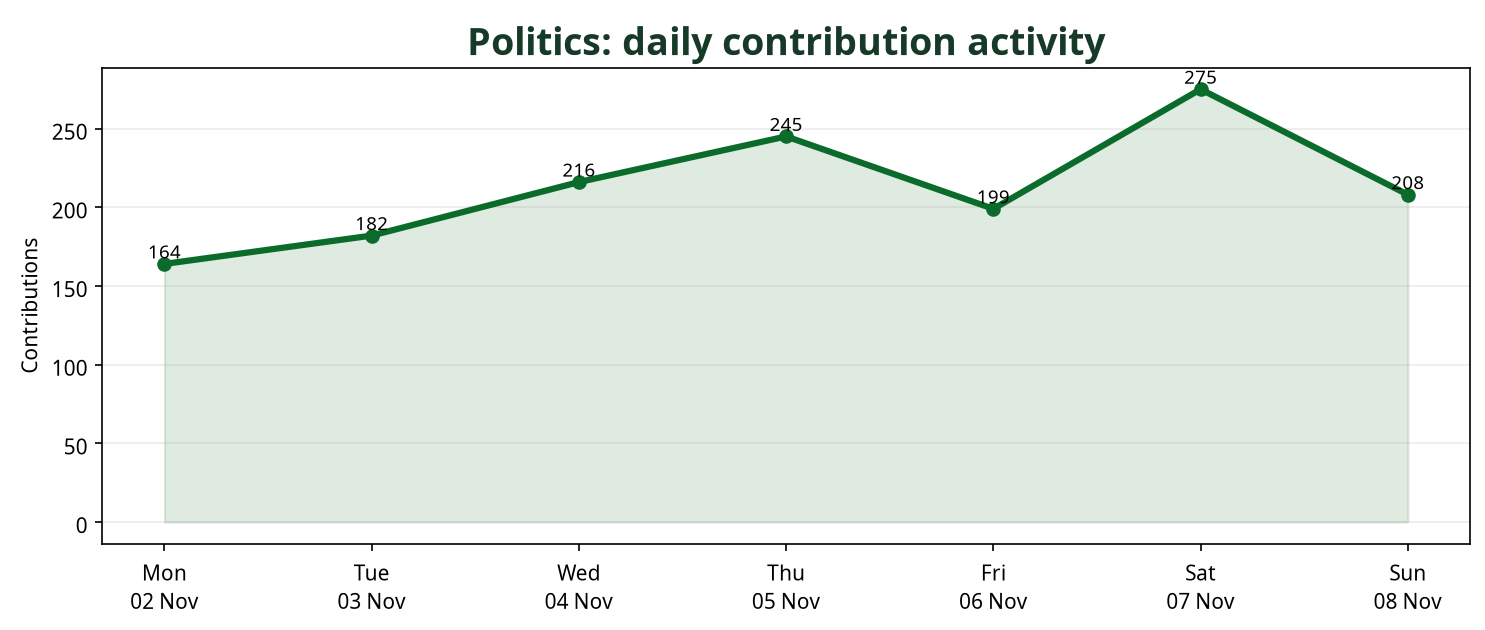
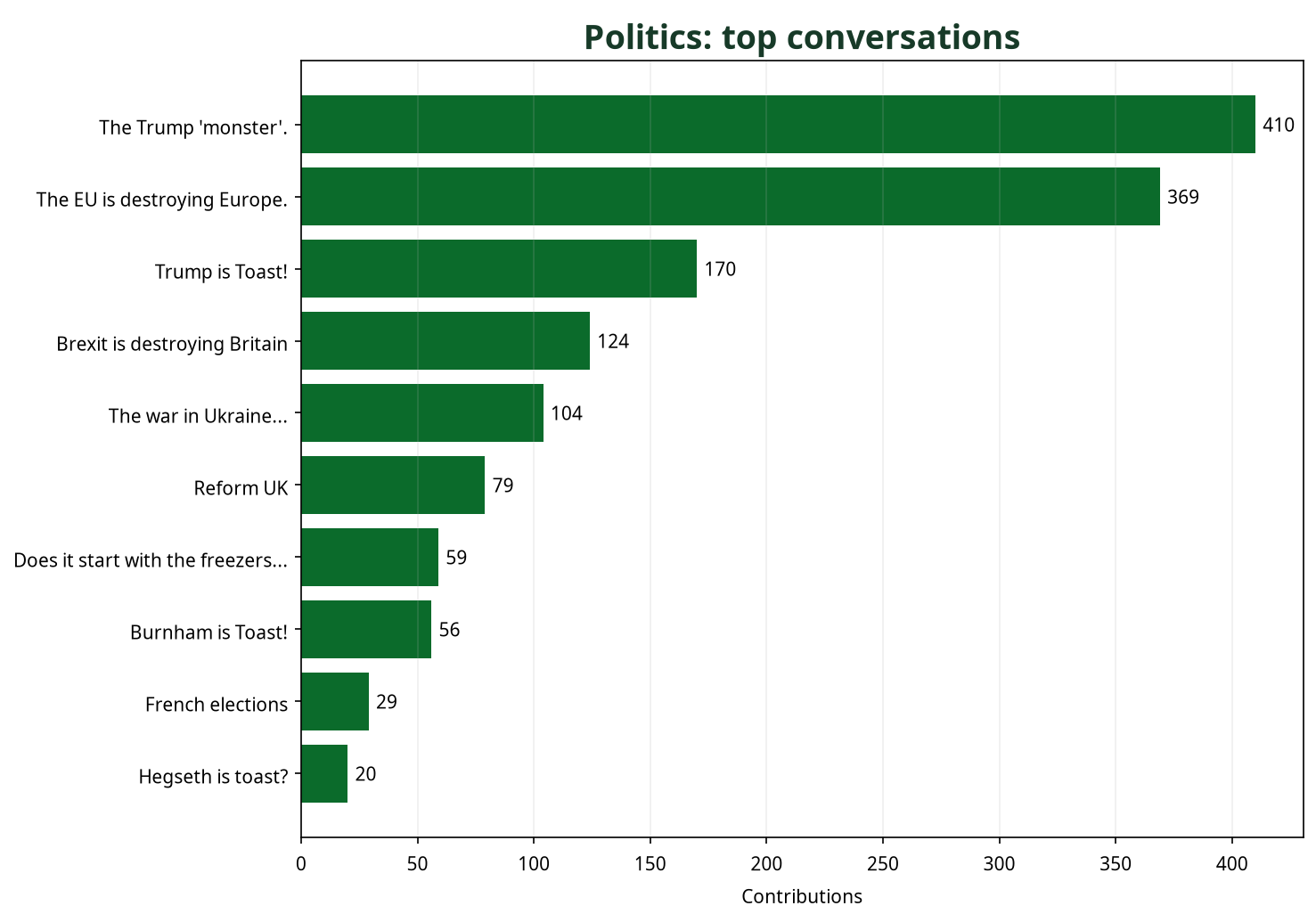
The Politics export for 2–8 November records 1,489 contributions across 30 conversations. The activity table below preserves the exact leading conversation titles, links and weekly counts. Titles are labels supplied by the forum, not findings endorsed by this report. Detailed prose draws on neutral themes in two independently reviewed conversations: the UK–EU relationship discussion with 124 contributions and the Reform UK conversation with 79. This narrower selection does not describe the full range of political discussion or establish which opinions were most widely held. Within it, contributors questioned economic comparisons, argued about institutional choices and debated public-spending priorities. They also expressed dissatisfaction with the alternatives available between parties. The account separates those arguments from claims about actual policy outcomes, election results or economic losses. A contribution count measures activity in the reporting window; it does not measure agreement, public support or the strength of the evidence behind a political claim.
—
Conversations at a Glance
| Conversation Name | Contributions | Key Topics |
|---|---|---|
| The Trump ‘monster’. | 410 | Recorded contribution activity; Narrative evidence excluded |
| The EU is destroying Europe. | 369 | Recorded contribution activity; Narrative evidence excluded |
| Trump is Toast! | 170 | Recorded contribution activity; Narrative evidence excluded |
| Brexit is destroying Britain | 124 | UK–EU relationship debate; Economic comparisons and public spending |
| The war in Ukraine… | 104 | Recorded contribution activity; Narrative evidence excluded |
| Reform UK | 79 | Public-spending priorities; Electoral choice and party confidence |
| Does it start with the freezers… | 59 | Recorded contribution activity; Narrative evidence excluded |
| Burnham is Toast! | 56 | Recorded contribution activity; Narrative evidence excluded |
| French elections | 29 | Recorded contribution activity; Narrative evidence excluded |
| Hegseth is toast? | 20 | Recorded contribution activity; Narrative evidence excluded |
—
Detailed Conversation Analysis
UK–EU choices and economic comparisons
Arguments about institutions and performance
The UK–EU relationship conversation recorded 124 contributions during the week. Reviewed messages included arguments for remaining outside the EU and criticism of centralised decision-making, alongside challenges to the comparisons being made. One exchange asked whether comparing a single country with a group of countries was meaningful. Other posts connected their views about institutions to concerns over economic prospects and public expenditure. This is evidence that those subjects were discussed, not confirmation that a particular institution caused economic damage or that one comparison resolves the question. The conversation also ranged beyond the implications of the UK leaving the EU, so its title should not be treated as a precise description of every contribution. The report retains the broad disagreement while omitting unverified figures, allegations about individuals and asserted outcomes of policy changes.
Public-spending priorities
Higher revenue or different allocations
The 79-contribution Reform UK conversation included a debate about how additional public expenditure could be funded. One position favoured examining existing allocations before raising further revenue. Replies pointed out that increasing spending requires money from somewhere and questioned the consequences of reducing other public services. The retained theme is the disagreement over priorities, rather than any proposed budget calculation. Specific sums cited in the posts are not repeated as verified accounts, and no route is presented here as an instruction or a recommended policy. This distinction matters because a conversation can contain a clear argument about trade-offs without providing the evidence needed to assess every option. The exchange shows contributors considering different funding approaches; it does not show that they agreed on which services should change or establish the feasibility of a spending programme.
Confidence in party alternatives
Dissatisfaction is not a measured voting intention
Other reviewed messages in the Reform UK conversation questioned the choices available between parties. Contributors discussed the possibility that support for one option can reflect dissatisfaction with another, rather than enthusiasm for every part of its platform. The article records this as an argument expressed in the thread. It does not use it to explain an election result, infer the intentions of voters outside the forum or describe any party’s overall level of support. The conversation title identifies where the exchange took place; it does not mean that all its contributions concerned that party’s programme. Keeping this separation avoids turning a discussion about alternatives into a claim about electoral behaviour. Together with the spending debate, these messages offer a limited view of the questions some participants were asking, without supplying a representative assessment of political confidence.
—
Conclusion
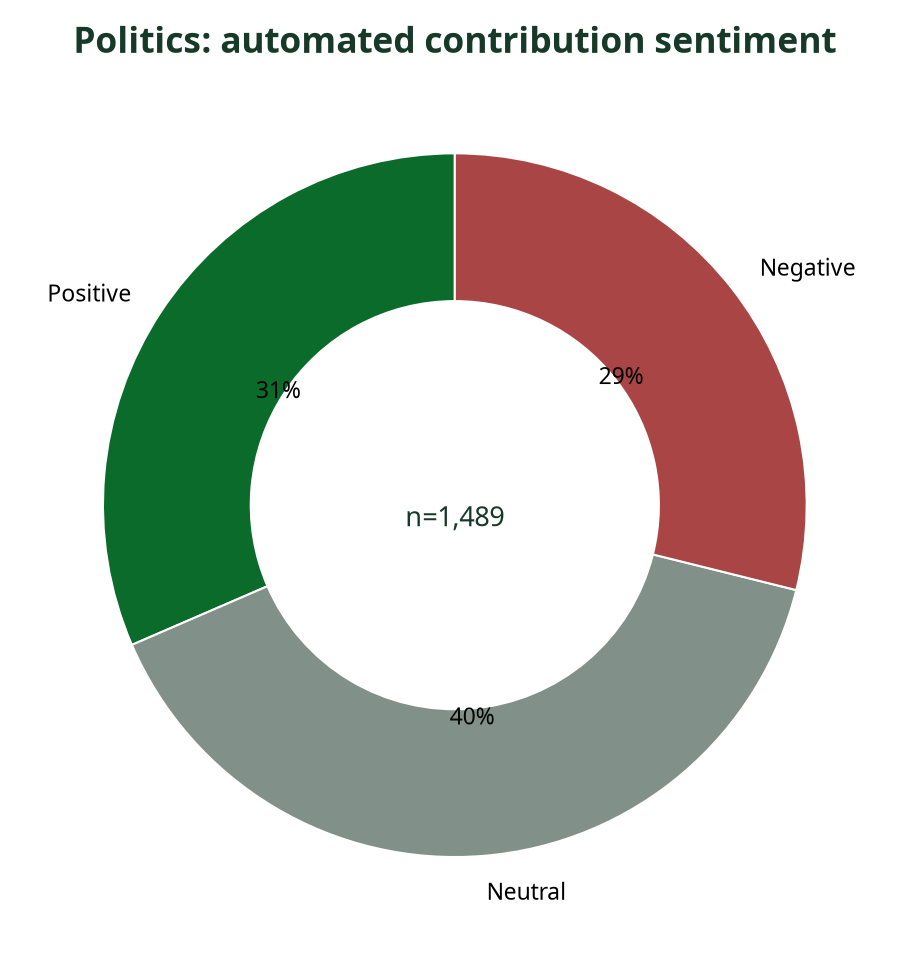
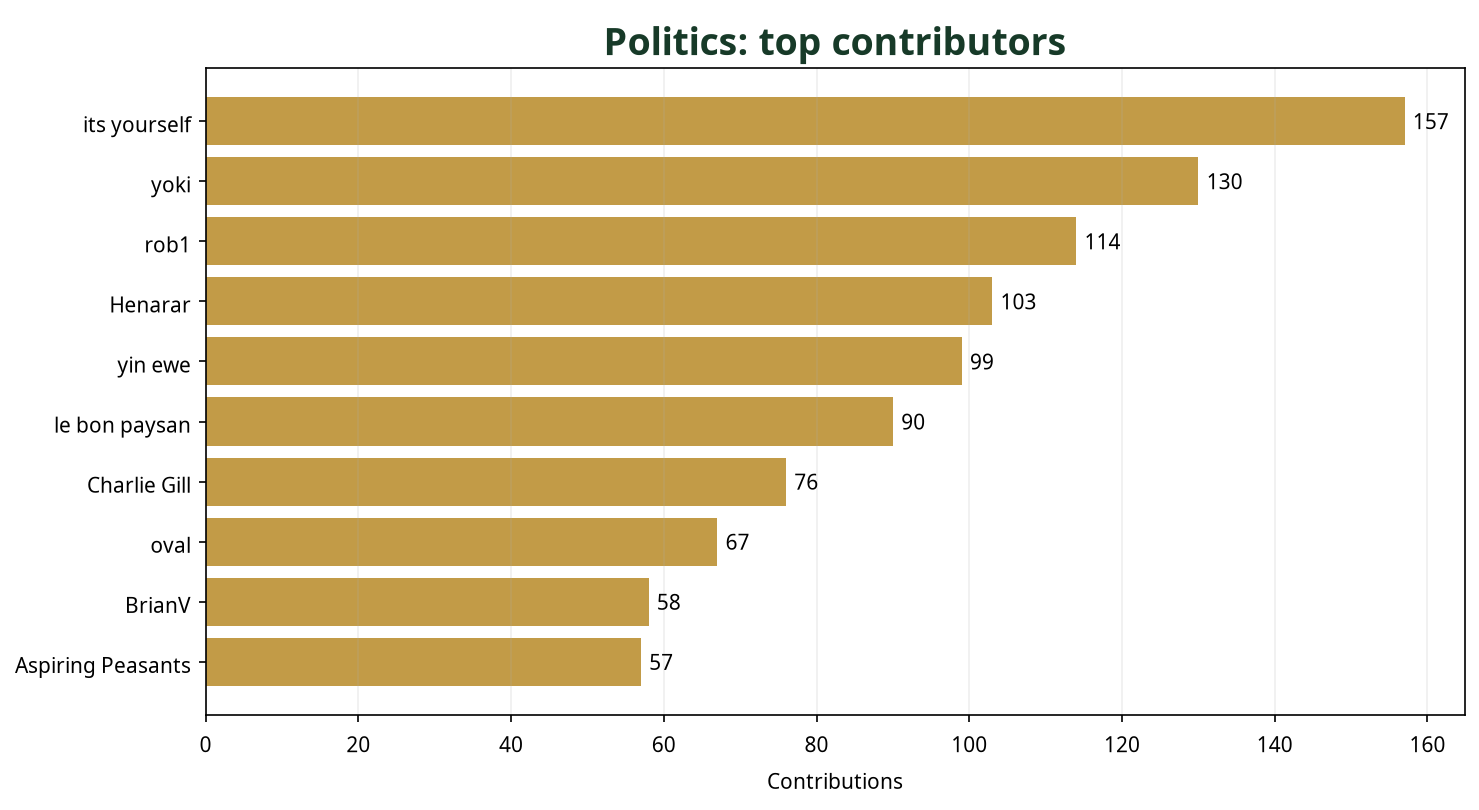
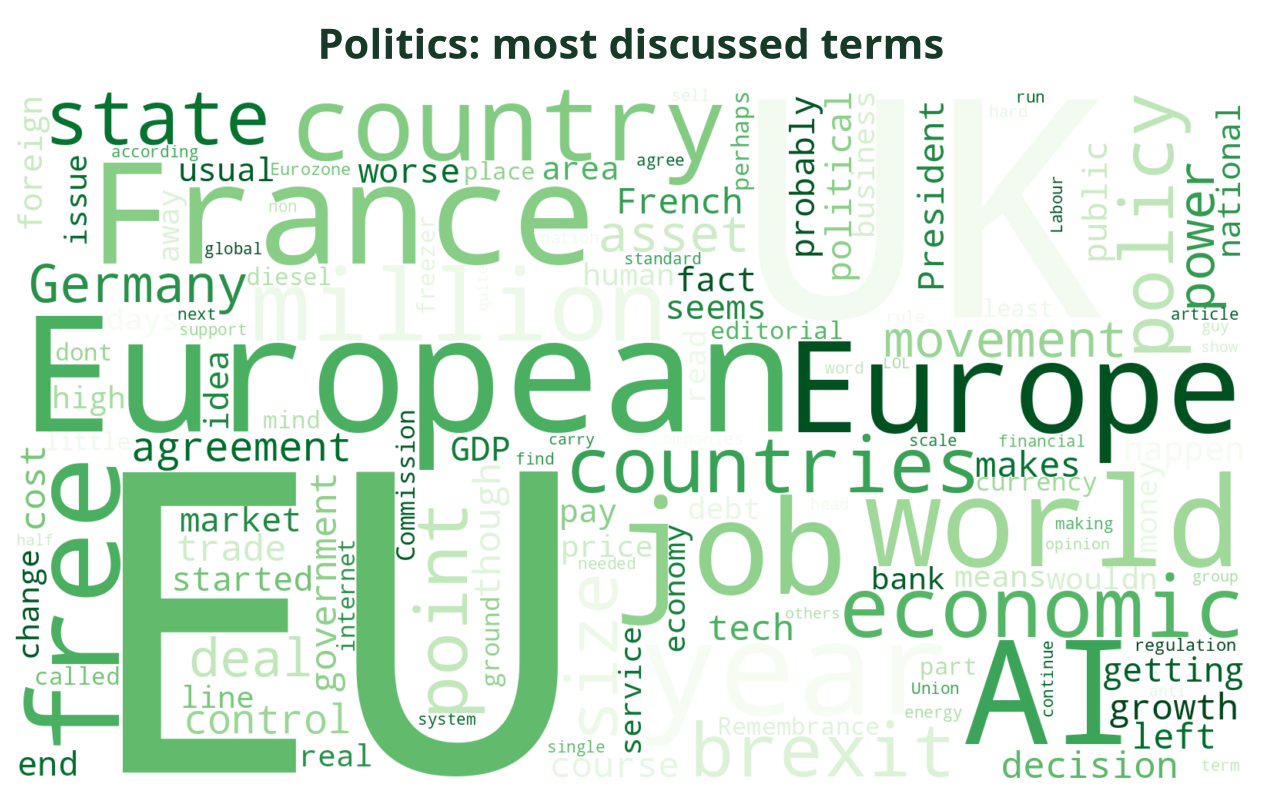
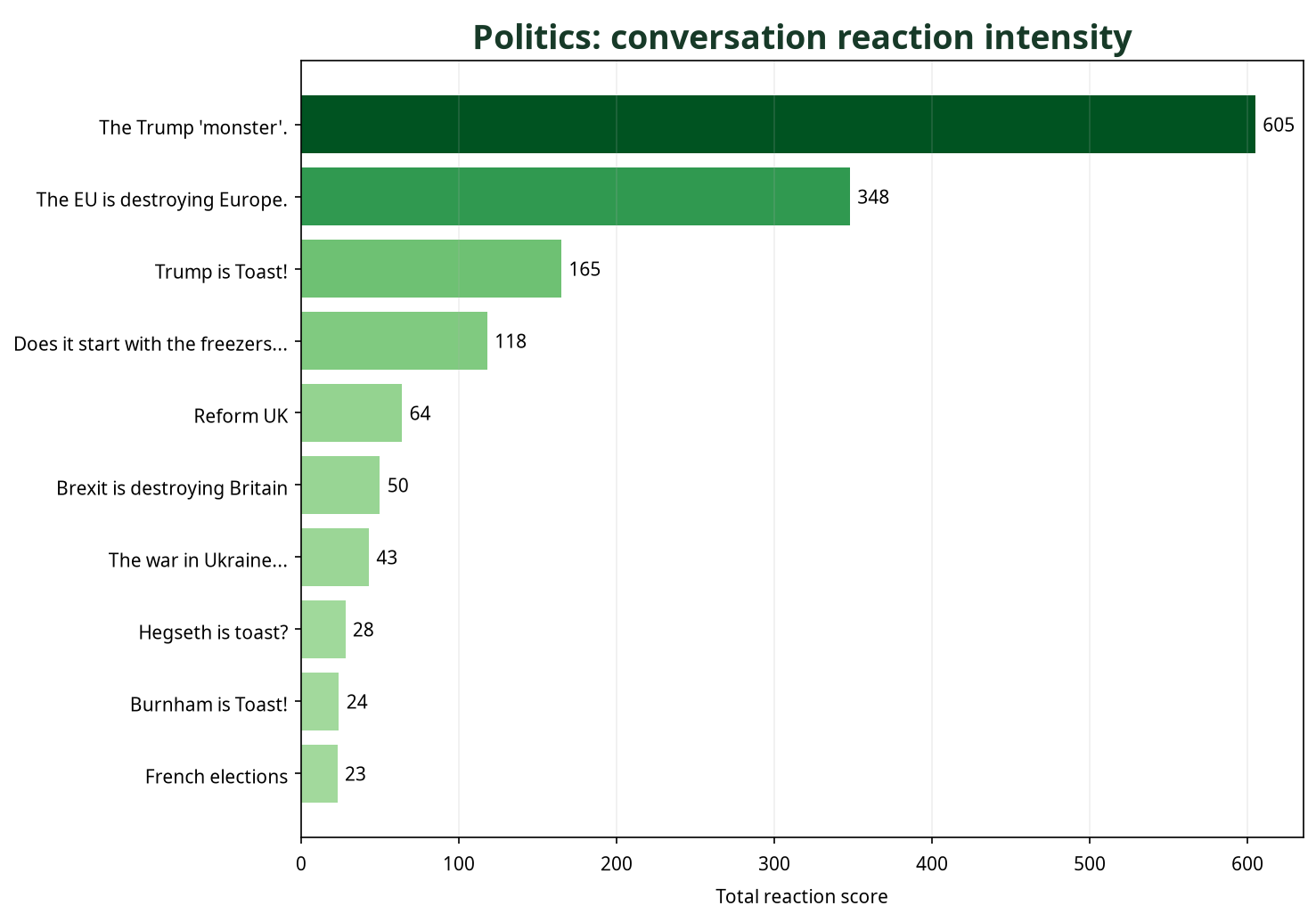
This week’s full activity record and its narrower narrative selection serve different purposes. The table and quantitative charts describe contributions in the verified export, while the prose retains only neutral themes from two reviewed conversations. Their subjects include the UK–EU relationship, economic comparisons, spending priorities and dissatisfaction with party alternatives. None establishes a policy outcome, an economic cause or a public consensus. Conversations excluded from the narrative still appear with their exact counts and source links where they rank in the top ten. The vocabulary cloud is deliberately filtered to limit sensitive language and is not a complete ranking of subjects. The sentiment donut uses automated VADER text classification across the export, including blank messages as neutral; its labels are not representative public opinion, clinical judgements or an assessment of the truth of political arguments. Readers can consult the linked conversations for the surrounding discussion.
—
For ongoing updates, readers can follow the active conversations linked throughout this summary.
This summary reflects contributions posted during the stated period. It is not a representative survey and should not be treated as professional, legal, financial, veterinary, agronomic or safety advice.