Weekly Summary: Politics Section
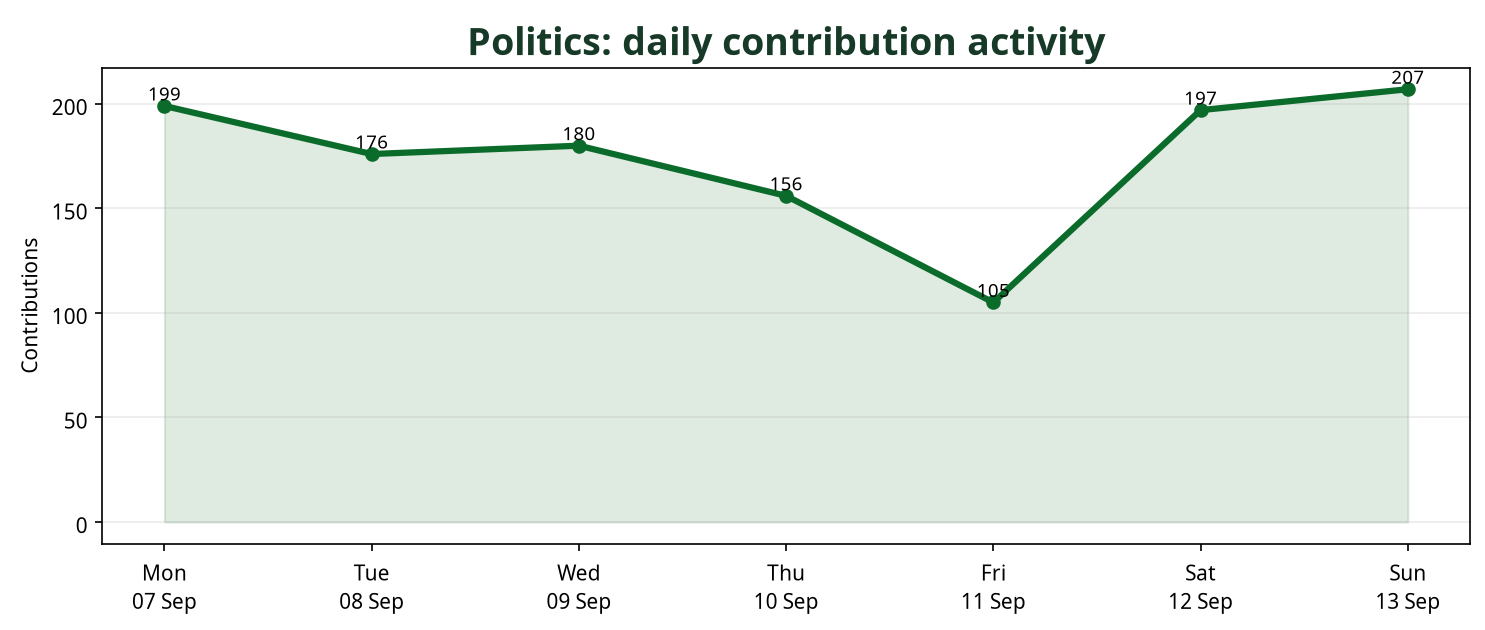
Date Range: 7th – 13th September 2026
—
Executive Summary
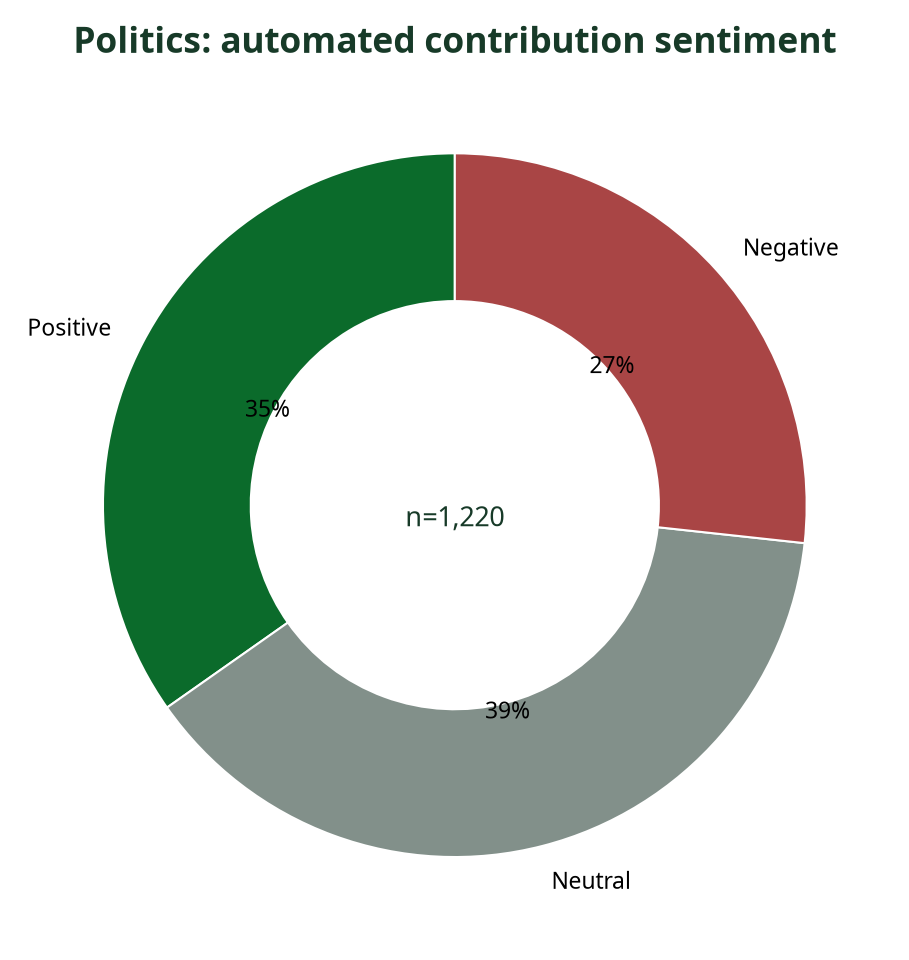
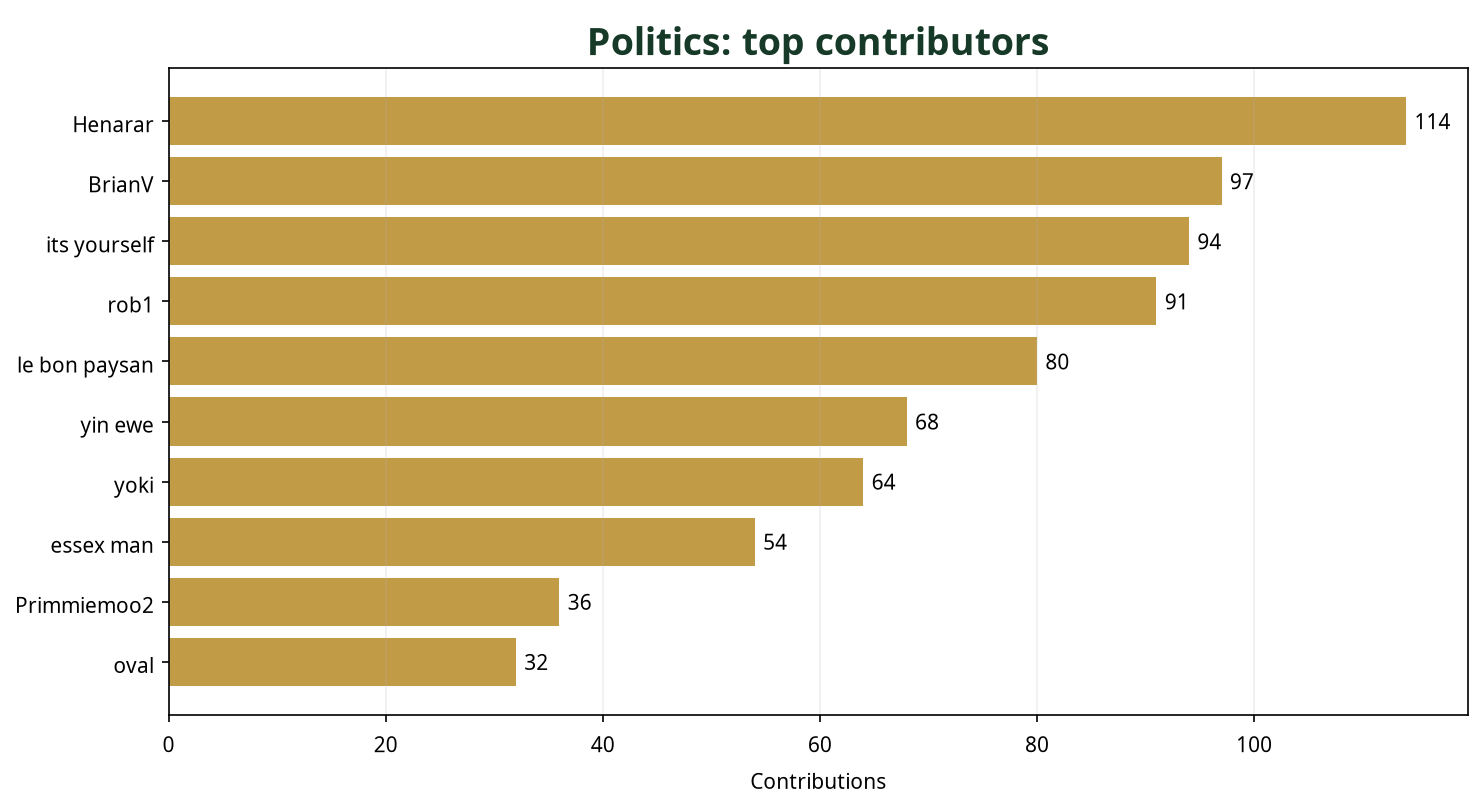
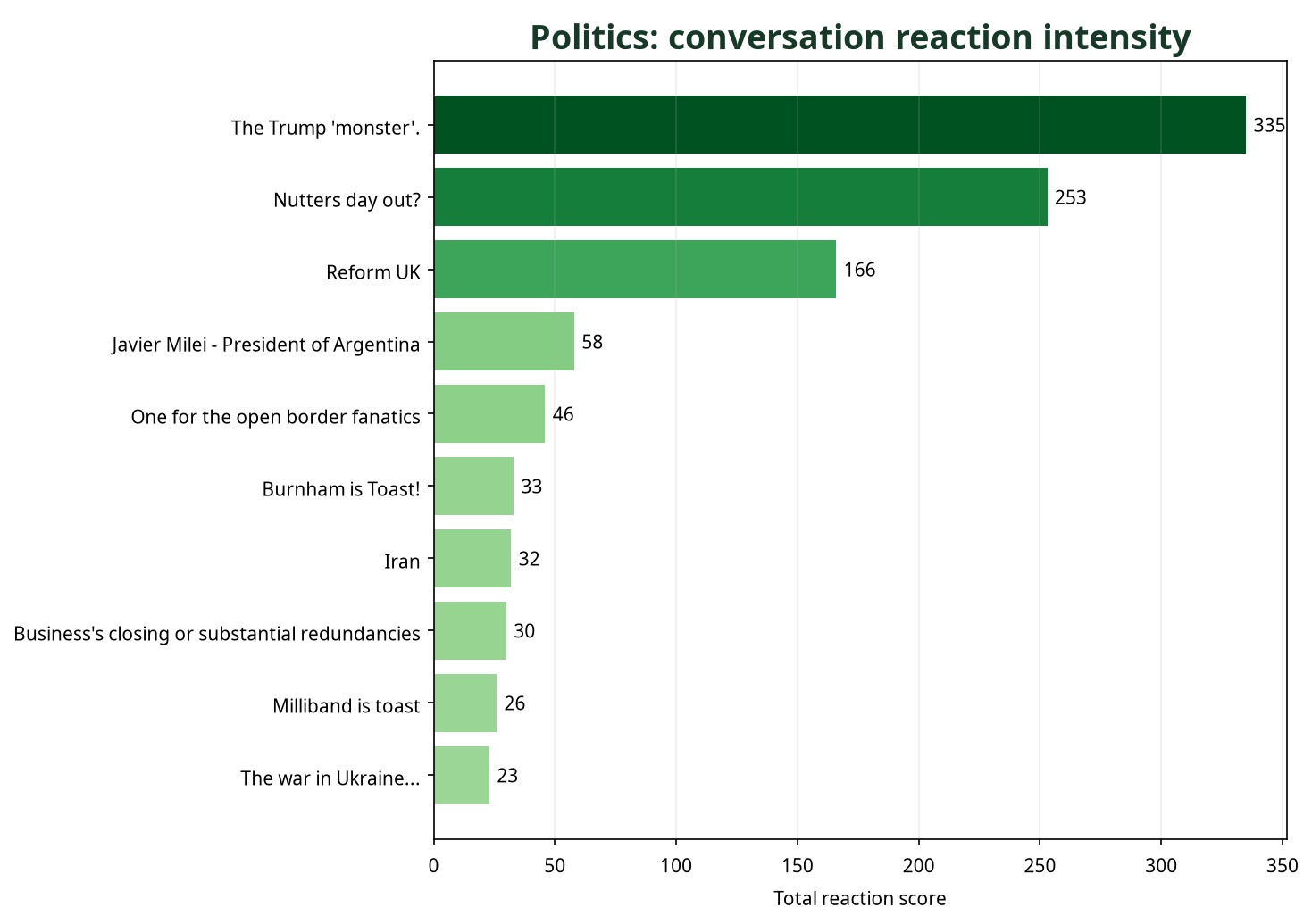
Between 7 and 13 September 2026, contributors made 1,220 contributions across 35 Politics-section conversations. The largest conversations overall included strongly worded or allegation-heavy discussions that remain visible in the exact table and charts but were excluded from thematic prose. The retained evidence covered political funding and infrastructure capacity, devolution and public-spending priorities, business closures, Brexit-related trade friction, party competition and the role of European institutions. Contributors combined personal observations, political interpretations and policy preferences; none of the forum claims should be treated as representative public opinion or independently verified evidence. The selected discussions reflect differing views about how national policy is financed, implemented and evaluated, rather than a shared position. This report summarises the range of retained arguments without endorsing parties, adjudicating allegations or amplifying inflammatory language.
—
Conversations at a Glance
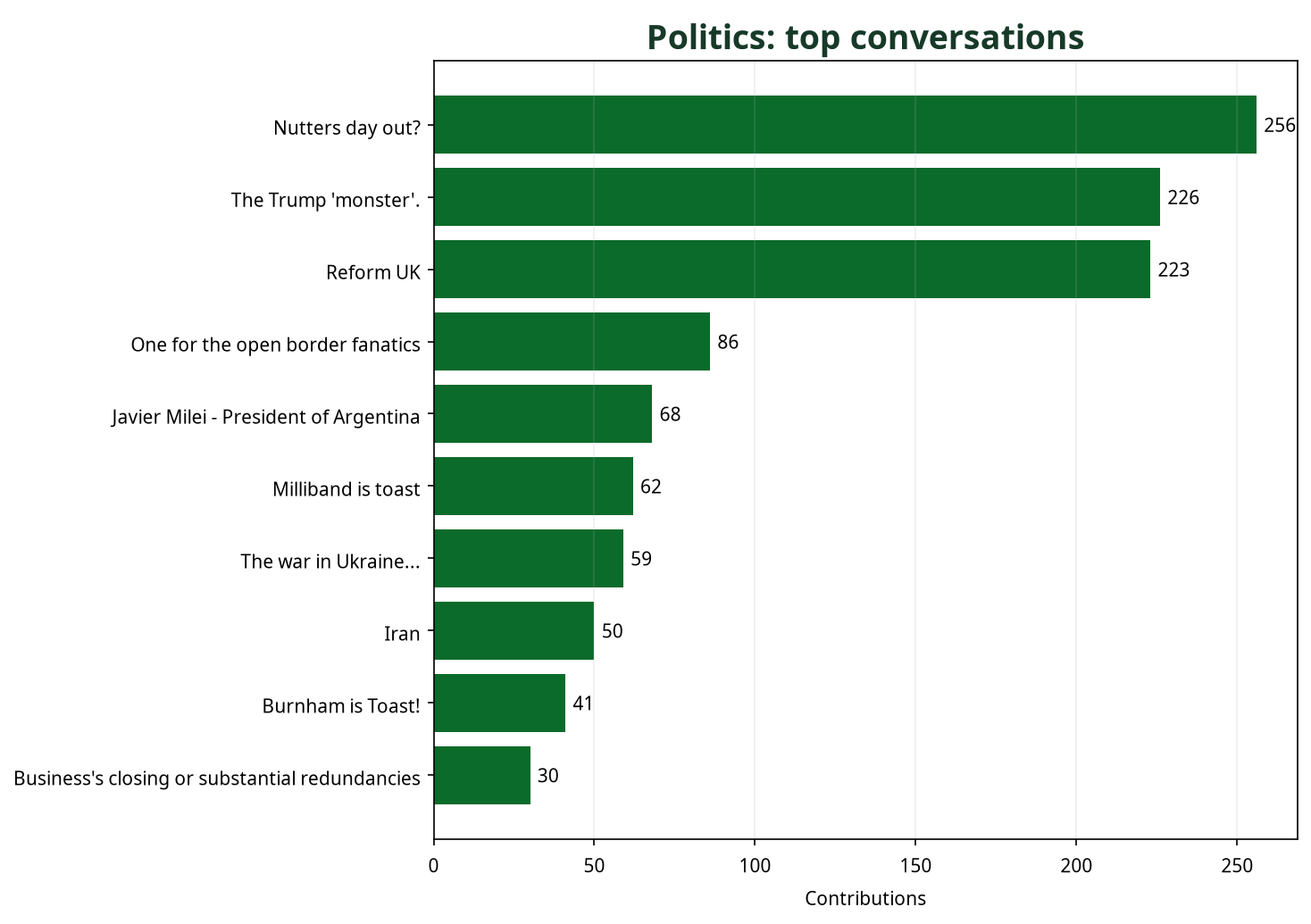
| Conversation Name | Contributions | Key Topics |
|---|---|---|
| Nutters day out? | 256 | Other discussion in the source section |
| The Trump ‘monster’. | 226 | Other discussion in the source section |
| Reform UK | 223 | electric-vehicle charging capacity; public-service delivery |
| One for the open border fanatics | 86 | Other discussion in the source section |
| Javier Milei – President of Argentina | 68 | Other discussion in the source section |
| Milliband is toast | 62 | Other discussion in the source section |
| The war in Ukraine… | 59 | Other discussion in the source section |
| Iran | 50 | Other discussion in the source section |
| Burnham is Toast! | 41 | mayoral powers; public-spending priorities |
| Business’s closing or substantial redundancies | 30 | business closures; redundancies; regulatory pressure; employment conditions |
—
Detailed Conversation Analysis
Official Context
The Office for Budget Responsibility treats Brexit’s effects on trade, productivity, investment and migration as forecast assumptions that are tested against emerging evidence; it notes broad agreement that higher trade frictions reduce openness, while the size and timing of any direct productivity effect remain uncertain. See OBR net-trade analysis.
Political finance, infrastructure and public services
Funding transparency and institutional trust
A high-volume party-political conversation broadened into questions about the influence of private donations and the transparency expected of political organisations. Contributors disagreed about how funding should be regulated and how much weight should be given to large donors. Specific donation figures and allegations about named people were excluded because they were not verified from the forum evidence. The retained discussion reflects concern about accountability and public confidence rather than a conclusion about any party or donor.
Infrastructure capacity and administrative delivery
The same discussion also considered practical limits on electric-vehicle charging and the administrative systems used to establish eligibility to work or receive services. Contributors contrasted policy ambitions with perceived gaps in local infrastructure and delivery capacity. Migration rhetoric, healthcare claims and prescriptive legal detail were removed. What remains is a broader political question about whether implementation capacity is keeping pace with policy commitments.
Employment, devolution and policy trade-offs
Closures and redundancies
A 30-contribution thread discussed closures and redundancies in a consumer-services sector. Contributors offered competing explanations involving regulation, taxation, operating costs and changing demand, while expressing concern about employment and local economic effects. Named-company figures, health claims, tax assertions and claims about illegal markets were excluded. The thread therefore illustrates disagreement about the balance between regulation, consumer behaviour and business viability rather than establishing a single cause.
Devolved powers and spending priorities
A separate 41-contribution discussion considered the balance between national and mayoral decision-making, including the distribution of fiscal powers and the priority given to pensions and social security. Contributors differed over which level of government should hold responsibility and how competing spending commitments should be reconciled. Named-person criticism, private tax-residence claims and specific personal financial figures were excluded. The retained comments show continuing interest in accountability across different tiers of government.
Brexit, trade and institutional alignment
Trade friction and public-project delivery
A 25-contribution conversation debated how far post-Brexit trade friction and domestic policy choices explain perceived weaknesses in trade and public-project delivery. Some contributors emphasised paperwork and border processes, while others focused on administrative capacity and procurement. Partisan slogans, unsupported market claims and allegations about named organisations were excluded. No consensus emerged about the relative importance of Brexit and domestic implementation.
European institutions and political identity
A smaller discussion considered the perceived durability and value of European and UK political institutions, and how institutional affiliation is used as a symbol in domestic debate. Contributors expressed contrasting views about cooperation, sovereignty and political identity. Military detail, territorial disputes, predictions of institutional collapse and personal remarks were excluded. The retained material records disagreement about institutional alignment without advancing a preferred outcome.
—
Conclusion
The Politics section was dominated numerically by several strongly worded conversations, but those threads contained allegations, inflammatory rhetoric or personal material unsuitable for narrative amplification. The retained evidence instead highlighted recurring questions about political finance, delivery capacity, employment, devolution, trade friction and institutional alignment. The OBR context clarifies that Brexit effects are handled as forecast assumptions tested against evidence and that uncertainty remains around the size and timing of productivity effects. Forum contributions remain anecdotal and non-representative, and the report does not endorse a party, infer public opinion or resolve contested factual claims. The linked table preserves the week’s exact activity record while the prose applies a narrower editorial evidence standard.
—
For ongoing updates, readers can follow the active conversations linked throughout this summary.
This summary reflects contributions posted during the stated period. It is not a representative survey and should not be treated as professional, legal, financial, veterinary, agronomic or safety advice.