Weekly Summary: Sustainable Farming Incentive (SFI)
Date Range: 20 April – 26 April 2026 Source: The Farming Forum – SFI Section—
Executive Summary
This week’s discussions in the SFI section of The Farming Forum focused strongly on practical challenges and strategic decisions related to the 2023 Sustainable Farming Incentive agreement. The dominant topics featured increasing option coverage to 100% on existing agreements, the specifics of SFI options for Permanent Pasture (PP), and the increasingly debated legume fallow practice under Num 3. Participants exchanged valuable insights on complying with record-keeping requirements for Wales’ Sustainable Farming Scheme (SFS), shared experiences on managing dog exercise fields with planning permission complications, and debated the continued viability of solar PV amidst regulatory and pricing uncertainties. Additionally, contributions touched on emerging renewable technology queries such as wood-fired boilers and battery costs for energy storage.The conversations captured a pragmatic and sometimes cautious approach among farmers navigating the balance between government scheme rules, practical farm management, and economic viability. Welfare inspections and the administrative burden of SFI compliance were also discussed, reflecting farmer concerns about scheme implementation.
—
Conversations at a Glance
| Conversation Name | Contribution Count | Key Topics Covered |
|---|---|---|
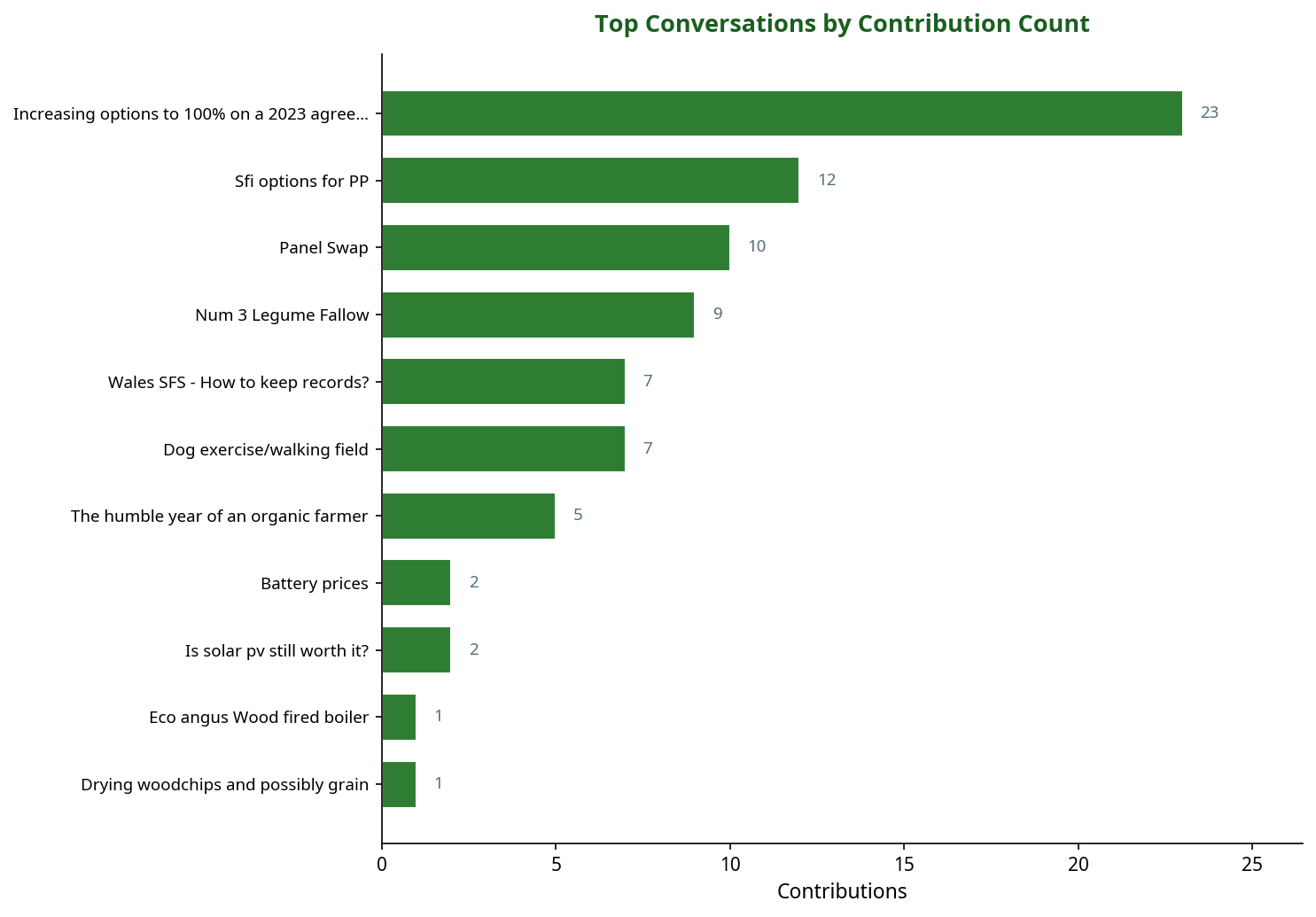
| Increasing options to 100% on 2023 agreement | 23 | Maximizing option area coverage, nitrogen and wheat price impacts, eligibility |
| SFI options for Permanent Pasture (PP) | 12 | Suitable options for PP, rotational constraints, persisting compliance questions |
| Panel Swap | 10 | Solar PV panel replacement issues, voltage concerns, warranty and costs |
| Num 3 Legume Fallow | 9 | Rules on legume fallow, hay/silage cutting permissions, species variety effects |
| Dog exercise/walking field | 7 | Planning permission challenges, retrospective applications, land-use exemptions |
| Wales SFS – How to keep records? | 7 | Record-keeping methods, online submissions, Universal Actions data management |
| The humble year of an organic farmer | 5 | Organic seeding equipment, cover crop mixes, establishment results |
| Is solar PV still worth it? | 2 | Financial viability, feed-in tariffs cessation, meter issues |
| Battery prices | 2 | Energy storage costs, installation requirements |
| Eco Angus Wood fired boiler | 1 | User experience, product availability |
| Drying woodchips and possibly grain | 1 | Technical feasibility discussion |
Detailed Analysis of Key Conversations
Increasing Options to 100% on 2023 Agreement
This was the most active conversation with 23 contributions, reflecting strong interest in how to optimize the Sustainable Farming Incentive agreements. Contributors shared experiences and strategic advice on increasing option coverage—particularly ALH1 and ALH2—to 100% of eligible land area. Key considerations included rotational requirements, nitrogen and wheat price volatility, and the interaction of cover crops to meet compliance without overstretching farm resources. Some contributors highlighted operational challenges when trying to exceed minimum thresholds, as well as the nuances of option eligibility based on pre-March conditions. The dialogue was highly practical, focusing on efficient land use within the confines of the scheme’s rules.SFI Options for Permanent Pasture (PP)
With 12 contributions, this conversation addressed the specific challenges associated with selecting and managing SFI options suitable for Permanent Pasture areas. Discussions revolved around balancing environmental benefit requirements with realistic management constraints, often referencing rotational rules and insect-friendly practices. Contributors debated the limitations imposed by the SFI framework on PP and sought clarification on eligible options, demonstrating the complexities faced by permanent pasture managers.Panel Swap – Solar PV Issues
This set of contributions dealt with concerns raised by farmers regarding solar panel replacement and associated voltage issues. Contributors exchanged technical knowledge emphasizing that voltage—not wattage—is the critical parameter when replacing panels, clarifying common misconceptions. Issues with feed-in tariffs (FIT) cessation, warranty claims, and the evolving regulatory context were raised. The consensus suggested growing uncertainty over the long-term financial advantage of solar PV installations under current policy frameworks.Num 3 Legume Fallow
In this nine-contribution conversation, farmers discussed the practicalities and regulatory boundaries of the legume fallow option. Key debates centered on whether cutting and removing fallow vegetation for hay or silage constitute a breach of scheme rules, with some contributors referencing official guidance allowing removal of blackgrass-infested cuttings but cautioning against feeding removed biomass to stock. Discussions also covered species diversity benefits from mixtures including lucerne, clover, and black medic, as well as the definition of “reestablishing” the fallow. Overall, contributions reflected attempts to balance scheme compliance with productive farm use.Dog Exercise/Walking Field
Seven contributions highlighted the planning difficulties and regulatory considerations encountered when managing fields used for dog exercise. Users shared experiences applying retrospectively for planning permission, fencing challenges, and navigating green belt restrictions. Some contributors stressed that grazing is generally permissible if the land remains for dog exercise purposes, offering a useful interpretation of land-use policies. The conversation indicated a strong need for clear guidance on this emerging land management practice.Wales SFS – Record Keeping and Data Submission
Participants exchanging seven contributions focused on the administrative side of the Sustainable Farming Scheme in Wales. Topics included methods for tracking and submitting Universal Actions data, clarity on records required beyond the application phase, and online submission platforms. Opinions varied on ease of use, with some farmers expressing frustration over ongoing data management, while others found the process straightforward. The discussion underscored the growing administrative workload associated with SFS participation.Additional Noteworthy Topics
– The Humble Year of an Organic Farmer: Organic farming equipment and establishment strategies, particularly the use of seeders for clover undersowing. – Solar PV Worth: Financial returns amid policy changes and meter issues continued to draw concern. – Battery Prices: Emerging discussions on costs and registration requirements for farm energy storage solutions. – Eco Angus Wood Fired Boiler & Drying Technologies: Limited but insightful contributions on alternative renewable heating options and grain drying considerations.—
Conclusion
This week’s discussions within the SFI forum section reflected a farming community actively engaging with the evolving Sustainable Farming Incentive landscape. The predominant themes showed a pragmatic approach to maximizing scheme benefits while managing compliance and operational realities. Technical challenges related to renewables, particularly solar PV and energy storage, point to ongoing uncertainty and adaptation needs. Meanwhile, emerging issues around land use, such as dog exercise fields, highlight farmers’ attempts to diversify land management within regulatory frameworks. Record-keeping and administrative burdens, especially within the Welsh SFS, remain key concerns. Overall, the conversations illustrate the dynamic challenges and opportunities farmers face as they implement environmental and sustainability commitments under current agricultural policy.