
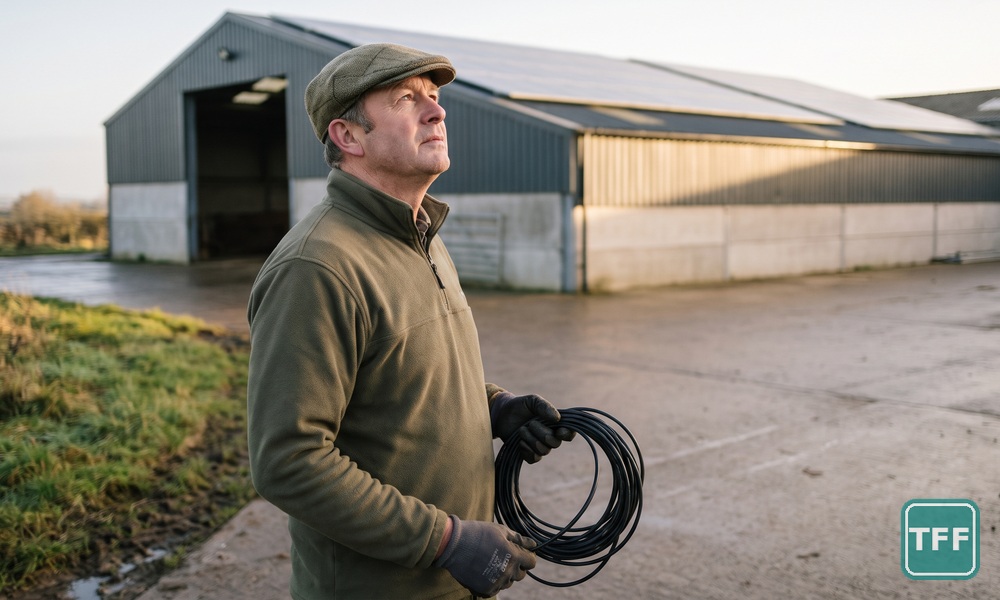
A question asked at the end of January, is solar PV still worth it, kept a conversation on The Farming Forum running for nine months, and by the time it went quiet in October the farmer who asked it had a 38.8kW system live on his barn roof. The answer matters for anyone selling energy kit into agriculture: farm solar stacks up again, for different reasons than in the subsidy era, and the firms quoting for it are being audited line by line in public.
By TFF News | 14 November 2026 | Energy
The conversation drew 254 visible contributions and 17,133 views on The Farming Forum, with 257 reactions across the run from 23 January to 11 October 2026, an average of 1.01 reactions per contribution. The figures describe one conversation among the farmers who chose to take part. They are not a representative survey of the sector.
The payback claims survived the room’s audit
The opening contribution laid out two installer proposals for a West Wales coastal farm with an all-electric farmhouse: 16kW of panels with 26kW of batteries at around £22,000, or 36kW with 44kW of batteries at £36,000, with quoted paybacks of eight and seven years. “Both seem almost too good to be true. Am I missing something?” the farmer asked. The first response priced the components and challenged the margin: “so about 10 grand in materials,and they want 36 grand ?”
The challenge did not stand. The buyer itemised the quote back, over £24,000 of components before cabling plus £7,000 of installation including a structural engineer and scaffolding, adding “It’s a VERY windy site looking straight out to sea, so we wont be cutting corners on the mounting & installation.” Other recent buyers backed the arithmetic, one of them the day after completion: “I was more interested in the pay back time which will be about 4 years.”
Quotes for similar kit are miles apart
The conversation’s sharper finding is how dispersed pricing is. One contributor was quoted £20,000 for a 10kW system: “They were keen to stick a 10kw system on shed roof, 15kwh battery. Magically his Ipad dreamed up a price of £20k!!” Another answered with his own larger system, “Far too much money my 17Kw panels + 40 kw Tesla battery plus car charger came in at £29,000”, and a third undercut both: “My 8kw system and 15kw battery came to £12000”.
Behind the dispersion sits a collapsed hardware price. “Panels are now so cheap (£30 wholesale) that it is worth putting in extra panels to generate more in low light conditions.” one contributor advised, and a former commercial installer’s buying price was relayed: “They were buying panels delivered from China. £30-£35 each.” When hardware is that cheap, a quote is mostly labour, balance of system and margin, and farmers can see it. One contribution asked whether independent consultants exist who will design a system a farm can then take out to tender, a question the conversation never answered.
Batteries and tariffs now carry the case
“the battery is the important bit”, one contributor wrote early on, and the numbers that followed bore it out: overnight import at around 8.5p a unit against daytime rates near 29p means a battery pays its way before the panels contribute. Export rates moved against buyers mid-conversation, the opener recounting that the 15p rate assumed in his quote had dropped to 12p before he signed, a figure that matches the 12p per kWh Octopus Energy currently publishes for its Outgoing export tariff. Rerunning his payback at 10p moved it from seven years to eight, and he signed anyway.
By September the system was live: “Waiting on paperwork to get export payments sorted, but produced enough today to supply all our needs and export 77kWh of leccy.” He also described a flexibility aggregator taking control of the battery at times of grid stress, paying £1 per kWh on top of export payments by his account, while cautioning that “That’s clearly not sustainable, so make hay while the sun shines, but don’t count on it for ROI calculations.”
Workmanship is the long tail of the sale
The sharpest warnings were not about panels but about the people fitting them. A contributor ten years into a shed system described the result of a poor install: “it’s one of those things I want to like but in the 10yrs since it was installed I am not sure it’s run fully for more than 3yrs.” The cause, he reported, was avoidable: “they didn’t tie the cables up under the panels so the pigeons get in there and the frost loves to open them up slightly when damp.” A contributor who has refitted large arrays for the same fault agreed: “it is so important for roof mounting that the cables and especially the MC4 connectors are tied up and never lay in the gutter or trough.”
After-sales worries farmers as much as fitting. Contributors recalled installers folding when the feed-in tariff closed, and one asked for advice after his inverter failed: “I have a GivEnergy inverter which has sadly died. So need to replace it.” GivEnergy, a British battery and inverter maker, was widely reported to have entered administration in April 2026. The buyer at the centre of it pushed back: “There are plenty of systems on rooves, all over the world. Don’t be put off by tails of cowboy installers.”
The grid is the other half of the bill
For farms starting from a single-phase supply, the connection can cost as much as the solar. “Just had our quote back for bringing 3ph to the farm £31k for a 700m run overhead which is better than the £40k estimate we were given 18months ago”, one contributor shared, with others warning of long waits for the work and the meter once the payment is in. Export limits, metering classes and standing charges all featured as live constraints, and one contributor summed up why so many big farm roofs still carry nothing: “You comments are exactly why UK hasn’t seen massive amounts of solar fitted to industrial units.”
New routes to market opened mid-conversation
Plug-in solar became legal in Great Britain while the conversation ran: the Government published its consultation response on 16 July 2026 and the amendment regulations came into force on 27 August 2026, covering kits up to 800 watts. The response states the specification does not extend to plug-in batteries, which one contributor saw as the flaw: “Until the battery system is approved to go with the balcony solar then its just a con.” in his view, though others argued the kits can usefully displace base load.
Land hosting also surfaced. “Been approached to host some solar panels on south facing land for a Community Power scheme.” one contributor reported, and the advice came with figures: “£2K and rising /ha rental. Will largely depend on the cost of grid connection.”
The question the trade cannot answer for them
Every payback here rests on tariff differentials that no farmer or installer controls, and the conversation ended on exactly that doubt. “Wouldn’t bet a fortune on it that 8.5p/kwh nighttime rate will stay for long.” warned a contributor watching overnight rates disappear in his own country, and the buyer whose question started it all closed with his forecast: “I suspect dynamic pricing will continue though, with price reflecting ebbs and flows in demand, and fluctuating renewable generation.” For installers, suppliers and energy firms selling into farming, the message is double-edged: the buying intent is real, the roofs are there and the maths currently works, but every quote is now stress-tested in public, and the tariff assumptions underneath it will be held against whoever signed them.
Read the source conversation and analysis
Read the full conversation on The Farming Forum here.
Download the full conversation analysis deck (PDF): Is solar pv still worth it? conversation analysis.
This conversation had been viewed 17,133 times on The Farming Forum when counted on
14 November 2026. Want your brand in the room when farmers talk energy?
Book advertising with Agri Web Media.