
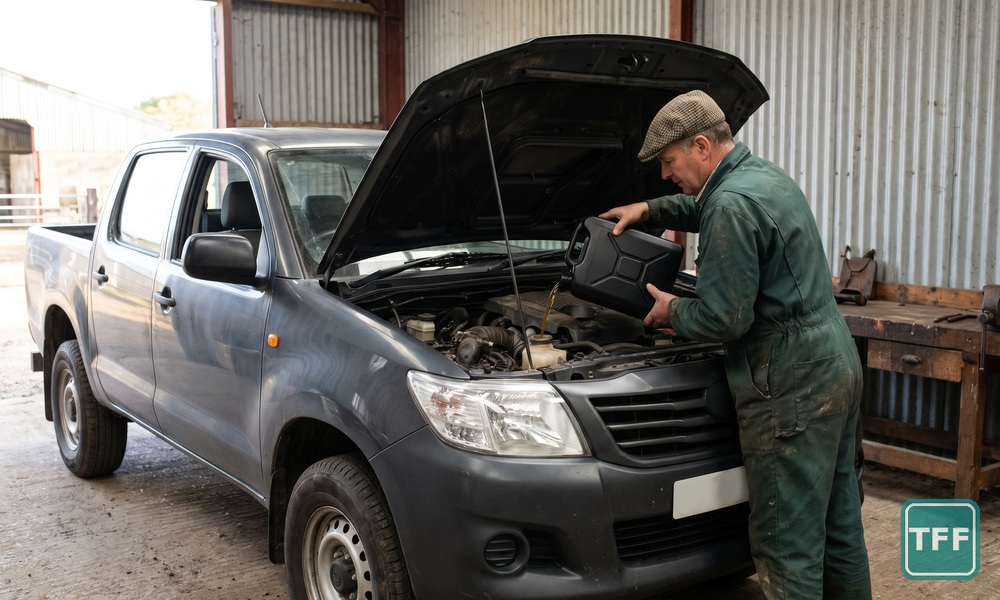
When a farmer asked The Farming Forum in January whether to buy a three year old Ford Ranger, the conversation that followed barely discussed the truck. It discussed the belt inside its engine. The 2.0 litre diesel fitted to most recent Rangers and Transits times its camshafts with a rubber belt running in the engine oil, and the room treated that one component as the deciding factor in a five figure purchase. Four weeks of contributions mapped how wet belt anxiety is now shaping farm vehicle buying, servicing spend and residual values, just as Ford abandons the design.
By TFF News | 15 November 2026 | Machinery
The conversation drew 145 visible contributions between 18 January and 16 February 2026, and had been viewed 11,554 times on The Farming Forum when counted on 15 November 2026. Contributions attracted 205 reactions, an average of 1.41 per contribution. These figures describe one conversation among the farmers who chose to take part. They are not a representative survey of the sector.
A five figure truck judged by one component
The opening contribution set out the purchase, “lookig at 3 year old ranger with 25 k miles in clock looking to keep the truck for 10 years hoprfully”, and the first reply was five words: “Do not do more than look.” Others were less absolute but no less conditional: “If you buy, change the belt.”
The sharpest framing of what is at stake came early: “seems to me there’s going to be a whole ‘raft’ of secondhand vehicles made 17-23 potentially worthless because of wet belts”. That is an opinion, not a settled fact, but it is the fear now sitting under secondhand valuations of these trucks.
The maintenance regime the room has settled on
For a conversation this anxious, the practical advice was remarkably consistent: “I believe the secret is to change the oil religiously, with short time spans or milages between changes and then change the belt before its necessary too.” One contributor explained why farm use is the worst case: “5000miles or 6 month oil changes should be considered mandatory with these engines, if you are using it on a farm scenario / towing etc.”, because short runs and interrupted DPF regenerations put diesel into the sump, where it attacks the belt.
The failure mechanism was described precisely: “The majority of engine failures on wet belt engines aren’t due to the belt breaking, they’re due to the belt breaking up and pieces of the belt blocking the oil pick up.” That matches the published guidance: Parkers’ guide to Ford wet belt issues lists the Ranger’s 2.0 EcoBlue among the affected engines, describes degraded belt rubber causing oil starvation, and records that Ford cut the belt replacement interval on the EcoBlue Transit to six years or 100,000 miles, down from ten years or 150,000 miles. One contributor’s advice was to “Change them young and use the very specific correct oil and they are ok.”, with a fairness note: “Remember, there is more of these engines around than any other commercial vehicle engine, so you will hear of more issues than alternative makes.”
The bill does not stop at the belt
Belt change prices quoted in the conversation ran from £1,100 to £2,000, with “Costs about £1500 to change the belt.” the most cited figure. The job rarely ends there: “Plus injector seals & washers, plus vac pump & gasket, plus oil & filter, coolant, fuel & air filters, front diff seals and oil, aux belt etc etc. It soon starts to snowball.” Against that, the preventive case: “you can buy a LOT of oil for 1500 quid”.
The scale of the work going through workshops came from a contributor relaying an account from a family member at a franchised dealership, which he reported did 38 wet belt changes in November alone, averaging at least 20 a month. His account cut both ways: “Of the total amount none of them had seized the engine”, and “generally very few now result in engine failures because everybody is aware of it.” His own verdict, after two belt changes: “Would I have another one? Yes.” This is a relayed account of one dealership, not published data, but it is the closest thing the conversation produced to a workshop level picture. Not every workshop wants the job: one owner of a 50,000 mile truck reported that his local garage flagged the belt but “hes not keen to do it himself.”
The dilemma of preventive spend was caught by a contributor who had the job done on his eleven year old 1.0 litre Ford, “Oh well, £1200 for peace of mind”, even though the old belt came out looking sound, and by a Ranger owner at 61,000 miles who booked his in for late February: “It’ll give us peace of mind,hopefully.”
Owners split between fine and fearful
Set against the anxiety was a steady line of untroubled ownership: “On my second ranger now and never had any problems. Main thing is stick to the service schedule, use the correct oil and don’t try to skimp on servicing”, and a “70 plate Thunder here on 49k miles which hasn’t put a foot wrong so far.” The split was less about whether the engines can last than about whether a working farm, with short runs, livestock trailers and winter idling, is the environment in which they do.
The hardline position got its airing too: “I wouldn’t touch any wet belt engine from any manufacturer”. Talk of a conversion kit to chain or gear timing followed, before the room concluded it was not viable: “Too expensive to be worth doing, as daft as that may sound when a failed wet belt often means a totalled engine.”
Buyers are already pricing in the alternatives
The conversation doubled as a tour of where the money goes instead. One contributor had already moved: “replaced it 15 months ago with a 2.9 Euro6 (Non-AddBlue) Dmax with 120,000 miles (Timing chain not belt)”, the parenthesis doing the work. A Toyota owner agreed by example, “Mine is 6 years old. Done 160k.”, needing almost nothing beyond consumables. A Volkswagen owner had “Taken 2 x 2 litre Amaroks to 150k miles and 120k miles so far” for little more than routine work.
New entrants came up unprompted. One contributor predicted in January that “I think the Mitsubishi is coming back to the uk later this year with a whole new model”, and events proved him right: Auto Express reported in February that the new L200 was back on sale in the UK from £36,295 excluding VAT.
The manufacturer has, in effect, conceded the argument. Chasing Cars reported in November 2025 that Ford is dropping the wet belt from its updated four cylinder diesel globally, moving the engine to a conventional timing chain from 2026. In the UK the point is already academic for new buyers: Auto Express reported that the 2.0 litre diesel left the UK Ranger range at the end of 2025, leaving the plug-in hybrid and the 3.0 litre V6 diesel. None of that helps the wet belt engines already in the field, which is why the conversation ran for a month.
The question the trade is left with
The Ranger remains the truck to beat: SMMT figures reported by Ford Authority put it as the UK’s best selling pickup again in the first half of 2026, on 4,829 registrations in a pickup market that has fallen sharply since the April 2025 tax changes. But this conversation suggests used examples now trade on their service history as never before. A belt change invoice and a stack of oil receipts are becoming part of the vehicle’s value, and trucks without them are the ones the room would not touch. For dealers, independent workshops, oil suppliers and the rival brands circling with timing chains, the commercial question is the one the conversation never resolved: whether the wet belt generation of farm pickups ends up a well documented bargain, or a running trade in parts and labour.
Read the source conversation and analysis
Read the full conversation on The Farming Forum here.
Download the full conversation analysis deck: Ford Ranger wet belt conversation analysis (PDF).
This conversation had been viewed 11,554 times on The Farming Forum when counted on
15 November 2026. Want your brand in the room when farmers talk machinery?
Book advertising with Agri Web Media.