
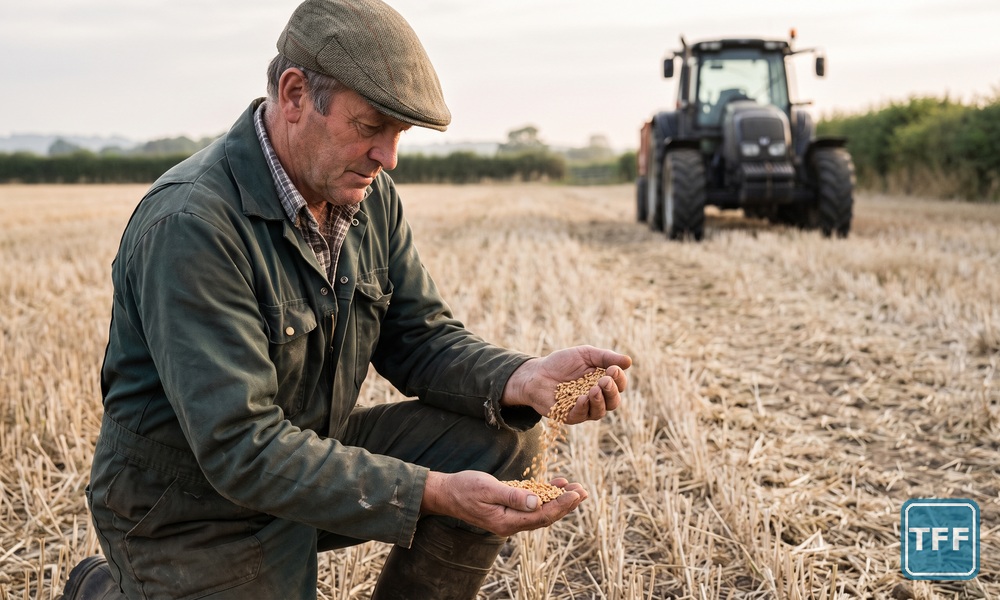
The earliest harvest on record has left drills hitched up weeks ahead of schedule, and a conversation on The Farming Forum shows arable growers arguing over what to do with the time. Some sowed wheat in the first half of September and have finished. Others, mostly on blackgrass land, are holding for October and warning that a hot dry summer has primed the weed to flush fast. In between sit the businesses that supply them: seed late or sold out, herbicide programmes priced field by field, and a variety changeover forced by availability rather than choice.
By TFF News | 21 September 2026 | Arable
The conversation ran from 25 August to 21 September and was still active on the morning of publication. It drew 107 visible contributions, 9,794 views and 150 reactions, an average of 1.4 reactions per contribution, peaking on 20 September as sprayer plans firmed up. The figures describe one self-selected conversation among farmers, not a representative survey of the sector.
The calendar argument
Drilling timing dominated, carrying 51 of the 107 contributions. The case for going early is the season itself. AHDB’s harvest progress reports had winter wheat 94 per cent cut by 24 August, and the levy board called it the earliest harvest since its records began in 2006. One contributor put the logic bluntly: “Well if harvest is now 6 weeks earlier why not drill 6 weeks earlier?” A Yorkshire grower who had first wheats and barley in by 9 September reasoned, “Seeing as how harvest seems to be earlier each year, getting it in early so it has chance to grow”, and reported the job finished by 18 September.
Grain prices sharpened the appetite for output. With Nov-26 feed wheat futures closing at £215.75/t on 28 August, the contract’s high to that point, one early driller argued “Mucky wheats be better than no wheats this year with way prices are heading”.
The other camp was equally direct. Asked on 10 September whether drills were rolling, one reply was simply “It’s the 10th September so No”. A fen grower is ploughing everything this year and stated, “It will be October before I drill anything this year. Sweet spot is usually Oct 10-20th.” An agronomist contributor described the same mid-September pressure arriving every year: “Every year I get ambushed in mid September about must get wheat in before weather breaks.” Another long-standing contributor summed up how the fixed date has already given way on many farms: “we now drill according to conditions, not a fixed date. That’s progress for you.”
Blackgrass is flushing early
The counter-argument rests on blackgrass, and this year it comes with a twist. Contributors reported the weed emerging well ahead of its usual pattern: “However we have noticed blackgrass seems to be flushing heavily (where it is) 2 weeks earlier than usual this year. What has everyone else seen?” One explanation offered in the conversation, “The theory is that hot dry weather during blackgrass flowering leads to lower dormancy. So I have read, anyway.”, matches AHDB’s research on grassweed dormancy, which found blackgrass seed dormancy is low when June and July are warm and dry, so emergence comes faster in the autumn. The same grower quoted above on programme planning was blunter still: “Dormancy is definitely low, generally stubble for low disturbance drilling.”
For the agchem trade, the conversation is a window on how programmes are being built and costed. One large-scale grower priced a worst-case pre and post-emergence stack at “About £104/ha.” and put the season’s chemical bill at “Probably 80-120 herbicides 50-80 fungicide maybe another another tenner max on growth regs and whatnot”. The timing of cinmethylin drew its own debate, with the agronomist contributor warning against leaving it late: “Do not delay to ‘post emergence’. or you will lose the efficacy of the cymethlin and wish you had put it on pre emergence.” Another contributor described stacking generic products around it, noting “Prosulfocarb is also fairly cheap now, so 5 modes of action in there.”
Drills, take-all and the second wheat question
Establishment method kept surfacing as more than a machinery preference. Several contributors credited direct drilling with suppressing take-all, the disease that traditionally punishes second wheats: “Since direct drilling with a disc, as long as it stays reasonably waterlogged free during the winter we se absolutely no Take all. been a revelation.” One second-wheat grower reported strong results from dressed seed sown early: “For the past 2yrs we have sown our second wheats in the 2nd week of september with latitude dressed tyhoon and yielded 3.75t/acre.” Others have given up on the slot altogether: “Second wheats ae out here. They cost as much and more than first wheats and rarely yield enough to be worthwhile.”
The rotation pressure behind that choice is commercial. One contributor observed, “There must be a lot of spring barley growers considering second wheats in the current malt market.” That reading fits AHDB’s June analysis, which put the GB barley area at a 16-year low, with the fall led by spring barley and attributed to lower prices and reduced premiums. Wheat sown after sprayed-off grass leys also drew steady interest, with experienced hands reporting “Been doing it for a time with no problems” and practical advice that “Ideally, the grass wants to have been dead for a few weeks before drilling to minimise pests like frit fly.”
Seed is the bottleneck
Whatever date growers pick, several could not act on it. A month after harvest finished, one reported “no seed yet apart from a couple of bags of over wintered stuff”, and by mid September a popular variety had gone entirely: “Alas there is no Gleam seed to be found”. That contributor switched to KWS Arnie, the breeder’s Group 2 wheat, a change made on availability rather than conviction. Not everyone was persuaded by the newcomer: “Had a bit, looked pretty, but didn’t better Gleam”, wrote one grower who is going back to farm-saved seed instead. For the seed trade, the signal is double-edged: demand came early and hard on the back of the early harvest, and the growers left waiting are the ones now weighing farm-saving as the default.
What the trade should watch
The conversation closed where it started, on the calendar. Dry seedbeds are still a brake in places, one contributor noting they “Can’t even get a cultivator in the ground. Will need 2 inches of rain to even think about rape going in, let alone wheat.”, and faith in forecasts is thin after a summer of promised rain that never came. The final contribution, made in the small hours of 21 September, weighed both risks of a warm open autumn: “Between the black grass coming and the bydv we will be first week of Oct if it doesn’t change.”
The unresolved question for the trade is whether the record-early harvest has permanently pulled the drilling window forward, or whether blackgrass and virus pressure will keep October discipline intact. Seed availability, dressing uptake, herbicide stacking and variety loyalty all hang off that answer, and the conversation suggests farmers have not settled it.
Read the source conversation and analysis
Read the full conversation on The Farming Forum here.
Download the full conversation analysis as a slide deck: Drilling wheat: conversation analysis (PDF).
This conversation had been viewed 9,794 times on The Farming Forum when counted on
21 September 2026. Want your brand in the room when farmers talk arable?
Book advertising with Agri Web Media.