
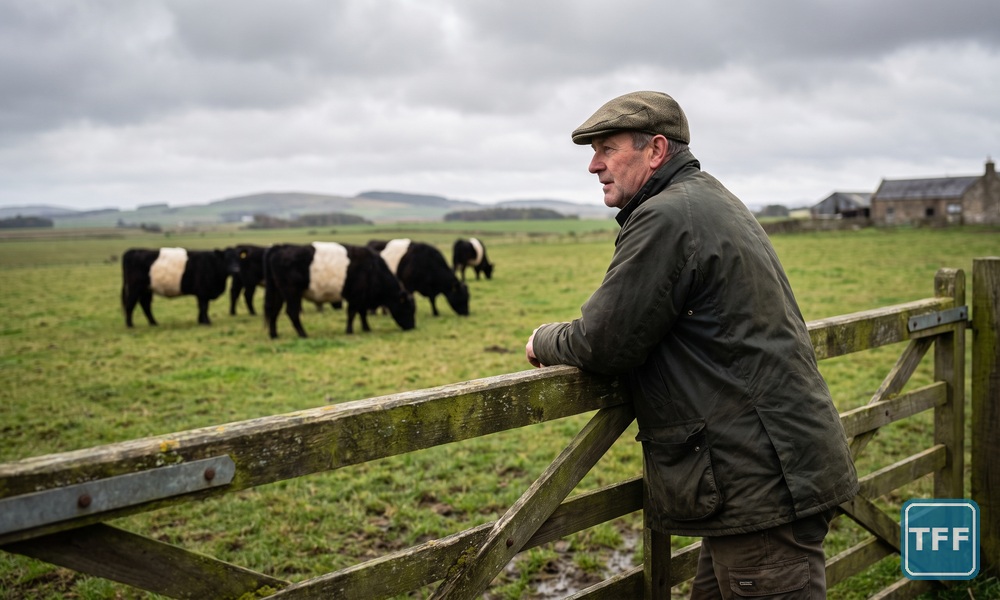
A routine inspection that ended with 271 healthy cattle booked for slaughter has made livestock farmers take a hard look at the system they comply with every day. When news broke that a Fife estate was to cull its entire herd because the animals could not be identified or traced, the reaction on The Farming Forum ran from disbelief at the waste to a firm defence of the rules, and the conversation became a working audit of what cattle identification is for, who checks it, and whether the penalties fit.
By TFF News | 29 September 2026 | Livestock
The conversation ran in the Livestock & Forage section from 2 June to 13 June 2026, drawing 192 visible contributions, 12,586 views and 538 reactions, an average of 2.8 reactions per contribution. Around a third of contributions were asides; the substantive strands covered the rules and their penalties, how the failure went unnoticed, and traceability and market confidence. These figures describe one conversation among the farmers who chose to join it. It is not a representative survey of the sector.
A herd lost on paper
The facts are unusually well documented. A routine cattle identification and traceability inspection by the Scottish Government’s Rural Payments and Inspections Division found 271 cattle at Falkland Estate in Fife, a herd of Aberdeen Angus and Belted Galloways valued at up to £500,000, to be unidentifiable and untraceable, barring them from the food chain and placing them under a permanent movement restriction, as Farmers Weekly reported. The decision to slaughter was the business’s own, with no compensation expected. The estate company, Falkland Rural Enterprises Ltd, said in a public statement that it accepted full responsibility for the management and oversight failures that allowed the situation to arise. Under the Scottish rules, set out in The Courier’s explainer, calves must be registered with ScotEID within 27 days of birth and beef calves tagged within 20 days.
One contributor set the opening tone: “I can’t really understand how they could have got things so wrong or are the authorities over-reacting about some small technical issues?”
How did nobody notice?
The question that ran hardest through the conversation was not why the rules exist but how a failure of this scale survived every check in the system. Contributors reasoned that if the whole herd was going, none of it can have been identifiable, and asked how long that had been running. One organic producer measured the case against her own inspection load: “For a start the Soil Association come to do our inspections yearly and talk about thorough. They want to see in the ins and outs of everything. Not just paperwork but visual inspections.”
The gap fed a darker suspicion, offered as opinion: “The more I think about it, it seems like this is being brushed under the carpet as quietly as possible because surely a lot of people/ agencies have failed in their duties for it to get this far?” Another put the resentment of the compliant plainly: “It’s because we comply. Those that don’t generally get left alone unless they do something bad enough that can’t be ignored.”
Culling was a choice, not an order
A correction supplied early in the conversation mattered commercially. A dairy contributor who had been through a tagging inspection failure explained: “We had a few cases a number of years back with missing tags during an inspection. We were allowed to keep them, keep calving them and keep milking them all into the food chain. They just couldn’t go into the food chain themselves once the time came.” His conclusion: “The decision to cull in this case is the farmers, no one elses.” That reading matches the official position reported by Farmers Weekly and The Courier, and little sympathy followed it in the conversation.
Waste, and the food safety answer
The waste argument drew some of the strongest agreement: “It seems a criminal waste of beef to me with hungry mouths in the world , they could isolate the cattle for a retention period before slaughtering them”, adding a challenge on double standards: “If they really followed the paper trail of imported beef following the same rules that they have condemed this herd with alot of imported beef would be chucked in the skip.”
The food safety counter-argument came back just as directly: “Now how do we identify which animals if any have been treated with various drugs with withdrawal periods?” And the commercial stake was spelled out by a contributor looking past the farm gate: “BSE has turned out to be little threat to humans but unfortunately without traceability then overseas markets for our beef might shut again. It’s all about confidence in the controls.”
Tags defended, penalties attacked
Very few contributors argued against identification itself. One called tagging “cheap, quick and useful”, and a suckler producer defended it on management grounds alone: “Livestock farming without tagging would be a nightmare. You have 20 days to tag which should be possible. Never mind the authorities, I need to know which calves were from what cow and bull.”
The attack fell on proportionality: “And yes, ID is useful. What isn’t are the rules surrounding it all, penalties for indiscretions most of which are totally disproportional.” Even the system’s defenders conceded: “I agree that the penalties for minor tag breaches are too severe.” The loosening case went further: “You should have six months to tag and register, not 3 days.”
The DNA argument
The most forward-looking strand asked whether technology has outrun the paperwork. One contributor argued DNA testing has made tags and passports obsolete. The rebuttal was technical and precise: “You can only prove parentage if there is a record of the calf’s parents with linked DNA. Once you go 2 or more unrecorded generations then a DNA sample is useless as you’ve nothing to compare it to.” DNA, in other words, extends a records system rather than replacing one; with no records there is no way back.
The question the trade is left with
The case turned ugly at its end. A contributor reported that “I see government inspectors are not attending the cull as they have been threatened.” That report checks out: First Minister John Swinney condemned threats made to officials, after which the Scottish Government said the cull would be verified by other means.
The conversation leaves the trade a double signal. Farmers who comply with identification rules every day defended the system’s purpose almost unanimously, because export access and consumer confidence stand on it. But the same farmers see an enforcement regime disproportionate on minor breaches yet apparently blind to a whole-herd failure until a routine visit found it. Whether the case brings a rethink of penalty design, inspection targeting or a formal DNA route back into compliance is the open question. Anyone selling identification, EID and herd-recording systems into UK livestock farms has just watched their market read a £500,000 case study in what happens without them.
Read the source conversation and analysis
Read the full conversation on The Farming Forum here.
Download the full conversation analysis as a nine-slide deck: Herd to be destroyed: conversation analysis (PDF).
This conversation had been viewed 12,622 times on The Farming Forum when counted on 1 October 2026. Want your brand in the room when farmers talk livestock? Book advertising with Agri Web Media.