
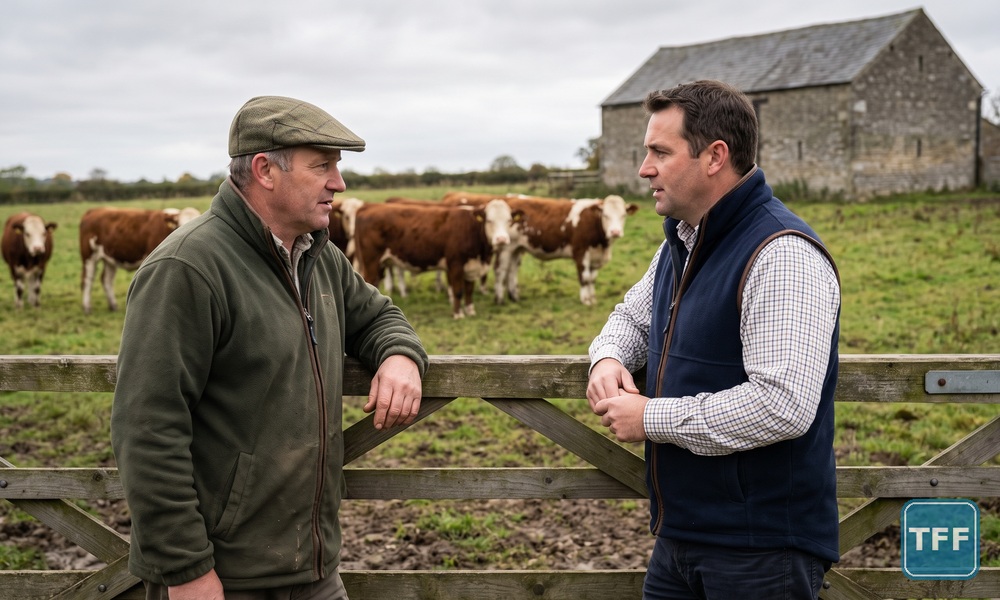
When a livestock farmer asked The Farming Forum which is the best agricultural business bank, the replies came back less as a league table than as a description of how farm banking now works. The clearest finding was that the service a farm gets depends on how much it owes: a dedicated agricultural manager, once ordinary, is now something a farm qualifies for by borrowing at scale.
By TFF News | 16 October 2026 | Business
The conversation ran from 12 to 15 October 2026 in the Agricultural Matters section of The Farming Forum and drew 107 visible contributions, 3,623 views and 181 reactions, an average of 1.69 reactions per contribution. The figures describe this one conversation and are not a representative survey of UK farm businesses.
A manager comes with the borrowing
Access to a named manager was the sore point that set the tone, carrying 23 contributions. One contributor recalled his time with RBS: “asked why we didn’t have a agri specalist and were told that you had to borrow 7 figures before you got one”. Another reported that at his bank there are “No agricultural managers at Lloyd’s anymore, only a switchboard of business managers who don’t seem to be able to make decisions”, though a larger borrower reported he still has a Lloyds manager who “only does agriculture”.
A Clydesdale and Virgin Money customer who lost his local agricultural manager because he does not borrow enough set out what that costs the bank: “I like to see the whites of the eyes of the people I am dealing with so I am not as happy so the next bit if business will probably go elsewhere.” A Barclays customer who got his good manager back only after moving into a higher lending bracket concluded: “Sad state of affairs when you need a big borrowing to get a good person on the end of the phone I suppose.”
The challengers earn their place
Comparing lenders carried 40 contributions, and the warmest recommendations went to names that barely featured in farm banking a generation ago. Virgin Money collected the most votes, one contributor calling it “breath of fresh air in comparison to RBS ! Understand farming, our relationship manager with them is a farmers son.” Another long-standing customer noted the caveat: “They’re in the process of becoming Nationwide though I think, so we shall see.” It is: Nationwide completed the legal transfer on 2 April 2026, keeping the brand for now.
Oxbury divided the conversation twice over, first on what it is, then on what it costs. Doubters called it a lender rather than a bank; in fact Oxbury holds a full banking licence, approved by the Prudential Regulation Authority and the Financial Conduct Authority in 2020 as a specialist founded, in its own words, by the farming industry for the farming industry. It offers lending and savings but no current account, something contributors said they had asked it about without result. On price, a borrower who refinanced through Oxbury reported he “shaved 4 years off the term. NatWest couldn’t compete this time.” Another was blunter the other way: “In 2024 they were more expensive than HSBC on borrowing”. A third split the difference: “Oxbury have a better lending criteria so cover a wider range of situations and lend in agriculture for a wider range of reasons. That’s the reason a lot of farmers are heading towards them not for their rates.”
AMC, the Agricultural Mortgage Corporation, a Lloyds Banking Group subsidiary since 1993, drew verdicts both ways, from “AMC ain`t what they used to be” to a borrower who chose it over Oxbury last year and found “AMC have improved in my opinion.” His wider verdict could stand over the whole conversation: “very little confidence in the industry.”
Letters asking why you bank at all
A smaller strand, 8 contributions, may matter most to the trade. The farmer who started the conversation described a letter from Barclays estimating what his account should receive over the next year and warning: “If we are not expecting to receive any money in the next 12 month they want us to explain why we need a account”. He has nothing borrowed. Another contributor confirmed the pattern: “Been with Barclays for 3 generations. Borrowed in the past to buy land. Now have nothing borrowed but have significant credit balances with them.” A third, who said his own bank dropped him altogether after an export sale, gave the advice the strand settled on: “Whatever bank you choose, I advise having a backup business account”.
The cost and shape of the money
The largest theme, 54 contributions, was the mechanics of borrowing itself: when an overdraft beats a loan, how banks treat livestock as security, and the serviceability test one contributor summarised as “serviceability is 1.5 times your debt repayment commitments that means basically more tax and less reinvestment money”. Spreading debt across lenders was urged as insurance: “If the bank pulls the pin on you, wouldn’t take whole business.”
The warmest words in the whole conversation were for money no longer on offer. “Just paid my bounce back loan of yesterday , used it to buy 45 cows and now have paid it off and got 90 cows”, reported one livestock farmer, and another agreed: “That’s the cheapest money I’ve ever had”. The Bounce Back Loan Scheme of 2020 lent up to £50,000, capped at 25% of turnover, at a flat 2.5% with a 100% government guarantee. Nothing on today’s market compares, which is why the nostalgia reads as a signal about current pricing.
Little appetite at today’s prices
Running under it all was reluctance, 19 contributions on whether to borrow at all. “I wouldnt want to borrow for anything at the moment , we are at stage where prices are still high and rates are rising.” The Bank of England has in fact held Bank Rate at 3.75% through 2026, most recently on 17 September, but three of the nine Monetary Policy Committee members voted for a rise and market pricing implies increases into 2027. Asked how a farm expands without borrowing, the opener answered “Slowly”, though another contributor set out the limit: “sometimes that opportunity just comes along and you just haven’t had 10 years to save or wait it’s now or never.” A third pointed out that much farm lending is not expansion at all but the day-to-day replacement of sheds, machines and stock.
The question the trade is left with
Read commercially, this is a market being rationed from both ends. The big banks have concentrated their agricultural attention on their largest borrowers, while their smallest farming customers receive letters asking, in effect, why they are still there. Specialist and challenger lenders are picking up exactly the business that attention gap creates, on criteria rather than headline rate. What the conversation does not settle is what happens when the farms now sitting on credit balances come back to the market. For the lenders that kept a person on the end of the phone through the quiet years, the question of the best agricultural business bank may answer itself.
Read the source conversation and analysis
Read the full conversation on The Farming Forum here. Our full nine-slide analysis of the conversation, with theme, sentiment and contributor breakdowns, is available as a PDF: download the conversation analysis deck.
Sources: Nationwide, Virgin Money transfer · Farming.co.uk, Oxbury banking licence · British Business Bank, Bounce Back Loan Scheme · Bank of England, September 2026 Monetary Policy Summary · Agricultural Mortgage Corporation
This conversation had been viewed 3,623 times on The Farming Forum when counted on 16 October 2026. Want your brand in the room when farmers talk business?
Book advertising with Agri Web Media.