
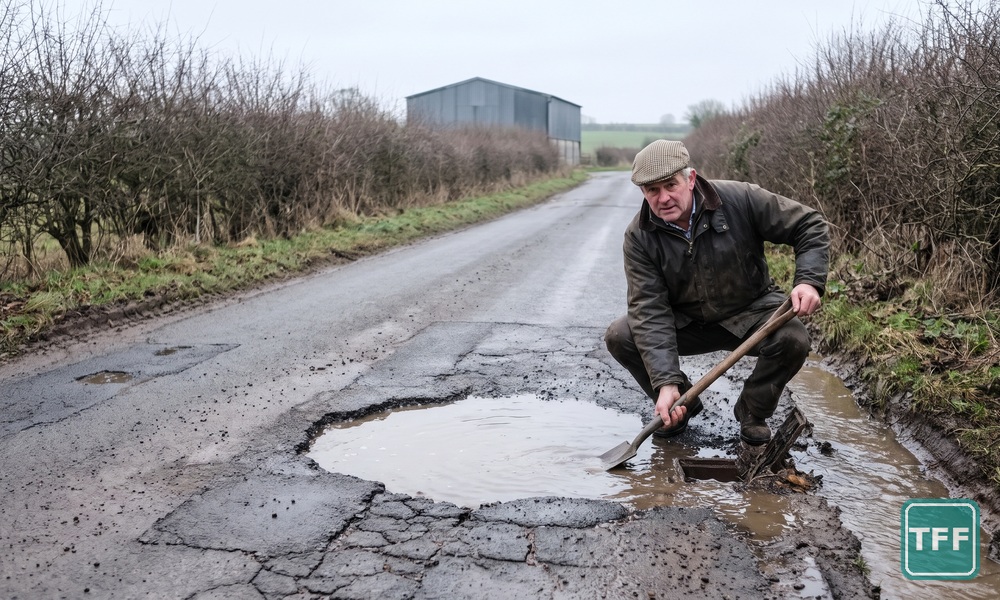
Rural Britain’s roads are wearing out faster than they are being mended, and farmers are counting the cost in broken wheels, flooded fields and council jobs they now do themselves. A conversation on The Farming Forum gathered damage reports from Aberdeenshire to Devon, and the pattern should concern anyone who sells, services or insures the vehicles rural businesses run on.
By TFF News | 8 November 2026 | Infrastructure
The conversation drew 164 visible contributions between 18 February and 5 March 2026 and had been viewed 7,710 times when counted on 8 November. Contributions attracted 345 reactions, an average of 2.1 each. These figures describe one conversation among farmers who chose to take part. They are not a representative survey of the sector.
Patching, not mending
Complaints about how repairs are done, not just whether they are done, were the largest strand of the conversation, carrying 46 contributions. The opening contributor set the tone: “I can’t remember the last time I saw them actually resurfacing a road like they used to”, he wrote, adding that councils now just fill the odd hole. Another had watched the work at close quarters: “Contractor lobs 2 shovefuls of fine tarmac in and stamp’s it down. And yes, I have seen this done!” A Northern Irish contributor reached the same verdict: “it seems that a lick and a thump with the shovel is all that’s done. A proper job should last for years.”
The economics of patching puzzled contributors as much as the workmanship. “why the councils insist on just chucking a bit of tarmac in a hole and expecting that to fix the problem is beyond me, the costs must be astronomical”, one wrote. Another offered a materials explanation, as his opinion: “Coal based Tar was phased out in the late 1980’s and replaced with petroleum based bituman which generally, in my opinion, is inferior.” A contributor from the Lakes summed up where the strand ended: “We don’t need potholes repaired we need properly maintained roads.”
The industry’s own figures support the patching picture. The Asphalt Industry Alliance’s ALARM survey, published on 17 March 2026 as this conversation wound down, reported that local authorities in England and Wales filled 1.9 million potholes in the previous year while resurfacing roads on average once every 97 years. Only 51 per cent of the local network is reported to be in good structural condition.
The bill lands on wheels and suspension
Vehicle damage ran through 16 contributions as the cost farmers could put a number on. “A two mile section of a busy B road near me has had at least 35 cars with damaged tyres or wheels. One night last week 5 cars were damaged in 1/2 an hour. The repairs often fail in less than 24 hours.”, reported one contributor. Another, in Angus, said his wife “counted 7 broken cars, 3 recovery vehicles and 2 police vans in a 1/4 mile stretch”.
The buying advice that followed is the part the trade should note. “I wouldn’t want a car without a spare tyre in the boot..still think the sealant/pump thing is not your friend in your hour of need”, wrote one contributor in the conversation’s most agreed-with observation. Another was blunter about specification: “Alloy wheels with low profile rubber band thickness tyres are the devil’s work and asking to be damaged”, preferring steel wheels and deeper tyre profiles.
The national data matches the anecdotes. The RAC Pothole Index recorded 6,290 pothole mentions from broken-down drivers in February 2026, the month this conversation ran, against 1,842 a year earlier, and puts the cost of anything more serious than a puncture at up to £590 for a typical family car.
Water first, tarmac second
The conversation’s most practical strand argued that the real failure is drainage. “Wet road base with poor drainage can only be patched, which is very temporary.”, one contributor explained. A Scottish Borders farmer put the maintenance case more forcefully: “the issue is don’t clean ditches let’s water on to road fair buggers them , if proper maintenance is done they take trucks no bother”.
New utility work is making the water problem worse in places, according to contributors. One described fibre broadband installation in his area: “here they threw the cables in the roadside ditches then filled them in, now everyone is wondering why there is so much standing water & flooding on the roads that never flooded before.”
And when the water does move, contributors said, it is often moved onto farmland. “Around here they come and dig grips into your field and dump all the road water into your land”, wrote the conversation’s opener. Another replied: “If your really lucky they do that here and rip holes in your stock fence”.
What the money buys
Thirty-five contributions questioned council priorities and spending. “We seem to paying more and more money to government and councils and yet getting worse and worse value for money”, wrote one contributor. A Cambridgeshire contributor gave his account of his county’s publicity: “Cambridgeshire CC were boasting a few days back that they had fixed 55,000 potholes”, he wrote, adding his own estimate that far more remained unfixed. The sharpest summary of the mood came late in the conversation: “Everything we do is short termism , cheapest solution for now ,tomorrow dosnt matter thats soneone elses problem.”
Farms are doing the council’s job
Eleven contributions described farms quietly absorbing maintenance work. “We patch our minor road or they would never get done.”, wrote one, who also clears snow, cuts verges and grits. Another has taken on the drains: “We shouldn’t have to do it but we’ve started un bunging any blocked roadside drains to help keep the road good for when we really need it at haytime and harvest”.
Where goodwill ran out, the dispute turned formal. “We’ve just sued the council after years of them flooding our land with their road water”, the opening contributor reported.
The question the trade is left with
Contributors did not agree on causes. “There will be a lot of agricultural machinery doing significant damage to roads too given the weights of equipment now. I’m not sure how some of the more rural roads will ever be repaired.”, offered one. “Roads designed for 5 tonne lorries having to take 30 tonners”, put another, while the Borders farmer countered that well-drained roads take trucks without trouble. What nobody disputed is the dependency: “there are no buses in rural areas, so no alternative to the personal motor vehicle”, as one contributor put it. Roughly a quarter of contributions were jokes and asides, the gallows humour of an old grievance.
The ALARM survey puts the one-off cost of bringing local roads in England and Wales up to authorities’ target conditions at a record £18.62 billion. Every load of grain, milk and stock moves over the network that figure describes. The conversation leaves the trade with a plain question: if the public network is now resurfaced once a century, how much of the cost of rural roads, from patching and drain clearing to stronger wheels and suspension, is quietly moving onto farm businesses, and who is pricing for that?
Read the source conversation and analysis
Read the full conversation on The Farming Forum here.
Download the full conversation analysis as a PDF slide deck: The state of the roads: conversation analysis.
This conversation had been viewed 7,710 times on The Farming Forum when counted on
8 November 2026. Want your brand in the room when farmers talk infrastructure?
Book advertising with Agri Web Media.